



"AI systems are not just retrieving pages. They are evaluating authority."
This is the core insight from TruLata CEO Tracewell Gordon's latest piece in the Forbes Business Council, published March 9, 2026. The article challenges a widespread and costly assumption among business leaders: that what worked for traditional Search Engine Optimization (SEO) will work for AI search.
A Strategic Mistake Hidden in Plain Sight
The rise of AI-powered search has created a deceptively familiar landscape for marketers. The interfaces look similar, and the goal of visibility feels the same. As a result, companies have almost reflexively reached for the same playbook they used for Google: optimizing keywords, building backlinks, and chasing rankings.
It is a logical instinct, but it is the wrong one. In his Forbes Business Council article, Gordon argues that this reflex is not just inefficient; it is a fundamental strategic misalignment that will leave companies invisible in the AI-driven future of search.
"AI systems are not just retrieving pages. They are evaluating authority. Companies that understand this distinction will define the next era of digital visibility."
How AI Search Changes the Rules
Traditional SEO operates within a well-understood framework. Search engines crawl pages, index content, and rank results based on signals like keyword relevance, backlink authority, and technical performance. The system rewards optimization, and optimization has become an industry unto itself.
AI search engines, including the large language models powering tools like ChatGPT, Perplexity, and Google's AI Overviews, work on fundamentally different principles. They do not simply retrieve and rank pages. They synthesize information, evaluate the credibility of sources, and generate direct answers. The question is no longer "does this page contain the right keywords?" but rather "does this source demonstrate genuine expertise and authority on this topic?"
This is a profound shift. It means that the tactics that drove traffic for the past two decades, including keyword density, meta tag optimization, and link-building schemes, are increasingly irrelevant to whether an AI system cites or recommends your brand.
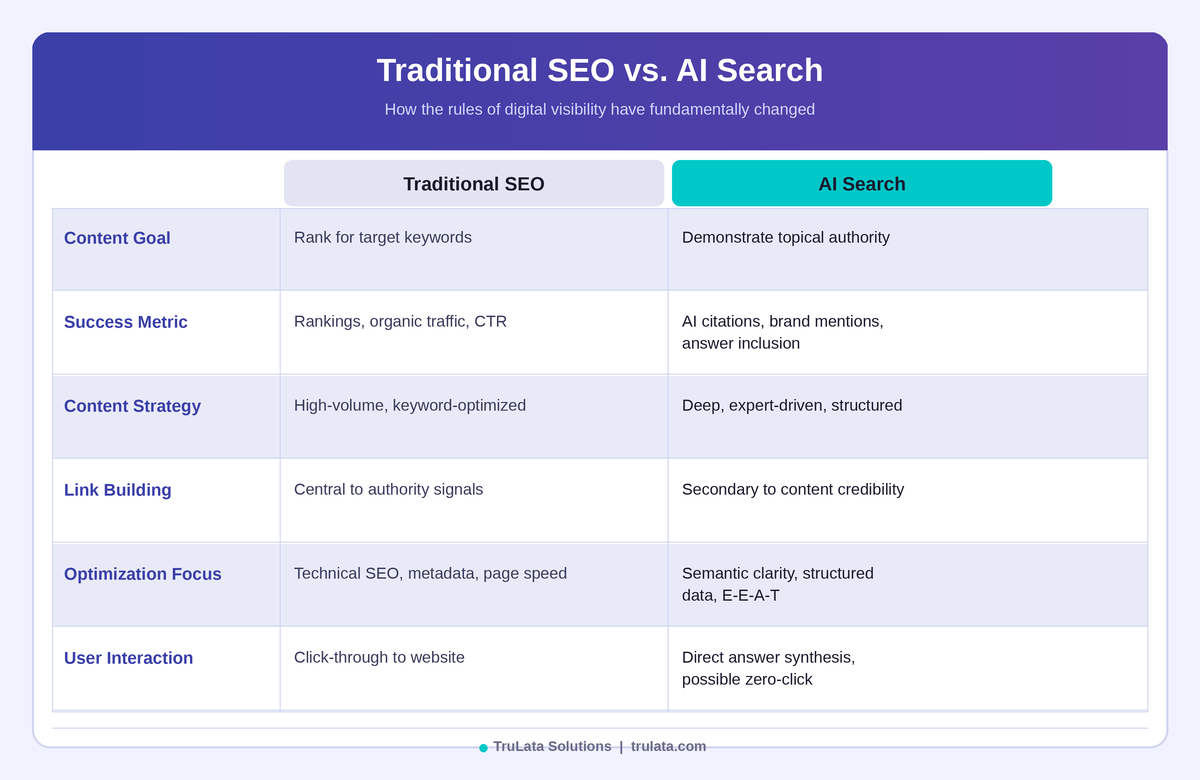
Key Distinctions: AI Search vs. Traditional SEO
Evaluation
AI evaluates topical authority and expertise. SEO rewards keyword optimization and backlink volume.
Delivery
AI synthesizes answers directly. SEO drives users to click through to external pages.
Content
AI rewards structured, semantically rich content. SEO rewards technically optimized pages.
Growth
AI visibility is built through consistent, credible thought leadership over time.
Focus
AI search is intent-driven and conversational. SEO is query-driven and keyword-centric.
Traditional SEO
- Rewards keyword optimization and backlink volume
- Drives users to click through to pages
- Rewards technically optimized pages
- Query-driven and keyword-centric
AI search
- Evaluates topical authority and expertise
- Synthesizes answers directly
- Rewards structured, semantically rich content
- Intent-driven and conversational
Why Generic Content Fails in the AI Era
One of the most consequential insights in Gordon's article is the failure of generic content. For years, content marketing operated on a volume model: produce enough keyword-rich articles, and the traffic will follow. AI search exposes the hollowness of this approach.
When an AI system is synthesizing a response to a user's query, it is not looking for the page that best matches a keyword. It is looking for the source that most credibly and comprehensively addresses the underlying question. Generic, surface-level content, regardless of how well it is optimized for traditional SEO signals, simply does not meet that bar.
What AI systems reward instead is depth, specificity, and demonstrated expertise. Content that reflects genuine knowledge, offers original perspective, and is structured in a way that AI can parse and cite is the content that earns visibility. This requires a fundamentally different approach to content strategy, one built around authority rather than volume.
What Actually Works: Building for AI Visibility
Gordon's framework for succeeding in AI search centers on a concept that TruLata has been developing with its clients: Generative Engine Optimization, or GEO. Where SEO asks "how do I rank on Google?", GEO asks "how does an AI system learn to trust and cite my brand?"
- Genuine thought leadershipReal expertise, not content optimized to look authoritative
- Structured data and semantic clarityWell organized, clearly attributed, semantically rich
- Presence across authoritative channelsIndustry publications, expert interviews, credible third-party mentions
The answer lies in several interconnected strategies. First, companies must invest in genuine thought leadership. This means producing content that reflects real expertise, not just content that is optimized to look authoritative. AI systems are increasingly capable of distinguishing between the two.
Second, structured data and semantic clarity matter enormously. AI systems parse content differently than traditional search crawlers. Content that is well-organized, clearly attributed, and semantically rich is far more likely to be understood, cited, and recommended by AI.
Third, brand presence across multiple authoritative channels, including industry publications, expert interviews, and credible third-party mentions, builds the kind of distributed authority that AI systems use to evaluate trustworthiness. A brand that exists only on its own website, however well-optimized, is invisible to AI in a way it never was to Google.
A brand that exists only on its own website, however well-optimized, is invisible to AI in a way it never was to Google.
The Business Implications of Getting This Wrong
The stakes of this misalignment are significant and growing. As AI-powered search continues to capture a larger share of how people discover information and evaluate brands, companies that are optimizing for the wrong system will find their visibility eroding, even as they continue to invest in SEO.
This is not a distant future scenario. It is already happening. Zero-click search results, AI Overviews, and direct answer synthesis are already reducing organic traffic to websites that rely on traditional SEO. Companies that have not begun building for AI visibility are already falling behind.
Gordon's article is a timely and direct call to action for business leaders: the time to rethink your search strategy is now, before the gap between AI-optimized competitors and SEO-optimized laggards becomes insurmountable.
The TruLata Approach
At TruLata, this insight is not theoretical. It is the foundation of how we build digital growth strategies for our clients. Our team works at the intersection of traditional marketing expertise and AI-native strategy, helping businesses build the kind of structured, authoritative digital presence that earns visibility in an AI-first search landscape.
From GEO-optimized content strategy to structured data implementation and multi-channel authority building, TruLata's approach is designed for the search environment that exists today and the one that is rapidly taking shape for tomorrow.