

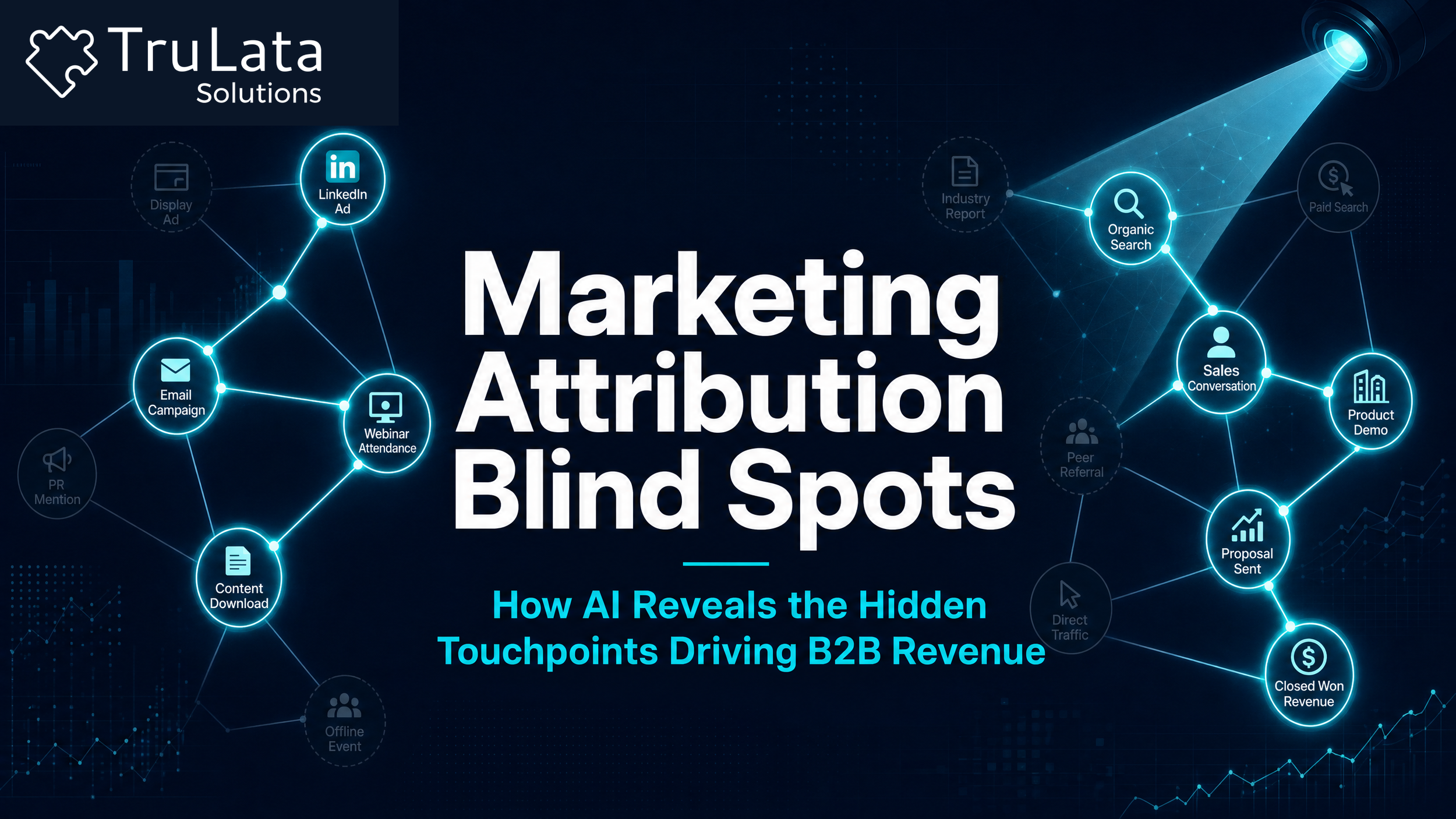

Here's an uncomfortable truth: if your B2B marketing team relies on first-click or last-click attribution, you're making budget decisions based on roughly 30-40% of the actual picture. The remaining 60-70% of touchpoints that influence deals, the peer conversations, the late-night content binges, the dark social shares, the AI-assisted research sessions, are invisible to your reporting. You're not just missing data. You're missing the story of how revenue actually happens. And in 2026, when every marketing dollar faces scrutiny, those blind spots aren't just inconvenient, they're existential. The good news? Marketing attribution AI has matured to a point where it can illuminate the full customer journey, giving B2B organizations the revenue intelligence they need to invest with confidence and outmaneuver competitors who are still flying blind.
Why Traditional Attribution Models Are Failing B2B Marketers
The B2B buyer journey has never been linear, but today's reality makes the old models look almost quaint. According to Gartner's research on B2B buying, the typical B2B purchase involves six to ten decision-makers, each consuming an average of four to five pieces of content independently. Multiply that across a buying cycle that stretches three to nine months, and you're looking at dozens, sometimes hundreds, of meaningful interactions before a deal closes.
Gartner's research on B2B buying, as cited in this post.
Single-touch attribution models like first-click and last-click were designed for a simpler era. First-click gives all the credit to whatever initially brought a prospect to your radar. Last-click hands the trophy to whatever happened right before conversion. Both models tell a radically incomplete story.
The Real Cost of Attribution Blind Spots
When you can't see the full journey, predictable problems cascade through your organization:
Budget misallocation: Channels that assist conversions but rarely get the last click (think podcasts, thought leadership, community engagement) get defunded, even though they're critical pipeline drivers.
Sales and marketing misalignment: Without shared visibility into touchpoint influence, sales teams question marketing's contribution, and marketing can't prove ROI on programs that nurture deals over months.
Stalled optimization: You can't optimize what you can't measure. Teams default to doubling down on what's easy to track rather than what actually works.
Competitive disadvantage: Organizations using advanced multi-touch attribution modeling can identify and scale winning strategies while competitors keep guessing.
A Harvard Business Review analysis noted that AI-powered attribution models can improve marketing ROI measurement accuracy by significant margins compared to traditional rule-based approaches, precisely because they account for the non-linear, multi-stakeholder nature of modern buying.
You can't optimize what you can't measure.
How AI Uncovers the Hidden Touchpoints in Your B2B Customer Journey
Marketing attribution AI doesn't just assign credit differently, it fundamentally changes what you can see. Here's how the technology addresses each category of blind spot that plagues B2B organizations.
1. Mapping Dark Funnel Interactions
The "dark funnel" includes every touchpoint that traditional analytics can't track: word-of-mouth referrals, Slack community mentions, podcast episodes consumed on third-party apps, content shared in private LinkedIn messages, and research conducted through AI assistants like ChatGPT or Perplexity. AI-driven marketing analytics platforms use probabilistic modeling, natural language processing, and behavioral pattern recognition to infer the influence of these dark touchpoints. By analyzing timing correlations, engagement velocity changes, and account-level behavioral shifts, AI can surface signals that indicate dark funnel influence, even when there's no direct click to track.
2. Unifying Cross-Channel, Cross-Stakeholder Journeys
In B2B, the buying unit is a committee, not an individual. Traditional attribution tracks individual user sessions. AI-powered B2B customer journey mapping operates at the account level, stitching together activities from multiple stakeholders within a buying group into a unified journey narrative. When a VP of Marketing reads your whitepaper on Tuesday, a Director of Operations attends your webinar on Thursday, and the CFO reviews your pricing page on Friday, AI recognizes these as a coordinated buying motion within a single account, not three unrelated events.
3. Identifying Non-Linear Influence Patterns
Rule-based attribution models (linear, time-decay, U-shaped, W-shaped) impose predetermined logic on how credit gets distributed. AI models, particularly machine learning-based algorithmic attribution, let the data reveal actual influence patterns. These models analyze thousands of conversion paths simultaneously, identifying which combinations and sequences of touchpoints most reliably lead to pipeline creation and closed revenue. The result is revenue intelligence that reflects reality rather than assumptions.
4. Detecting Diminishing Returns and Saturation Points
AI attribution doesn't just tell you what's working, it tells you when something stops working. By continuously analyzing marginal conversion contributions, machine learning models can detect when a channel hits saturation, when retargeting frequency becomes counterproductive, or when a content asset's influence decays. This real-time optimization intelligence prevents wasted spend that static models miss entirely.
Single-touch attribution sees
- The first click
- The last click
- Individual user sessions
AI attribution also sees
- Dark funnel interactions, from podcasts to AI assistants
- The whole buying committee as one account
- Which sequences of touchpoints lead to pipeline
- When a channel hits saturation
A Practical Framework: Diagnosing and Fixing Your Attribution Blind Spots
Understanding the problem is one thing. Systematically solving it is another. Here's a step-by-step framework for B2B organizations ready to move from broken attribution to AI-powered revenue intelligence.
Step 1: Audit Your Current Attribution Gaps
Before implementing any new technology, document what you currently can and cannot see. Map every known channel and touchpoint, then identify categories where tracking breaks down. Common blind spots include:
Offline events and conversations
Content syndication on third-party platforms
AI search and answer engine interactions
Peer review sites and community forums
Multi-device, multi-stakeholder buying committee activity
Sales-assisted touchpoints that live only in CRM notes
This audit creates the baseline against which you'll measure improvement.
Step 2: Unify Your Data Infrastructure
AI attribution is only as good as the data feeding it. This means integrating your CRM, marketing automation platform, website analytics, ad platforms, sales engagement tools, and customer data platform (CDP) into a unified data layer. According to the McKinsey Global Institute's research on B2B growth, organizations that integrate data across their full commercial tech stack see materially higher revenue growth rates than those operating in silos.
Key actions at this stage:
Implement consistent UTM taxonomy across all campaigns and channels
Establish account-level identity resolution to connect individual user activities to buying accounts
Integrate offline and sales-sourced data through CRM automation and manual logging protocols
Deploy server-side tracking to mitigate cookie deprecation and browser-based tracking limitations
Step 3: Implement Multi-Touch Attribution Modeling with AI
With clean, unified data in place, deploy an AI-powered multi-touch attribution modeling solution. The market now offers platforms ranging from enterprise-grade tools (like those built on Markov chain or Shapley value methodologies) to more accessible solutions designed for mid-market B2B organizations.
What to prioritize when selecting or building your model:
Algorithmic, not rule-based: Choose models that learn from your actual conversion data rather than applying predetermined credit-distribution rules.
Account-level attribution: Ensure the model can aggregate individual touchpoints into account-level buying journeys.
Incrementality testing integration: The best attribution models are validated through controlled experiments, holdout tests, geo-lift studies, or media mix modeling, to confirm that statistical attribution aligns with causal impact.
Real-time or near-real-time processing: In 2026's fast-moving landscape, retrospective quarterly analysis isn't enough. Look for systems that update attribution insights continuously.
Step 4: Run Scientific Tests to Validate AI Insights
This is where most organizations stop, and where strategic advantage truly begins. AI attribution models generate hypotheses about what's working. Scientific testing confirms them. Design controlled experiments around your AI's highest-confidence insights. If the model says a specific webinar series disproportionately accelerates mid-funnel deals, run an A/B test where one segment receives the webinar nurture and a matched control group doesn't. Measure pipeline velocity and close rates.
This test-and-learn loop creates a compounding advantage: each experiment refines your attribution model while simultaneously generating proven playbooks for revenue growth. As Forrester's research on marketing measurement has consistently emphasized, the organizations that combine attribution modeling with incrementality testing achieve the most reliable marketing ROI measurement.
Step 5: Operationalize Insights Across Teams
Attribution intelligence is worthless if it stays in a dashboard that nobody checks. Build operational workflows that translate attribution insights into action:
Weekly pipeline reviews: Include attribution data showing which channels and campaigns are contributing to active deals.
Monthly budget reallocation: Shift spend toward high-attribution channels and away from underperforming ones, using AI recommendations as the starting point.
Quarterly strategic planning: Use cumulative attribution data to inform campaign strategy, content investment, and channel mix decisions.
Sales enablement: Share journey intelligence with sales teams so they understand what a prospect has engaged with before outreach, and which content to recommend next.
Putting attribution to work
- Pipeline reviews: which channels touch active deals
- Budget shifts toward high attribution channels
- Planning campaigns, content and channel mix
- Sales sees what the prospect engaged with
Why Boutique Agencies Outperform on Attribution
There's an irony in the attribution space: the largest enterprises with the biggest budgets often struggle more with attribution than focused, agile organizations. That's because effective AI-driven marketing analytics require deep strategic integration, not just tool implementation. Boutique agencies and strategic consultancies that embed with their clients' teams can accomplish what large-scale vendors often can't: connecting attribution insights directly to business strategy, aligning cross-functional stakeholders around shared metrics, and running the scientific testing required to validate and refine AI models.
The competitive edge isn't owning the most sophisticated tool. It's having the strategic discipline to ask the right questions, design the right experiments, and translate data into decisions that compound over time.
The Future of Marketing Attribution AI in 2026 and Beyond
Several trends are reshaping what's possible with marketing attribution AI right now:
AI-to-AI attribution: As buyers increasingly use AI assistants for research, attribution models must track how AI-generated recommendations influence buying behavior, a new category of touchpoint that didn't meaningfully exist two years ago.
Privacy-first modeling: With evolving regulations under frameworks like the FTC's regulatory guidance and global privacy legislation, AI attribution is shifting toward privacy-preserving techniques like federated learning and differential privacy that deliver insight without compromising individual user data.
Predictive attribution: Rather than only measuring what happened, next-generation models predict which touchpoints will most influence a specific account's likelihood to convert, enabling proactive rather than reactive marketing investment.
Self-improving systems: Modern attribution AI continuously retrains on new conversion data, automatically adapting to shifts in buyer behavior, channel effectiveness, and market conditions without manual recalibration.
Stop Flying Blind, Start Seeing Your Full Revenue Picture
Every B2B organization is leaving revenue on the table when attribution blind spots hide the touchpoints that actually drive deals. The gap between companies using legacy single-touch models and those deploying marketing attribution AI with scientific validation is widening every quarter. The organizations that see the full picture will optimize faster, invest smarter, and prove marketing's impact with credibility that earns budget and trust.
At TruLata, we help B2B companies diagnose attribution blind spots, implement AI-powered multi-touch attribution, and build the scientific testing frameworks that turn data into compounding strategic advantage. Whether you're starting from scratch or upgrading broken models, our team brings the strategic depth and technical fluency to make attribution a genuine growth lever, not just another dashboard.