

See every inspection request, review and ad dollar on one screen.
Built for a pest control company that sells treatments and plans across a territory, whether the marketing sits with a marketer or with an owner who is under a house when the phone rings. TruLata reads the accounts you already have and runs the watching and the drafting on a schedule whether anyone is at a desk.

Is this built for a pest control company?
Yes. One thing describes the company it is built for: you sell a service, across a territory, whoever runs the marketing. A company with several branches fits the same way. Pest control is a business built on the second visit: a quarterly plan a household keeps for years, an annual termite warranty that renews without a second sales call, a commercial account for a restaurant or a property manager that pays every month. A one-off bed bug treatment or a wildlife exclusion job counts as a lead on its own, and it is often the first job on a plan.
The moment a customer chooses you is short. A homeowner finds carpenter ants in the kitchen or a wasp nest over the back door, searches from a phone, reads the top results and the reviews under them, and calls the first company that looks nearby and answers. The national franchises are in the same results. The company that wins the call is the one whose listing, reviews and site are in front of that search, and whose form request gets picked up.
The alternatives are the ones every trade knows: a retainer with an agency you cannot see inside, a shared lead from a marketplace that other companies also bought, or the owner doing it at 9pm. TruLata is the fourth option. It shows you which of those pieces is working, counted from your own accounts rather than from a vendor's report, and it runs the parts that can run without you.
The three usual options
- A retainer with an agency you cannot see inside
- A shared lead a marketplace also sold to other companies
- The owner doing it at 9pm
The fourth option
- Shows which piece is working
- Counted from your own accounts, not a vendor's report
- Runs the parts that can run without you
What does TruLata read for a pest control company?
The accounts you already have. Each Google account is connected by a manager invitation you can revoke in your own console. Google Analytics 4 gives sessions, sources, pages and key events, hours behind intraday. Search Console gives the queries you appeared for, impressions, clicks, average position and top pages, two to three days behind; for a pest control company the queries are the pest and the town, and the position is Search Console's own average, not a rank tracker. Google Ads gives campaign spend, conversions and cost per conversion. Google Business Profile gives reviews, rating and listing performance once you add our Google account as a manager on the listing, and where the listing is connected the search view carries a Google reviews card with your rating and review count.
Your site's forms are the lead source. Each inspection or quote request is appended to a lead sheet server-side as it lands, and the Leads view reads that sheet newest first with the received time, name, contact, what they asked about and town on the row. Where you run the business on a CRM or booking platform, the Jobs view reads jobs and the job pipeline live, and it shows a coming-soon card rather than a number until that data is trustworthy. Where you bill plans through Stripe, the Revenue view reads payments, subscriptions and recent charges live, read only. On all tiers, ChatGPT, Gemini, Claude and Grok are each asked who to call for pest control in your territory, scored at baseline and re-run as the program moves; Google's AI Overviews are measured through the search view instead.
What stays yours matters as much. Your inbox and your calendar stay private to you, and card data stays with Stripe. Phone calls count through your CRM today: a call it records as a lead is on the screen, and a call-tracking platform is connected during setup where your business runs on one. Each view appears as its source is connected, and the Integrations view lists what is connected.
The accounts you already have, on one screen
- Your site's forms
- Google Business Profile
- Google Ads
- Search Console and GA4
- Stripe, where you bill plans
- Leads, newest first
- Google reviews card
- Spend and cost per conversion
- Pest and town queries
- Revenue, read only

The national franchises are in the same results.
What runs while my techs are on routes, and what waits for me?
The watching runs on a schedule whether anyone is at a desk. Every morning at 7:05 Eastern the ads change watch reads your Google Ads account's change history and its user list, and separates our own writes and routine noise from material changes made by anyone else, including the recommendations Google applies on its own. It reads the user list directly, because a grant of access is not written as a change event, so a new address on your account shows up the next morning like any other material change. What the watch raises goes to your team the same day, with the date the change was made and the login that made it. On all tiers the search campaigns are managed by our team, each change recorded in the same history the watch reads.
On Launch, Growth and Command the content engine takes topics through queued, researching, writing and draft. Each topic passes a demand gate first: real search volume from Google's keyword planner, and the live top ten for the phrase, with the topic rejected when major publishers already own that page. The dedupe reads the titles actually published on your site, the research step cites current sources, each piece is filed as a Google Doc in your Drive with a featured image, and auto-publish is a per-client setting with approval optional. On Growth and Command, Facebook and Instagram campaigns run alongside search. On Command the outbound engine sources prospects weekly to a target profile set with you, which for a pest control company can be the commercial account: property managers, restaurants, warehouses, the customers who sign a recurring contract rather than book once. Every night at 12:01am Central a fallback snapshot is baked, and a failed pull leaves the previous page up. When you open the page it loads that snapshot first and runs a fresh pull behind the request if it is older than five minutes. Every path through the Refresh button ends in a reloaded page whose stamp says how old the data is.
What waits for a person is the judgement: the limits on spend. A budget or bid change in an ad account is made within the limits set for your engagement and lands in your account's own change history. A prospect email leaves from a review-first queue; a person releases it, or the queue releases it on the schedule set for the engagement, and every send is logged with the draft, the mailbox and the time. Replies are classified, and not-interested and bounced addresses are suppressed. A content piece with auto-publish off waits as a draft until your team approves it. From the screen you can set a lead outcome, request a website change, or request a content, keyword, category or targeting change; each request reaches your team as a logged ticket, and the engine's writes to your ad accounts and your site go through their APIs and land in each account's own change history.
While the techs are on routes
- Ads change watchChange history and the user list, with the date and the login behind each material change
- ContentQueued, researching, writing, draft, on Launch, Growth and Command
- Commercial prospectsProperty managers, restaurants, warehouses, on Command
- Fallback snapshotA failed pull leaves the previous page up
- Live numbersA fresh pull behind the page when the snapshot is older than five minutes
Can I see it before I sign?
Yes. The demo runs the same engine code every client runs, on a fictional company called Meridian, with every number illustrative and your name and email in front of it. Open the Leads view, the Google Ads view and the search view and you are looking at the screen a pest control company gets, with your accounts in place of Meridian's.
Then picture it on your own business. You sell treatments and plans across a territory, and the marketing falls to whoever has a free evening. TruLata counts every inspection request from your own forms, reads the jobs your CRM or booking platform records and the plans you bill through Stripe, and puts your ad spend beside them. You set an outcome on each request from the screen, so a termite treatment with its warranty, a quarterly plan held for years or a commercial contract each shows as a lead that was won, beside what your ads spent. If you would rather have the work done without the screen, the services side of TruLata is the door, and we would rather say that here than in month three. The industries page shows the same screen applied to every trade.
What pays the techs is a job, not a position. Ranking is not earning, so the search view puts clicks beside impressions and positions, and the Leads view counts what the site actually sent you. A position there is Search Console's average for the query rather than a rank tracker's guess.
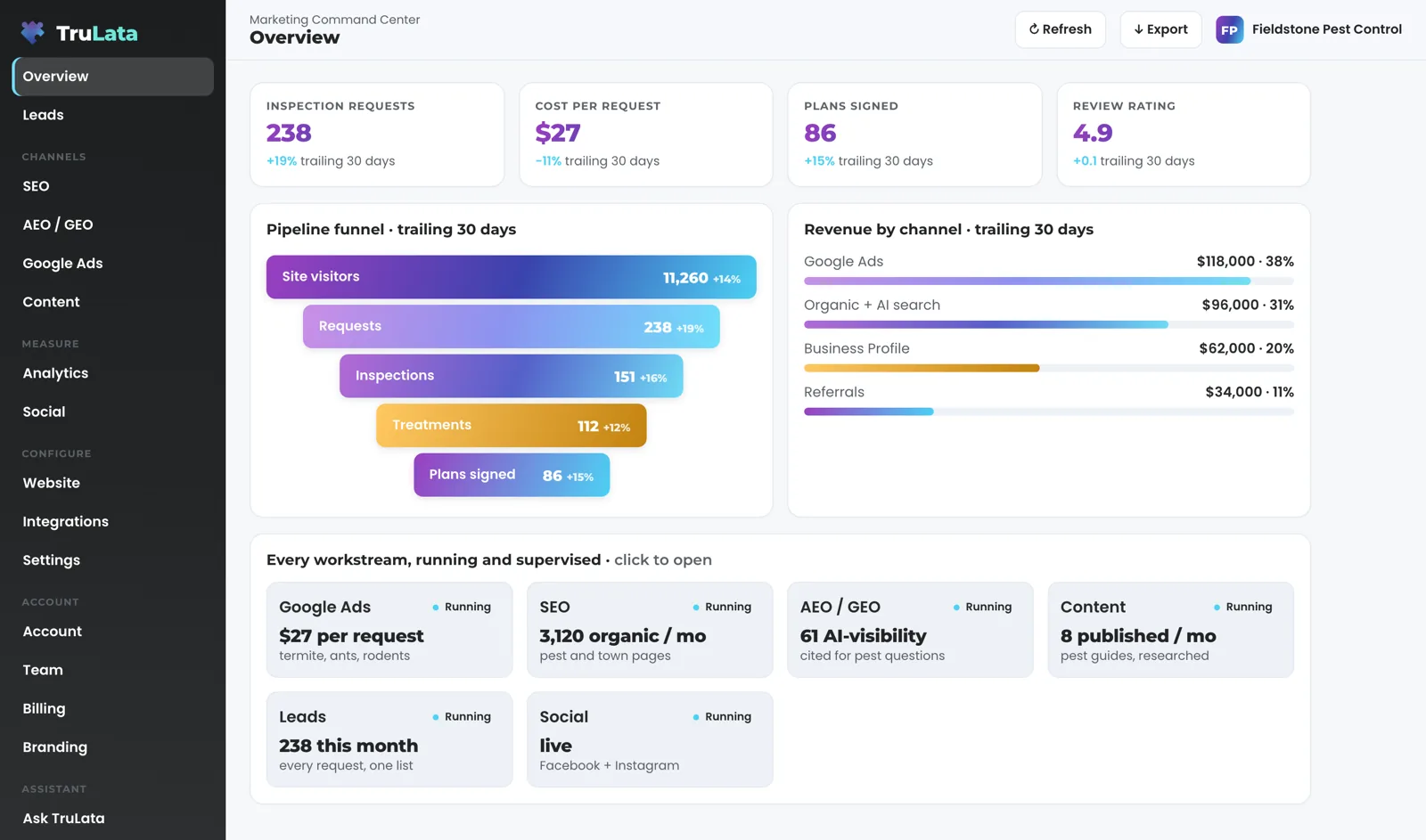
What pays the techs is a job, not a position.
Which tier fits a pest control company?
The one whose engines you want running. Starter includes the TruLata dashboard, full analytics, leads, search visibility, the AI visibility program, managed Google Ads search, the assistant and briefings and support tickets. The content engine is on Launch, Growth and Command. Meta ads are on Growth and Command. The outbound engine is on Command, and Command adds the outbound engine, social media management and your full marketing team, always on.
Seats are three on Starter, three on Launch, ten on Growth and unlimited on Command. Starter is $400 a month, Launch $650, Growth $1,200, and Command is scoped per engagement. Every tier is month to month with nothing metered, and an annual commitment takes twenty percent off the monthly. The pricing page carries the same figures on every page of this site.
What if I want it run for me?
Then our team runs it. On Command the judged work sits with our people: the ads account, the cadence, the approvals, the outbound queue. Our changes land in the same change history the 7:05 Eastern watch reads, sorted as ours, so your own record shows what we did and when. The managed page covers it.
TruLata also works as an agency for a pest control company that wants the work done without the screen, or alongside it: local services marketing, search work and paid search run with a daily account watch. Same people, same watch.
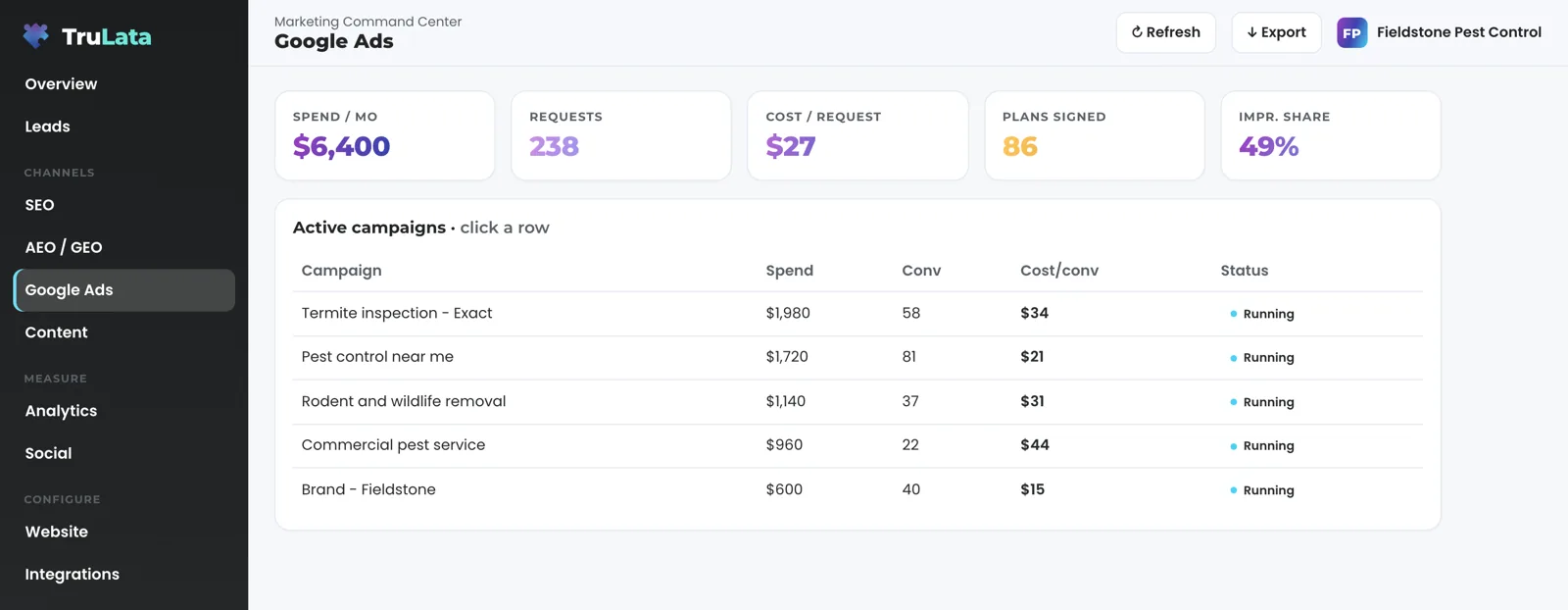
What the screen reads for a pest control company.
| What | Where it comes from | How fresh |
|---|---|---|
| Inspection and quote requests | Your site's forms, appended to the lead sheet server-side | Live, newest first |
| Jobs and the job pipeline | Your CRM or booking platform, where you run on it | Live; a coming-soon card until the data is trustworthy |
| Reviews, rating and listing performance | Google Business Profile, with our account as a manager | Read from your Business Profile; the header stamp says when |
| Ad spend, conversions, cost per conversion | Google Ads | Hours behind intraday; change history read daily at 7:05am ET |
| Queries, impressions, clicks, average position | Search Console | 2 to 3 days behind |
| Sessions, sources, pages, key events | Google Analytics 4 | Hours behind intraday |
| Plan payments, subscriptions, recent charges | Stripe, where you bill through it | Live, read only |
Your CRM, Stripe, your booking platform, website leads and email stats are live. Google Ads and GA4 intraday lag hours. Search Console runs two to three days behind. The header stamp says when the data was pulled, and every path through the Refresh button ends in a reloaded page.
Questions, answered.
Do you count phone calls?
Through your CRM today: a call it records as a lead counts on the screen, and a call-tracking platform with an API is connected during setup where your business runs on one. The leads the screen counts are requests from your own site's forms, appended to a sheet server-side as they land, plus jobs where you run on a CRM or booking platform.
Does it reply to my Google reviews?
The screen reads reviews, rating and listing performance from your Business Profile, and listing updates go through the same manager role. Replying to a review stays with you or your office today. A request from the screen goes to your team as a logged ticket, and the engine's writes to your ad accounts and your site go through their APIs.
Can I pull ad spend back in the slow season?
Yes. Budget and bid changes are made within the limits set for your engagement and land in your account's own change history, and on all tiers our team runs the account. A targeting change requested from the screen goes to the team as a logged ticket. Either way the change lands in the account's change history, which the watch reads the next morning at 7:05 Eastern.
Can I tell a one-off job from a plan on the screen?
You can mark what each lead became: contacted, quoted, won, lost, or not a lead with a reason, and the outcome stays on the row. Whether it became a quarterly plan is your CRM or booking platform's record, and where you run on one the Jobs view reads the pipeline live. Where you bill plans through Stripe, the Revenue view shows subscriptions and recent charges.
Does the demo show a pest control company?
It shows a fictional company called Meridian with illustrative numbers, on the same engine code every client runs, so the views you open are the ones a pest control company gets. Your accounts fill them instead.
What do I have to set up myself?
Manager invitations on your Google accounts during setup: Analytics, Search Console, Ads and the Business Profile listing. Our team connects your CRM, Stripe, your booking platform, your email platform and your site's forms from the inside with the access you grant, so your part ends with the grant. We never ask for your account password.
The engine behind this is now a product.
Run this work inside TruLata and watch your own numbers move.
See how it would run
for your business.
15 minutes with TruLata. We show you what your marketing brings in, what each lead costs, and what we would change first.
Book a demo or start a 7-day free trial
No card. It ends on its own after 7 days unless you add one. See pricing.
Just need a website? Build it free.
New here? See what TruLata is. Prefer to write? Send us the one thing you want to know.
Start here: AI marketing platform · AI marketing software · all-in-one marketing platform · marketing automation software · marketing software for small business.
- Refreshed when you open itLive data on page load, never a monthly PDF
- Counted from your own formsLeads recorded server-side, compared daily with Ads and GA4
- Seen in AI answersHow often ChatGPT, Gemini, Claude and Grok name you, measured
- Every send loggedProspect emails leave from a review-first queue, and every send is logged.