



By Tiffany Bednar, President of TruLata and its Holdings and Software divisions
In this article, you'll discover:
•How the scientific method provides a timeless framework for business decision-making and continuous improvement
•The evolution from data-driven to AI-led business strategies in 2026
•Key AI trends reshaping experimentation: autonomous analytics, AI factories, and conversational AI
•A practical six-phase roadmap to implement AI-powered scientific methods in your organization
•Real-world guidance on overcoming common challenges and ethical considerations
•Answers to frequently asked questions about getting started, timelines, and resource requirements
Two years ago, our CEO, Trace Gordon, published an article that went viral on applying the scientific method to business processes. It resonated deeply, confirming that a systematic, data-driven approach is a powerful antidote to guesswork and intuition. In the fast-evolving landscape of business and technology, the core principles of that method remain as relevant as ever. However, the tools and the environment in which we apply them have undergone a seismic shift. As we look to 2026, the conversation is no longer just about being data-driven; it is about becoming AI-led.
This updated guide provides a forward-looking perspective on how the scientific method is evolving in the age of advanced artificial intelligence. We will explore how trends like autonomous analytics and agentic AI are reshaping what is possible and provide a practical, six-phase roadmap for businesses to not only adapt but to lead in this new era of experimentation.
The Unchanged Foundation: The Scientific Method in Business
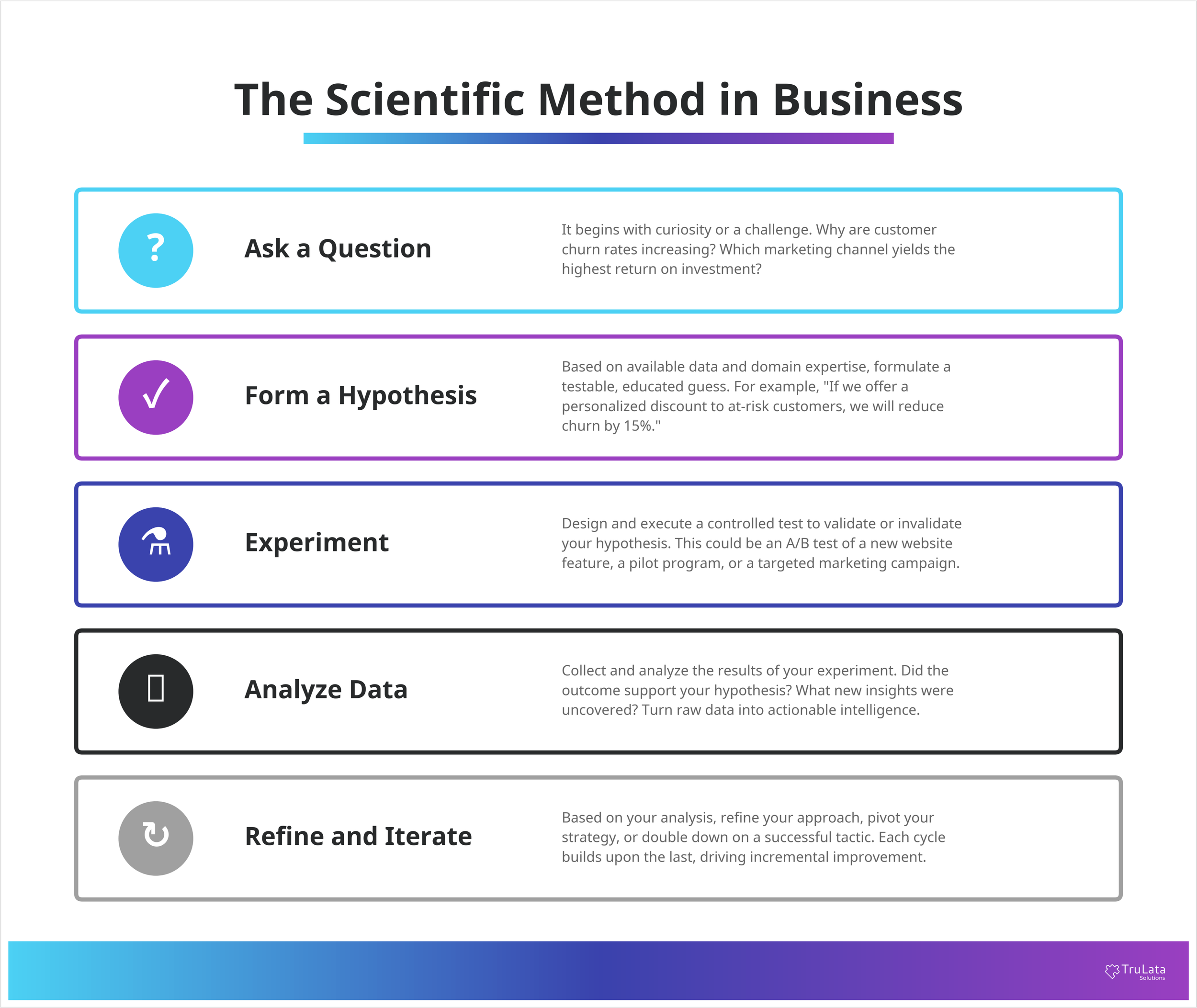
The timeless, five-step cycle of the scientific method continues to provide the essential framework for structured problem-solving and continuous improvement. It is the bedrock upon which the more advanced, AI-powered strategies are built.
The 2026 Evolution: From Data-Driven to AI-Led
While the core principles remain, the technological landscape of 2026 supercharges this process. The evolution is marked by a significant shift from manual analysis to automated, intelligent systems that augment and accelerate every phase of the scientific method.
In 2026, leading organizations are moving beyond simple data analysis and establishing what are known as "AI Factories". These are integrated infrastructures of technology, data, and algorithms that enable the rapid and scaled development of AI applications. This factory approach allows businesses to industrialize the process of experimentation, moving from isolated tests to a continuous stream of automated insights and optimizations.
A key trend fueling this evolution is the rise of autonomous analytics. As predicted by industry analysts, AI is evolving from a tool that answers questions to a system that can execute multi-step business processes independently. An AI system might not only identify a drop in sales for a particular product but also investigate the cause by analyzing supply chain data, competitor pricing, and customer sentiment from reviews, and then propose a solution, such as a targeted promotion.
Furthermore, the user interface for data is changing. Conversational AI is democratizing data access, allowing non-technical team members to query complex datasets using natural language. This breaks down the traditional bottlenecks between business users and data analytics teams, fostering a more widespread culture of data-informed decision-making.
The 2026 Roadmap to AI-Powered Business Experimentation
To navigate this new landscape, businesses need a modern, practical roadmap. The following six-phase plan is designed to guide organizations in building a mature, AI-powered experimentation capability.
Phase 1: Foundational Readiness (The Lab Setup)
Before you can run sophisticated experiments, you must prepare your laboratory. Research indicates that many organizations are not yet ready for autonomous AI due to underlying weaknesses in their data infrastructure. This initial phase is about building a solid foundation.
Key actions include:
Data Governance: Establish clear policies for data quality, security, and privacy.
Infrastructure Investment: Invest in a modern data stack that can handle real-time data ingestion and processing.
Data Unification: Break down data silos to create a single, trusted source of truth for all business data.
Phase 2: Strategic Hypothesis Generation (Asking the Right Questions)
With a solid foundation, you can move to formulating more strategic hypotheses. Instead of just asking, "Which button color converts better?" you can start asking more impactful questions. In this phase, AI can be used as a partner to identify opportunities that might be missed by human analysts. For example, an AI model could analyze market trends and internal data to suggest new product features or untapped market segments.
Phase 3: Designing and Running Experiments (The Modern Experiment)
This phase is about leveraging technology to run more complex and insightful experiments.
This includes:
Advanced Testing: Move beyond simple A/B tests to multivariate and multi-armed bandit testing to test multiple variables simultaneously.
AI-Powered Simulation: Use predictive AI models to simulate the potential outcomes of different strategies before committing resources to a live experiment.
Hyper-Personalization: Leverage AI to deliver personalized experiences to different customer segments as part of the experiment, gathering more granular insights.
Phase 4: Autonomous Analysis and Insight (The AI Analyst)
This is where the most significant shift from the traditional model occurs. Instead of manual data analysis, AI systems can take the lead in interpreting experiment results. An AI analyst can identify statistically significant outcomes, uncover subtle correlations, and even generate a narrative summary of the findings. This dramatically accelerates the feedback loop and frees up human analysts to focus on more strategic tasks.
Phase 5: Scaling and Systematizing (Building the AI Factory)
Successful experiments should not remain as one-off wins. This phase is about industrializing the process of experimentation. By building an "AI Factory," you create a system where successful hypotheses are automatically scaled and integrated into business processes. For example, if an experiment proves that a new pricing strategy is effective, the AI factory can ensure that this strategy is automatically deployed and monitored across all relevant products.
Phase 6: Ethical Oversight and Responsibility (The Guiding Principles)
As AI takes on more autonomous roles, the need for human oversight and ethical guidelines becomes paramount.
This final, ongoing phase involves:
Regulatory Compliance: Ensuring that all AI-driven experiments and processes comply with the rapidly evolving landscape of AI regulations.
Bias Detection: Actively monitoring AI models for biases that could lead to unfair or discriminatory outcomes.
Human-in-the-Loop: Maintaining human oversight of critical decisions and ensuring that there are clear processes for appealing or overriding AI-generated conclusions.
Navigating the Challenges of 2026
The path to becoming an AI-led organization is not without its challenges. The much-discussed "AI bubble" may lead to increased scrutiny of technology investments, making it more important than ever to demonstrate a clear return on investment for AI initiatives. Furthermore, the increasing focus on data privacy and the environmental, social, and governance (ESG) impact of technology means that businesses must choose their technology partners and strategies wisely.
The Future is Experimental
Applying the scientific method to business is no longer a novel idea, but a foundational requirement for competitive survival. As we move further into 2026, the integration of artificial intelligence will transform this method from a manual, often slow process into a dynamic, automated engine for growth and innovation. By following a structured roadmap, businesses can build the capabilities needed to thrive in an era where the ability to learn and adapt faster than the competition is the ultimate competitive advantage.