



The go-to-market (GTM) playbook that built the last decade's unicorns is broken. The era of "growth at all costs," fueled by cheap capital and a tolerance for massive inefficiency, is over. In 2026, the GTM landscape is defined by a new set of rules, a new economic reality, and a new breed of investor. Startups that cling to the old ways of scaling will burn through their cash and fade into obscurity. Those that embrace the new paradigm of "Efficient Intelligence" will build resilient, high-margin businesses that can weather any market cycle.
This guide, informed by our work at TruLata, is primarily for founders of venture-backed B2B startups, particularly in SaaS and deep tech, who are navigating the pressures of scaling in a capital-constrained environment. While the principles of efficiency and data-driven decision-making are universal, the specific tactics and investment levels discussed here are most relevant to companies aiming for high growth and market leadership. Bootstrapped or direct-to-consumer (D2C) startups will find the underlying themes valuable, but will need to adapt the execution to their unique economic and operational realities.
We'll explore the often-overlooked aspects of the 2026 GTM landscape, from the new economics of customer acquisition to the art of building a proprietary data moat. We'll provide a framework for deciding when and where to invest your precious capital, and we'll reveal the research strategies that will give you an unfair advantage. This is not just another list of marketing tactics; it is a strategic blueprint for building a dominant and defensible market position.
The New GTM Landscape: Beyond the Funnel
The traditional sales funnel, a linear model of awareness, consideration, and conversion, is a relic of a bygone era. In 2026, the buyer journey is a complex, non-linear web of digital touchpoints, peer reviews, and AI-driven recommendations. To succeed in this new landscape, startups must move beyond the funnel and embrace a more dynamic and intelligent approach to go-to-market.
Growth at all costs
- Cheap capital, tolerance for inefficiency
- Vanity metrics like user growth
- A linear funnel
- Selling software licenses
Efficient intelligence
- Capital efficiency and moat defensibility
- Solid unit economics, a path to profitability
- A non-linear web of touchpoints
- Selling outcomes
From "Growth at All Costs" to "Efficient Intelligence"
The venture capital landscape has shifted. The "growth at all costs" mantra has been replaced by a laser focus on capital efficiency and moat defensibility. Investors are no longer impressed by vanity metrics like user growth if they are not backed by solid unit economics. They want to see a clear path to profitability and a sustainable business model. This means that startups must be far more strategic about how they allocate their resources, focusing on activities that generate the highest return on investment.
The Rise of "Outcome as a Service" (OaaS)
Customers are no longer buying software licenses; they are buying outcomes. They want to know that your product will deliver a specific, measurable result, and they are increasingly unwilling to pay for a solution that doesn't deliver on its promise. This has given rise to the "Outcome as a Service" (OaaS) model, where pricing is tied to the actual value delivered. This requires a fundamental shift in how startups think about their business model, but it also creates a powerful opportunity to build deep, long-lasting relationships with customers. For venture-backed startups, this can be a key differentiator in a crowded market. For bootstrapped companies, it can be a way to generate predictable revenue and build a loyal customer base without relying on outside funding.
The Proprietary Data Moat: Your Most Defensible Asset
In an era where foundation models are a commodity, your GTM data is your greatest strategic asset. Every interaction with a customer, every objection, every successful pilot, this is all valuable data that can be used to train your own proprietary models and create a defensible data moat. This is what separates the billion-dollar unicorns from the ten-million-dollar feature wrappers. By capturing unique data points that generic models cannot access, you create a "Decision Engine" that is increasingly difficult for competitors to replicate. For a deep-tech, VC-backed startup, this might involve complex, proprietary data from the core product. For a bootstrapped SaaS company, it could be as simple as meticulously tracking customer support interactions and feature requests to inform the product roadmap. The principle is the same: turn your unique operational data into a competitive advantage.
The New Economics of GTM: Where to Invest and When
The economic reality of 2026 is that the cost of model inference has plummeted, while the cost of human attention has skyrocketed. This has profound implications for how startups should think about their GTM investments. The old playbook of hiring a large sales team to do manual outbound is no longer economically viable. Instead, startups must embrace a more automated and intelligent approach to customer acquisition.
Where the 2026 channel mix is working
Intimate in-person events
- Regional dinners, happy hours, meetups
Founder brand and warm outbound
- A one-two punch
AI discovery
- Signals that show a company is in a buying window
Ecosystem marketing
- Partnerships as you grow
The Rise of the "Agentic GTM"
The most successful, well-funded startups of 2026 are using an "Agentic GTM," where specialized AI agents are used to automate many of the tasks that were previously done by humans. These agents can do everything from identifying high-intent leads to personalizing outreach and even running a full sales cycle. This allows startups to scale their GTM efforts without a linear increase in headcount, giving them a significant cost advantage over their legacy competitors. For bootstrapped startups, the principle of automation still applies, but it may be implemented with more accessible tools like Zapier or HubSpot, focusing on automating specific, high-leverage tasks rather than building a fully agentic system.
Rethinking Your Channel Mix
The GTM channels that worked in the past are not necessarily the ones that will work in 2026. SEO is becoming less effective as search engines provide AI-generated answers, and paid advertising is becoming increasingly saturated. So, where should you be investing your GTM budget?
Here are some of the channels that are delivering the best results in 2026:
•Intimate In-Person Events: In a world of digital noise, people are craving real human connection. Small, intimate events like regional dinners, happy hours, and meetups are proving to be one of the most effective ways to build relationships with high-value customers.
•Founder Brand and Warm Outbound: The combination of a strong founder brand and a targeted, personalized outbound strategy is a powerful one-two punch.
•AI Discovery (AEO): AI-powered discovery tools are quickly becoming the most effective way to identify high-intent leads. These tools can analyze a wide range of signals, from social media activity to news articles, to identify companies that are in a "buying window."
•Ecosystem Marketing: As you grow, partnerships with other companies in your ecosystem can become a powerful channel for customer acquisition.
When to Invest in Different Channels
The right channel mix will depend on your stage of growth and funding model. Here is a general framework for how to think about your GTM investments, primarily geared towards venture-backed B2B startups:
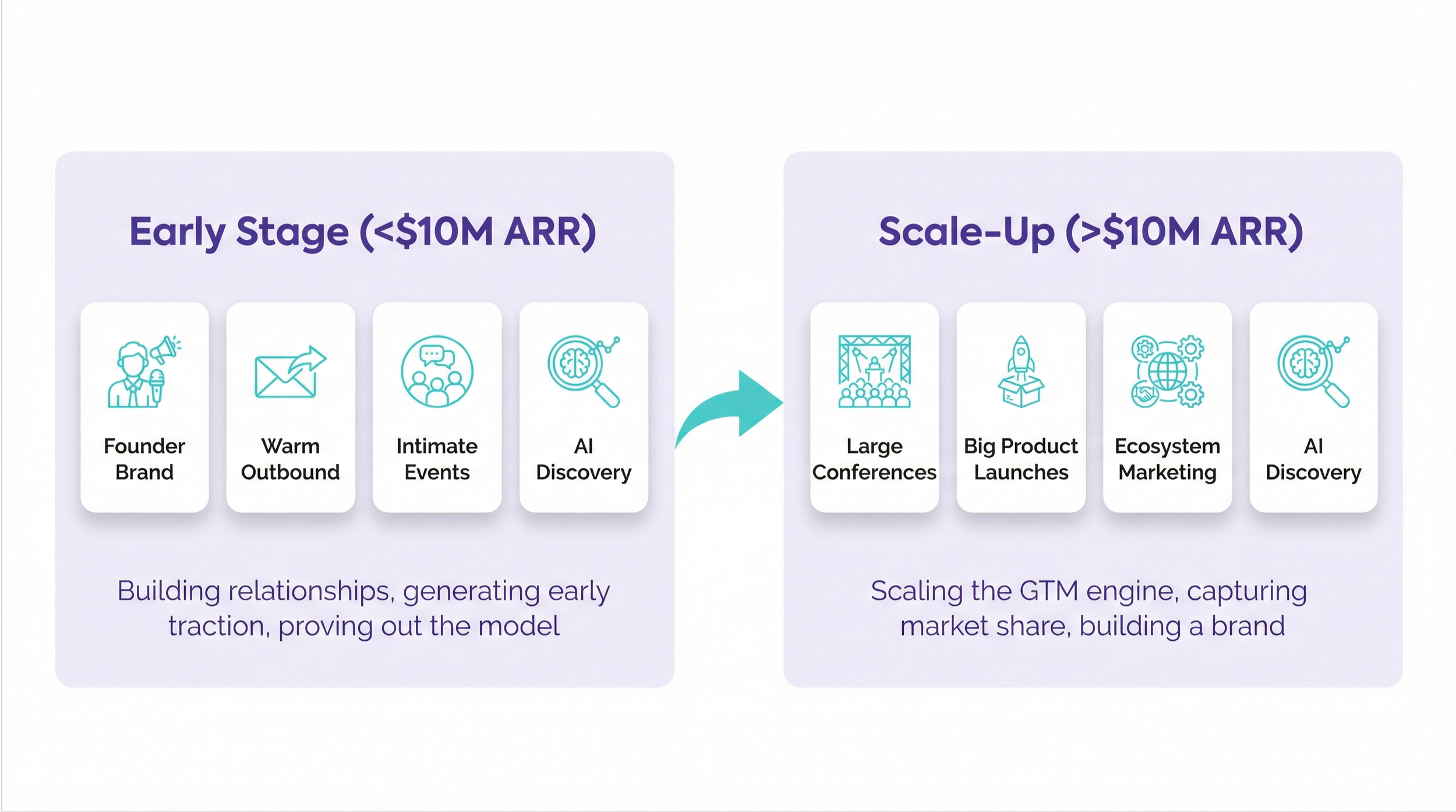
It is important to note that this is just a general framework. The right channel mix for your startup will depend on a variety of factors, including your industry, your target customer, and your budget. The key is to be constantly experimenting and learning to find what works best for you.
The Unfair Advantage: A New Approach to Market Research
In a world where everyone has access to the same data, the only way to gain an unfair advantage is to have better insights. This requires a new approach to market research, one that goes beyond traditional methods like surveys and focus groups.
- Synthetic customer testingBuyer objections and pricing sensitivity, simulated before launch
- Intent triangulationDark social, third-party intent and first-party behavior point to the buying window
- Hyper-refined ICPStack maturity, pain complexity and procurement readiness
Synthetic Customer Testing
Before you even launch your product, you can use fine-tuned AI models to simulate buyer objections and pricing sensitivity. This "digital pre-validation" allows you to identify and address potential issues with your messaging and pricing before you ever go to market. This can save you months of expensive A/B testing and give you a significant head start on your competition. While a well-funded startup might build a sophisticated simulation engine, a bootstrapped company can achieve a similar outcome through structured, in-depth customer interviews and by creating mockups to test messaging with a small, targeted group.
Intent Triangulation
Instead of just looking at demographic data, you need to be looking for signals of intent. This means combining "dark social" signals (mentions in private Slack communities, Discord channels, etc.) with third-party intent data and first-party behavioral signals to identify accounts that are currently in a "buying window." This allows you to focus your GTM resources on the accounts that are most likely to close. A large, venture-backed startup might invest in expensive data platforms to do this at scale, while a smaller startup can achieve this by manually monitoring a handful of key online communities and using more affordable tools to track website visitor behavior.
Hyper-Refined ICP
Your Ideal Customer Profile (ICP) in 2026 must be more than just demographics. It must include factors like Stack Maturity (how well they can actually use your tool), Current Pain Complexity (is the problem they face worth $50k or $500k to solve?), and Procurement Readiness (do they have the budget and authority cycles currently active?). This level of granularity ensures that you are not wasting your time on accounts that are not a good fit for your product. This is a critical exercise for all startups, as it forces a level of focus that is essential for survival in the early stages.
In an era where foundation models are a commodity, your GTM data is your greatest strategic asset.
Conclusion: Building a GTM Engine for the Modern Era
The go-to-market landscape has changed. The old playbook is no longer relevant. To succeed in 2026, startups must embrace a new paradigm of "Efficient Intelligence." This means building a GTM engine that is automated, intelligent, and data-driven. It means focusing on outcomes, not just features. And it means building a proprietary data moat that will give you a long-term, defensible advantage.
At TruLata, we help startups build GTM engines for the modern era. We provide the strategic guidance, the technological infrastructure, and the operational support you need to scale your business in a capital-efficient way. We help you build a GTM machine that is not just a cost center, but a strategic asset that will drive growth for years to come.
Book a CallQ&A
A: Day one. Your GTM strategy is not something you bolt on after you have a product; it is an integral part of your product development process. From the very beginning, you should be thinking about who your customer is, what their pain points are, and how you are going to reach them. The insights you gain from your early GTM efforts will be invaluable in shaping your product roadmap.
A: The biggest mistake is not having one. Many startups fall into the trap of thinking that if they build a great product, customers will just come. But in today's crowded market, that is simply not the case. You need to have a clear and well-defined plan for how you are going to get your product in front of the right people.
A: There is no one-size-fits-all answer to this question. It will depend on a variety of factors, including your industry, your target customer, and your stage of growth. However, as a general rule of thumb, you should be prepared to invest a significant portion of your budget in GTM, especially in the early stages. For venture-backed startups, it is not uncommon to see GTM spend exceed R&D spend.
A: Founder-led sales and marketing. In the early days, there is no one who can sell your product better than you can. You have the passion, the vision, and the deep understanding of the problem you are solving. Leverage that to your advantage. Get out there and talk to customers, build relationships, and start generating those first few sales. This will not only bring in revenue, but it will also provide you with invaluable feedback that you can use to refine your product and your GTM strategy.