



** Original article published on Forbes.com
Here is an uncomfortable truth that many B2B executives fail to recognize: the most critical decisions you make are not the ones your team celebrates during all-hands meetings. They are the quiet, behind-the-scenes trade-offs you resolve before anyone else enters the room. In a fast-paced business environment, leaders often measure their impact by visible milestones, such as launching a new product, announcing a strategic pivot, or closing a major partnership. However, the real driver of organizational velocity is not the decision itself, but the invisible alignment work that precedes it.
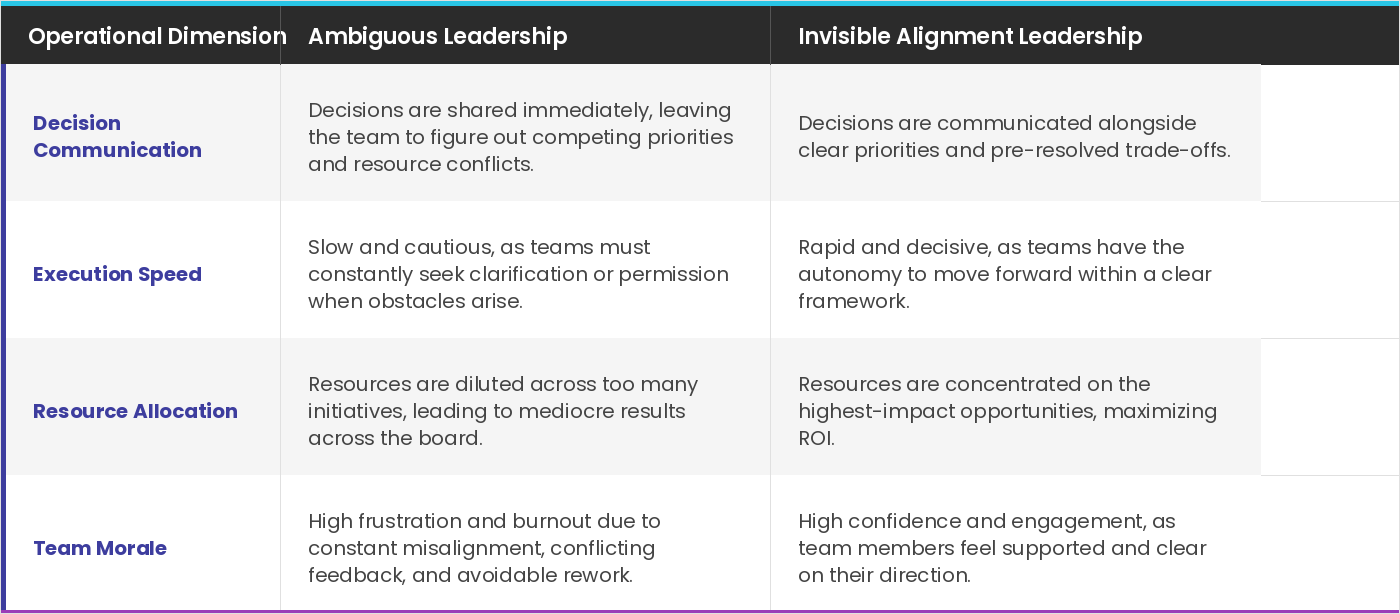
When leadership fails to clarify priorities and trade-offs early, the burden of navigating that ambiguity falls directly on the execution teams. This creates a hidden friction that slows down progress, causes costly rework, and drains team morale.
The visible milestones
- Launching a new product
- Announcing a strategic pivot
- Closing a major partnership
The invisible work before them
- Trade-offs resolved before anyone enters the room
- Priorities clarified early
- Ambiguity removed from the path
The Hidden Cost of Ambiguity in B2B Teams
In many organizations, teams are constantly forced to guess which priorities matter most when resources are constrained. If a marketing team is told to focus on both enterprise lead generation and brand awareness, but is not given a clear hierarchy of importance, they will naturally split their efforts. When obstacles arise, as they inevitably do, the team will hesitate, debate, and potentially stall because they do not know which goal to sacrifice.
This hesitation is a direct consequence of ambiguous leadership. When leaders present decisions without resolving the underlying trade-offs, they are essentially delegating the hardest part of strategy to the people least equipped to handle it. True strategic leadership requires making difficult choices in advance, ensuring that the team has a clear, frictionless path to execution.
When the trade-offs are left unresolved
- Two goals, no hierarchy
- Constrained resources
- An obstacle arrives
- Split effort
- Hesitation and debate
- Rework and drained morale
The Power of Invisible Alignment
TruLata CEO Tracewell (Trace) Gordon was recently featured in a Forbes Business Council expert panel on the powerful, unseen habits of effective leaders. His contribution cuts to the heart of what separates reactive leaders from those who consistently build high-performing teams:
"I spend time clarifying priorities and trade-offs before decisions are communicated. Teams often see the outcome but not the alignment work behind it. That invisible effort reduces confusion, speeds execution and prevents rework. Leadership is often less about making visible moves and more about removing ambiguity others would otherwise have to navigate."
-- Tracewell (Trace) Gordon, CEO of TruLata, as featured in Forbes Business Council
This approach shifts the role of the leader from a mere decision-maker to an ambiguity remover. By resolving competing priorities and clarifying trade-offs beforehand, leaders protect their teams from the operational noise that frequently derails execution. The team sees the outcome. They rarely see the deliberate, disciplined effort that made it possible.
To understand the difference this invisible alignment makes, consider how organizations operate under ambiguous leadership versus aligned, invisible leadership:
How B2B Leaders Can Practice Invisible Alignment
Transitioning to a model of invisible alignment requires a deliberate shift in how leaders prepare for and communicate decisions.
- Define the trade-offsDecide what gets paused before the announcement
- Align the leadership team firstDisagreement at the top amplifies on the way down
- Remove frictionMake execution feel seamless, not your own moves visible
First, leaders must explicitly define the trade-offs before any major announcement. If you are launching a new growth initiative, you must decide what existing projects will be paused or deprioritized to make room for it. Communicate these boundaries clearly so your team does not try to do everything at once.
Second, align your core leadership team first. Before a decision is shared with the broader organization, ensure that all key stakeholders are fully aligned on the priorities and trade-offs. Any lingering disagreements or confusion at the leadership level will inevitably amplify as the decision trickles down to execution teams.
Third, focus on removing friction rather than drawing attention to your own moves. The goal of invisible alignment is to make the execution process feel seamless for your team. When things go smoothly, they may not realize the immense effort that went into clearing their path, and that is exactly how successful leadership operates.
By embracing the quiet, invisible work of clarifying priorities and trade-offs, B2B leaders can build highly resilient, focused, and efficient organizations. In an era where speed and agility are paramount, the ultimate competitive advantage is not just having a bold vision, but having the discipline to remove the ambiguity that stands in the way of achieving it.
Read the full Forbes Business Council feature here:Powerful Leadership Habits Teams May Never See

 Tiffany Corson Bednar
President
Tiffany Bednar, a native Texan and seasoned executive, is the President of TruLata, LLC and its subsidiaries, TruLata Holdings and TruLata SaaS. She brings more than a decade of experience scaling organizations through critical growth phases, with deep expertise supporting private equity, backed companies and service-based businesses operating in highly regulated industries, including healthcare.
Tiffany’s leadership sits at the intersection of operational technology, strategic marketing, and organizational scale. She specializes in building the systems, infrastructure, and growth strategies that enable companies to expand efficiently while maintaining compliance, performance, and exceptional customer experience. Her work has helped organizations strengthen market position, accelerate revenue growth, and prepare for investment, expansion, or exit.
Before joining TruLata, Tiffany founded and led SFMinc.co, a marketing and growth firm focused on brand development, customer experience, and integrated digital strategy. Under her leadership, the firm became a trusted partner to organizations navigating complex regulatory environments and competitive markets. Today, SFMinc.co operates in partnership with TruLata, extending its capabilities through TruLata’s advanced technology, data intelligence, and scalable growth infrastructure.
Tiffany is passionate about building resilient, purpose-driven organizations and believes that sustainable growth is achieved through operational clarity, disciplined strategy, and a deep understanding of human behavior.