

Put a model on the work you repeat, and limits you set on every decision that spends money.
The Command Center already runs AI on three jobs. It researches and drafts content behind a demand gate, classifies every reply to outreach, and measures whether ChatGPT, Gemini, Claude and Grok cite you. Each job reports into a view that refreshes when you open it. Bespoke AI work is scoped on top, in the same shape: the scheduled step runs whether anyone is at a desk, and the judged step waits for a person.
What do I get when I ask TruLata for AI development?
Work that repeats gets done by a model on a schedule. Every decision that spends money stays within the limits you set and lands in the account's change history. The content engine researches and drafts on your cadence. A classifier reads every reply to outreach the engine sent. A measurement runs your buyers' questions through ChatGPT, Gemini, Claude and Grok and records whether you were cited. Each job reports into its own view, and the header stamp says how old the data is.
Bespoke work starts from the stream you name: the account nobody reads, the messages someone sorts by hand, the question you want scored. We build it on the pattern the product already runs: a gate in front of the model, a log of what it did, and the judged step handed to a person. No hourly rate is published. The price is settled when the work is scoped, and if your tier already carries what you were about to ask for, we say so first.
We build this for service businesses where nobody on staff has marketing as their job, so the work that repeats runs whether or not anyone had time. The content engine, AI visibility and outbound each show one of the three jobs in its own view, and how the Command Center works shows the base every bespoke piece loads on top of.
What AI already runs inside the Command Center, and where do I see it?
The content engine runs on Launch, Growth and Command. Each piece moves through queued, researching, writing and draft, then approved, posting and posted, or rejected. Before writing, the topic passes a demand gate with two checks: real search volume for the phrase from Google's keyword planner, rejected below a floor and above a ceiling, and the live top ten, rejected when major publishers already own the page. A topic without established demand is rejected. The dedupe reads the titles actually published on your site, the research step cites current sources, and each piece is filed as a Google Doc in your Drive with a featured image beside it. The Content view counts each piece as researched, drafted, optimized or published.
On Command, every reply to outreach the engine sent is classified once, as a positive sales reply, another kind of sales reply, or not outreach at all, so a vendor pitching us is sorted apart from a prospect answering you. The classifier reads our outreach mailboxes, where a prospect's reply lands, not your inbox. Replied and positive counts sit on the Outbound view.
The answer-engine measurement, on all tiers, runs your buyers' questions through ChatGPT, Gemini, Claude and Grok, each through its own API with web search on, asked bare the way a person types them. A blank answer is a measurement error and leaves the denominator, never a miss. It is scored at baseline and re-run as the program moves, and Google's AI Overviews are measured through the search view. The AI visibility view shows the score, presence by engine, and each question with whether you were cited. The assistant view, where offered, takes a question from the screen; it is being reworked and is not sold as available on every dashboard.
Every number carries a stated ceiling. Your CRM, Stripe, your booking platform, website leads and email statistics are live. Google Ads and GA4 lag by hours intraday. Search Console runs two to three days behind, and its positions are Search Console's own averages, not a rank tracker.
What runs on a schedule, and what still needs a person?
Scheduled work runs whether anyone is at a desk. Prospects are sourced weekly to the target profile set with you. Content is researched and drafted on your cadence. Every morning at 7:05am Eastern the ads change watch reads your Google Ads change history and user list and separates our own writes and routine noise from material changes by anyone else, including the recommendations Google applies on its own. That sort is a deterministic rules table, not a model. On one instance whose forms feed a lead sheet, a lead watch runs five checks at 7:20am Eastern across the sheet, GA4 and Ads. At 12:01am Central a fallback snapshot is baked, and a failed pull leaves the previous page up.
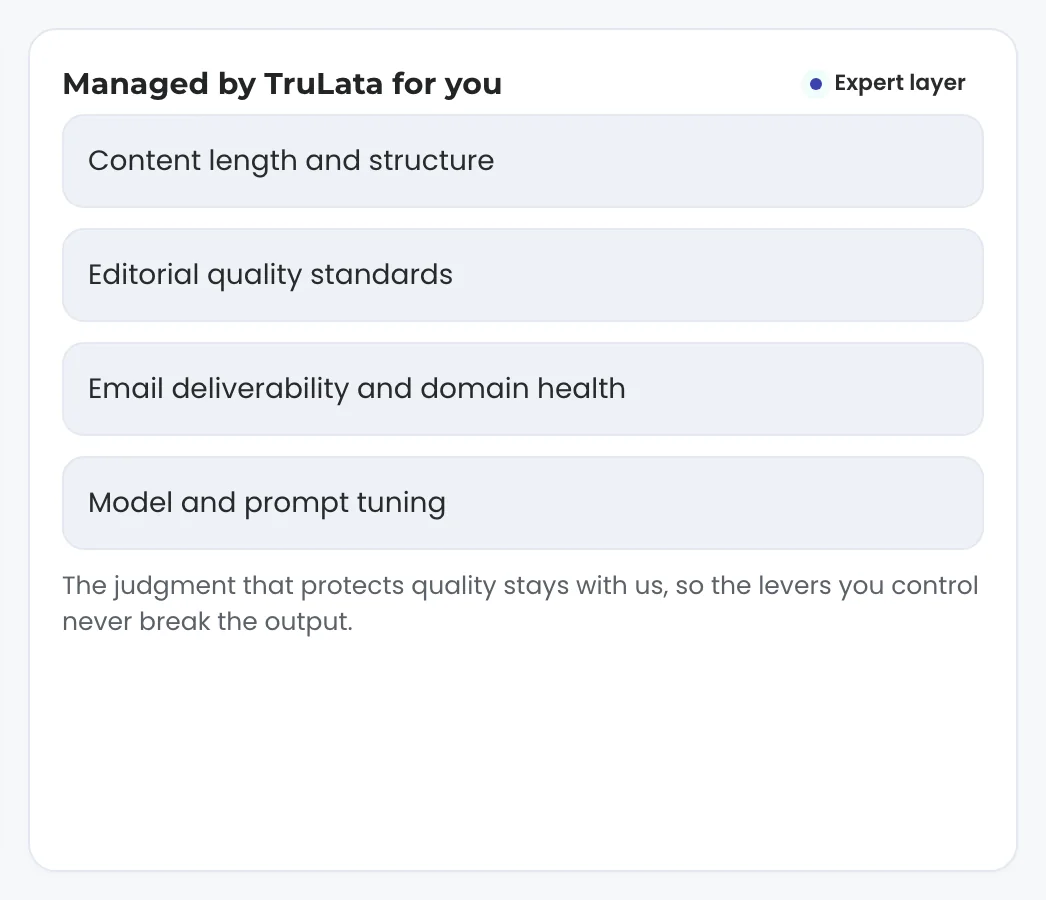
Judged work stays with a person. A budget or bid change in your ads account is made within the limits set for your engagement and lands in your account's own change history. Prospect emails leave from a review-first queue; a person releases them, or the queue releases on the schedule set for the engagement, and every send is logged with the draft, the mailbox and the time. Replies are classified and shown, and not-interested or bounced addresses are suppressed from further sends. Named accounts you hand us are always reviewed by a person. Content approval is a per-client setting: where it is on, a draft sits as awaiting approval until a person approves or rejects it. Stripe is read only.
From the screen you can set a lead outcome, request a website change, and request a content, keyword, category or targeting change. Each request lands with the team as a logged ticket, and the engine's writes to your ad accounts and your site go through each platform's API and land in its change history. Bespoke AI work is scoped on the same line: the model reads, classifies, drafts or scores on a schedule, the log says what it did, and the step that spends money belongs to a person.
What does bespoke AI work look like, and can I see the pattern first?
Bespoke work takes one of three shapes, each scoped with you and each already running in the product. A classifier on a stream you have: the reply classifier is the pattern, each message classified once, recorded, suppressed where due, a person seeing the ones that matter. A generation step with a gate in front of it: the content engine is the pattern, a demand check that rejects a topic without established demand, a dedupe against what is already published, a draft filed where you can read it, and a setting that publishes on the cadence or holds the draft as awaiting approval. A measurement: the answer-engine program is the pattern, each engine through its own API, the question asked bare, a blank recorded as an error rather than a miss, a baseline and a re-run as the program moves.
Every piece runs on our side and reports into your dashboard or your Drive; we host, patch and maintain it for you. The engine every dashboard runs is one shared file, and a piece built for you loads after it from your own file, so it survives every engine refresh.
See the pattern before anything is scoped. Open the demo at demo.trulata.com: no form in front of it, a fictional company called Meridian, every number illustrative, and the same engine code every client dashboard runs. Open the Content, Outbound and AEO / GEO views. AI agents covers the workflow side of the same scheduled work, marketing automation the moves between your tools, and custom software the views and integrations built around a model.
Which tier carries the AI I want, and what does bespoke work cost?
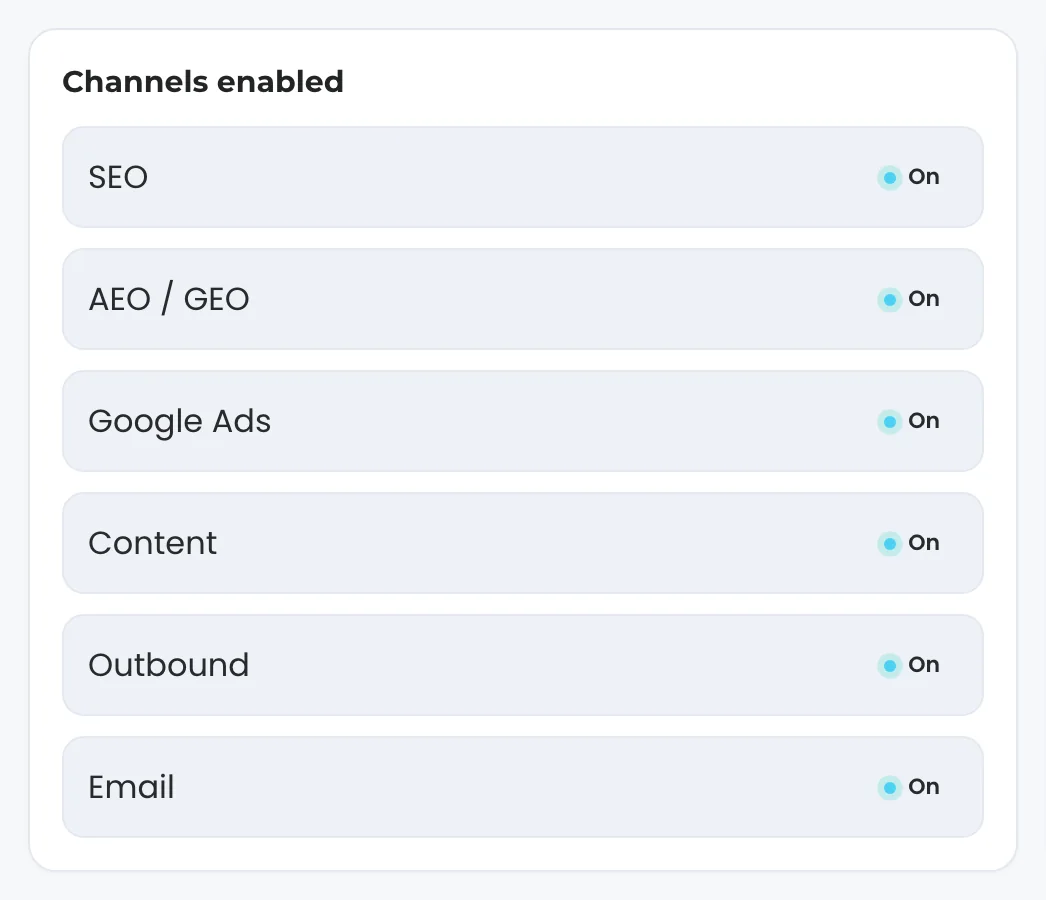
Starter includes the Command Center, full analytics, leads, search visibility, the AI visibility program, managed Google Ads search, the assistant and briefings and support tickets. The content engine runs on Launch, Growth and Command. Google Ads search is managed on all tiers. Meta ads are managed on Growth and Command. The outbound engine runs on Command. Command adds the outbound engine, ad creatives and your full marketing team, always on, is scoped per engagement and carries no number on this site.
Seats are three on Starter, three on Launch, ten on Growth and unlimited on Command. Starter is $400 a month, Launch $650, Growth $1,200, and Command is scoped per engagement. Every tier is month to month with nothing metered, the three published tiers carry no setup fee, and an annual commitment takes twenty to twenty-five percent off the monthly. Bespoke AI work is scoped with you on top of whichever tier you are on, and no hourly rate is published. The pricing page carries the full table.
Can your team run it for me?
Yes. Command is our team running the program. It adds the outbound engine, ad creatives and your full marketing team, always on, scoped per engagement. The managed strategy retainer sits on top of any tier, scoped with you, and puts strategy, optimization and the approvals on our side. Every change our team makes in your ads account lands in its own change history, which the same 7:05am Eastern watch reads and sorts as ours. The managed page covers both, and the pricing page shows where Command sits above the three published tiers.
Bespoke AI work is scoped the same way, on top of the tier or the engagement you are on. TruLata is also a marketing services firm. The services hub lists everything our team does, custom software and AI agents are the nearest neighbours to this page, and the AI search visibility use case shows the measurement from the owner's seat.
AI inside the product, and where a person comes in.
| What runs | What it reads | What a person still does |
|---|---|---|
| Content engine | Search volume from Google's keyword planner, the live top ten for the phrase, the titles already on your site, current sources for the research | Approval is optional and per client; where it is on, a draft waits as awaiting approval |
| Reply classification | Replies to outreach the engine sent, in our outreach mailboxes; each classified once | Sees the replies that matter; not-interested and bounced addresses are suppressed from further sends |
| Answer-engine measurement | ChatGPT, Gemini, Claude and Grok, each through its own API with web search on, the question asked bare | Sets the question set with you and re-runs it as the program moves; no published cadence |
| Ads change watch | Your Google Ads change history and user list, daily at 7:05am ET; a rules table, not a model | Makes every budget and bid change |
| Assistant view | A question typed on the screen, where the view is offered | Being reworked; not sold as available on every dashboard |
| Bespoke AI work | The stream you name, scoped with you, on one of the three patterns above | The step that spends money |
| Price | Scoped with you on top of your tier | No hourly rate published; Starter is $400 a month, Launch $650, Growth $1,200, and Command is scoped per engagement |
Every number here is measured, with its date on the screen. A phone lead counts where your CRM records it, and a call-tracking platform with an API is connected during setup where you run one. Card data is never read, and your inbox and calendar are connected only where you ask. Positions are Search Console's own averages, labelled as such. The editor changes your words on a site our team built. The price is scoped with you on top of your tier. A budget or bid moves within the limits set for your engagement and lands in the account's own change history. Prospect emails leave from a review-first queue; a person releases them, or the queue releases on the schedule set for the engagement, and every send is logged.
Questions, answered.
Which AI already runs inside the Command Center?
Three jobs. The content engine, on Launch, Growth and Command, researches and drafts each piece behind a demand gate and files it as a Google Doc in your Drive. On Command, every reply to outreach the engine sent is classified once as a positive sales reply, another sales reply or not outreach. The answer-engine measurement, on all tiers, scores ChatGPT, Gemini, Claude and Grok at baseline and again as the program moves. The assistant view takes a question from the screen where it is offered and is being reworked, so it is not sold as available on every dashboard.
Does the content engine publish without a person?
Only where you set it to. Auto-publish is a per-client setting. Where approval is on, a draft waits as awaiting approval until a person approves or rejects it. Before any of that, the topic has to pass a demand gate on real search volume and the live top ten, and a topic without established demand is rejected rather than passed. The dedupe reads the titles already published on your site.
Can a model spend money on my ads account or email my prospects on its own?
A budget or bid change in your ads account is made within the limits set for your engagement and lands in your account's own change history. Prospect emails leave from a review-first queue; a person releases them, or the queue releases on the schedule set for the engagement, and every send is logged with the draft, the mailbox and the time. Named accounts you hand us are always reviewed by a person. Stripe is read only; nothing here creates a charge or a refund.
How is AI visibility measured, and how often?
Your buyers' questions are run through ChatGPT, Gemini, Claude and Grok, each through its own API with web search on, asked bare the way a person types them. A blank answer is a measurement error and leaves the denominator; it is never counted as a miss. The program is scored at baseline and re-run as it moves, with no published cadence, and Google's AI Overviews are measured through the search view. <a href="/product/ai-visibility">The AI visibility page</a> shows the view.
What does bespoke AI work cost?
It is scoped with you on top of the tier or the engagement you are on. No hourly rate is published; the price is settled when the work is scoped. Command and the managed strategy retainer are scoped as well and carry no number on this site, and <a href="/product/pricing">the pricing page</a> carries the three published tiers.
What data does the AI see, and what does it never see?
The content engine reads search volume from Google's keyword planner, the live top ten for a phrase, and the titles already published on your site. The reply classifier reads replies to outreach the engine sent, in our outreach mailboxes. The answer-engine measurement reads what each engine answered. Card data is never read, your inbox and calendar are connected only where you ask for it during setup, and a phone lead counts where your CRM records it or where a call-tracking platform with an API is connected during setup. Every Google connection is a manager invitation you can revoke in your own console, and we hold no password of yours.
See it running
before you decide.
The demo is the real product on a fictional company, with no form in front of it. Pricing is three published tiers.
Open the live demo See pricing
New here? See what the Command Center is. Prefer to write? Send us the one thing you want to know.
Start here: AI marketing platform · AI marketing software · all-in-one marketing platform · marketing automation software · marketing software for small business.
- Refreshed when you open itLive data on page load, never a monthly PDF
- Counted from your own formsLeads recorded server-side, compared daily with Ads and GA4
- Seen in AI answersHow often ChatGPT, Gemini, Claude and Grok name you, measured
- Every send loggedProspect emails leave from a review-first queue, and every send is logged.