

Hold any agency to a live screen. Ours included.
TruLata sells marketing services, and this comparison includes us. Your numbers and your leads sit on a screen you open yourself, your ads account's change history and its list of users are read at 7:05 Eastern every morning, and you can hold any agency to that record, ours included.

Am I buying software or people?
Both. TruLata started as a marketing services firm, built the software for its own client work, and now sells it as a product. The three published tiers are the software, and Starter already carries the TruLata dashboard, full analytics, leads, search visibility, the AI visibility program, managed Google Ads search, the assistant and briefings and support tickets. Command is a managed engagement that adds the outbound engine, social media management, your full marketing team, always on and a website our team builds for you, the named people you talk to. That is an agency relationship, and we call it one.
This page sets an engagement with an instrument against one without. Put every question below to the agency you pay today, then to us. Where our answer is a page you can open instead of a sentence, we link to it.
An engagement without an instrument
- Their people, inside the scope you pay for
- What they choose to report, when they choose to
- Accounts in whoever's name the contract says
An engagement with one
- A screen at your own address, behind your own login
- Your ads account's change history, read every morning
- Any agency held to that record, ours included
What can I see, and how old is it?
You see a screen at your own address, behind your own login, and it refreshes because you opened it. On load it shows last night's snapshot at once and asks our service for the live payload. If that payload is older than five minutes, a pull starts in the background and the numbers update when it lands. Your CRM pipeline, Stripe payments, booking platform jobs, website leads and email statistics move on a refresh. Google Ads and GA4 publish hours behind. Search Console runs two to three days behind. Google sets both ceilings, and the header stamp says how old the snapshot is.
A scheduled report is as fresh as the day someone exported it, and it shows the numbers someone chose to include. The screen shows each connected source at the newest point we have pulled from it, with the age stamped in the header. Press Refresh and every path ends in a reloaded page that says how old the data is, whatever the live service did.
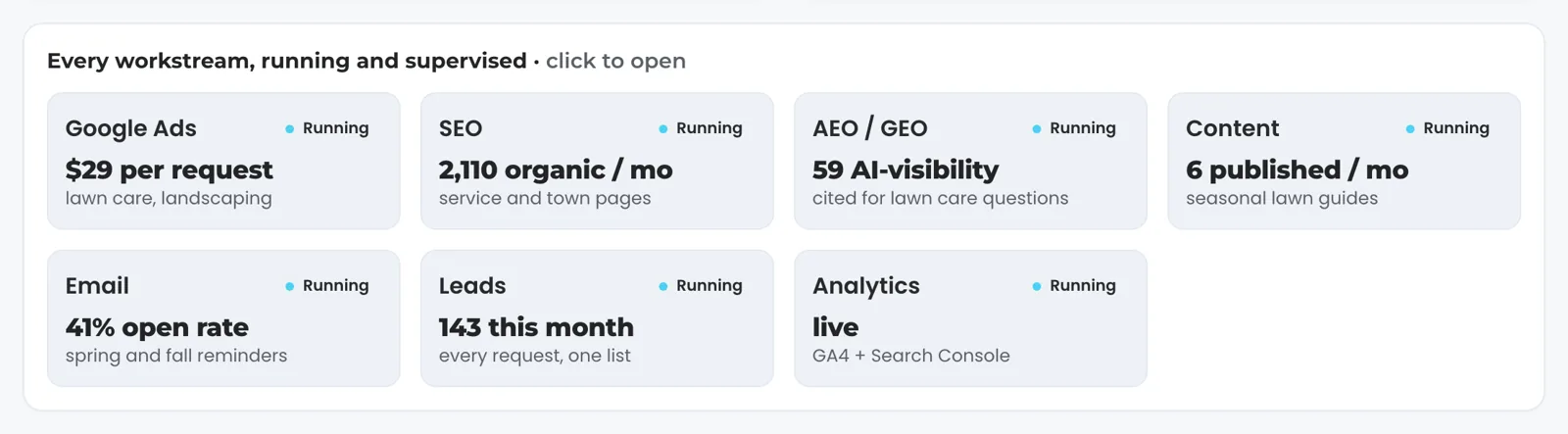

A scheduled report is as fresh as the day someone exported it.
Whose lead count can I trust?
Trust your own. Forms on a site we build are handled server-side, and each submission is appended to a Google Sheet and emailed to the team as it lands. The Leads view reads that sheet, newest first. The ad platform's conversion count and GA4's event count are read for the same period, and at 7:20 Eastern every morning the lead watch compares the three on an instance whose forms feed the sheet. It raises when form leads land in the sheet while GA4 records no form event, and when paid-click leads land while the ad account records no conversion.
The watch exists so a wrong number gets caught in a day. A dead tag, a blind ad account or a stalled form shows up the next morning instead of at the end of the quarter, while the budget is still yours to move. A report built from the ad platform's own number carries the platform's mistakes straight into your budget decisions. A phone lead counts when your CRM records it.
Three counts, compared every morning
- Your forms, written server-side to a sheet
- Google Ads conversions
- GA4 key events
- Form leads with no GA4 form event: raised
- Paid leads with no Ads conversion: raised
- A dead tag, caught the next day
Will I know who changed my ads account?
Yes, and press any agency hardest on this one. At 7:05 Eastern every morning one job reads the change history of every ads account connected to us, plus the list of who holds access to it, because access changes are not change events and the history cannot carry them. Our own writes land in that same history under our account, so what our team did sits on the same record as everyone else. The watch sets our own writes and Google's routine churn aside and raises what is left, a material change made by anyone else, to the team the same day. That sorting is what makes it a watch rather than a feed.
The same watch shows who holds access to the account. Grant a new address read access today and it appears in tomorrow morning's read of the account users, because Google's change history carries no event type for access. The rest of the engagement runs on the same rule. Type a request into the screen, for a website change or a content, keyword or targeting change, and it is logged and sent to the team. A request from the screen goes to your team as a logged ticket; the engine's writes to your ad accounts and your site go through their APIs and land in each account's own change history. The security page lists every write path. Where the outbound engine runs, prospect emails leave from a review-first queue; a person releases them, or the queue releases on the schedule set for the engagement, and every send is logged. Where the content engine runs, every piece moves through named stages and is filed as a Google Doc.
One job, every morning
- Change history readevery ads account connected to us
- Account users readaccess changes are not change events
- Our own writes set asidewith Google's routine churn
- A material change raisedmade by anyone else, to the team
- New access shows upin the read of the account's users
That sorting is what makes it a watch rather than a feed.
What does it cost next to my retainer?
We publish our number, not the agency's. Any figure we put on an agency retainer would be invented, and the one retainer we know is our own. Starter is $400 a month, Launch $650, Growth $1,200, and Command is scoped per engagement. Starter carries the TruLata dashboard, full analytics, leads, search visibility, the AI visibility program, managed Google Ads search, the assistant and briefings and support tickets; Launch adds the content engine; Growth adds Meta ads; Command adds the outbound engine, social media management, your full marketing team, always on and a website our team builds for you. Seats are three on Starter, three on Launch, ten on Growth and unlimited on Command. A managed strategy retainer is an add-on scoped with you.
Every published tier is month to month. Nothing is metered. Commit annually and the monthly drops twenty percent. Hold your current agreement to the same four terms: what the number includes, what is billed beyond it, what happens to the price when you do more, and how long you are held. The same figures sit on the pricing page.
- What the number includesAsk for it line by line; ours is published
- What is billed beyond itOn our published tiers, nothing is metered
- What happens to the price when you do moreAsk before you add a channel
- How long you are heldOurs: month to month
What do I keep if I leave?
Keep your accounts. They were always yours. Every Google connection is a grant you can revoke in your own console, and we never ask for your account passwords. Where your forms feed a lead sheet, the sheet stays where it is, with every row in it. Your seats are revoked. Ask any agency the same before you sign, and ask specifically who owns the ad account, the analytics property and the domain on the day you leave. What we read and what leaves with you is written out in full.

Put these to any agency, including us.
| Ask this | Our answer | Where to check it |
|---|---|---|
| What I can see | A screen behind your login, refreshed when you open it, with the age of the snapshot stamped in the header | demo.trulata.com, a fictional company on the same engine |
| Who counts my leads | Your own forms, written server-side to a Google Sheet; the lead watch compares the sheet with Ads and GA4 daily on an instance whose forms feed it | The Leads view; the lead watch at 7:20am ET |
| Who changed my ads account | The change history and the account users, read daily, our own writes included | Google's own change history in your account; our change watch reads it daily at 7:05am ET |
| What the screen writes to my accounts | A logged request to the team; the engine's writes land in each account's own change history | The security page lists every write path |
| What it costs | Three published tiers; Command scoped; nothing metered; month to month | The pricing page, the same figures everywhere |
| What I keep when I leave | Your Google accounts, with our access revoked by you, and the lead sheet, which stays where it is | The Your data page |
The screen, the sheet and the change history hold every agency to the same record, ours included.
Questions, answered.
Is TruLata an agency?
Yes. TruLata sells marketing services, and the Command tier is a managed engagement run by a named team. The published tiers are the software those services run on.
Can I keep my current agency and use TruLata?
Yes. Grant us access to the ads account during setup and the screen reports on it. The daily change watch reads its history whether the changes are ours, yours or your agency's, and the record is the same either way.
How is the lead count different from an agency report?
It comes from your own forms. Each submission is written server-side to a Google Sheet, and on an instance whose forms feed the sheet a daily watch compares it with Ads conversions and GA4 events. A report built from the ad platform's number alone cannot see when that number is wrong.
Do you publish what an agency typically charges?
We publish our own: Starter is $400 a month, Launch $650, Growth $1,200, and Command is scoped per engagement, plus a managed strategy retainer scoped with you. A figure for an agency retainer would be invented, so it stays off the page.
Will I see the changes your own team makes?
Yes. On any account we run, our changes land in the same ads change history the daily watch reads, and every request sent from the screen is logged. Nobody is exempt from the record.
What happens if I leave?
You revoke our manager access in your own Google consoles, your seats are revoked, and where your forms feed a lead sheet it stays where it is with every row in it. Month to month means the next month is not billed.
See how it would run
for your business.
15 minutes with TruLata. We show you what your marketing brings in, what each lead costs, and what we would change first.
Book a demo or start a 7-day free trial
No card. It ends on its own after 7 days unless you add one. See pricing.
New here? See what TruLata is. Prefer to write? Send us the one thing you want to know.
Start here: AI marketing platform · AI marketing software · all-in-one marketing platform · marketing automation software · marketing software for small business.
- Refreshed when you open itLive data on page load, never a monthly PDF
- Counted from your own formsLeads recorded server-side, compared daily with Ads and GA4
- Seen in AI answersHow often ChatGPT, Gemini, Claude, Grok, Manus, Google AI Overviews, Perplexity, Meta AI and DeepSeek name you, measured
- Every send loggedProspect emails leave from a review-first queue, and every send is logged.