

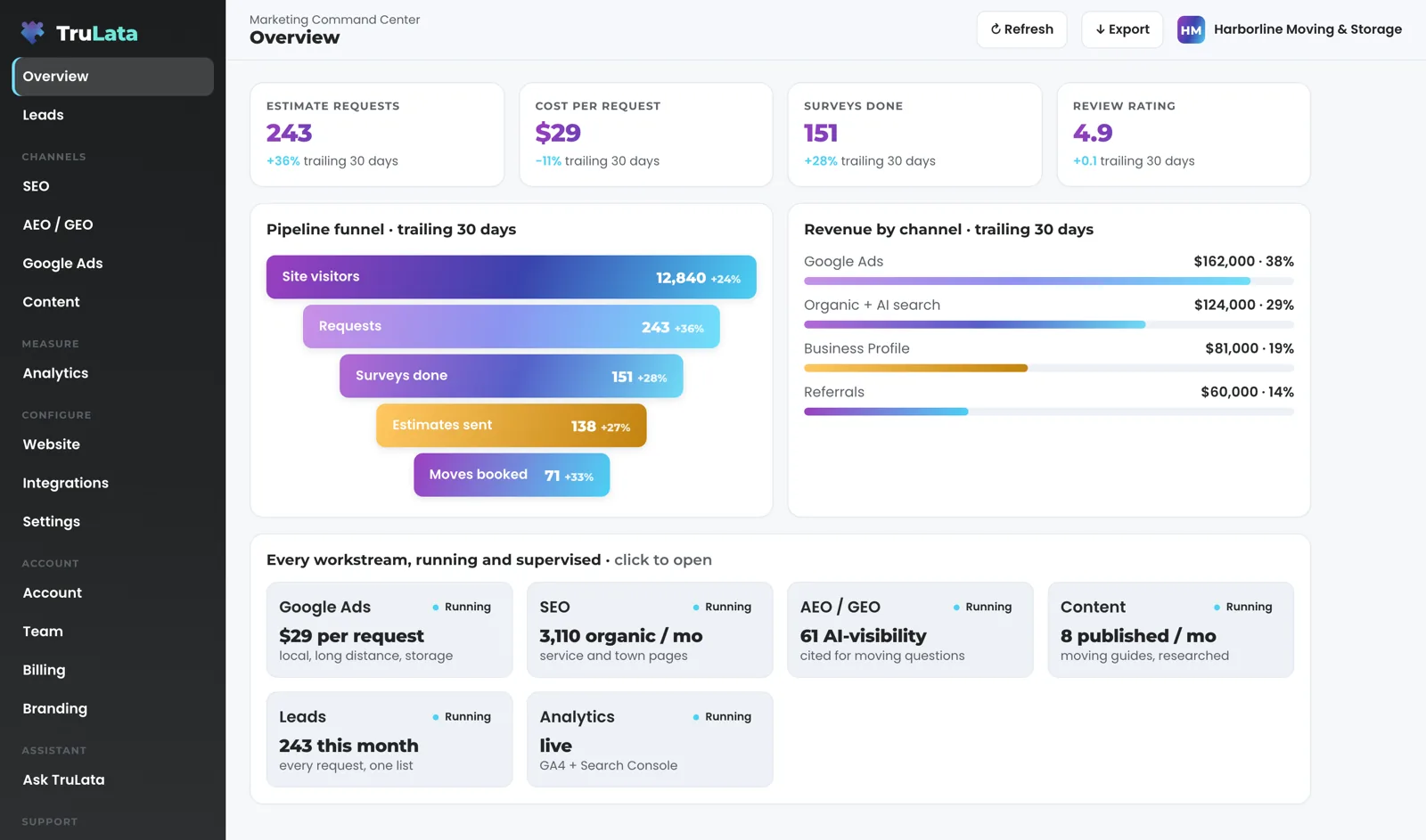
See every move estimate request the day it lands, and which ones became booked moves.
Built for a moving company that runs local and long-distance moves across a service area, whoever runs the marketing. TruLata reads your Google accounts, your Business Profile reviews and the estimate requests from your own site's forms, runs the watching and the drafting on a schedule whether anyone is at a desk, and shows you what each request became.

Is this built for a moving company?
Yes. TruLata is built for a moving company that sells local moves, long-distance moves, packing and storage across a service area, and a company with several locations or a commercial moving side fits the same way. The marketing is often the owner's, done between dispatching crews, booking trucks and settling a damage claim, and a company with a marketer on staff reads the same screen. Search, ads, content and the counting run on a schedule whether or not anyone had time this week, every estimate request is counted from your own site, and one screen shows what happened and what it cost.
A customer shopping for a mover is shopping against a date. They have a closing, a lease end or a start date at a new job, and they compare movers before they pick. They search for movers and the town, read the reviews for the words careful, on time and no surprise charges, and ask for an in-home or virtual estimate. Calling back fast and getting the survey on the calendar is how you stay in the running. A move lead bought from a marketplace is a shared lead, the same household sold to several movers at once, and you are competing with every other mover it was sold to from the first call. A request from your own site's form is yours alone, and it is the kind the Leads view counts. The comparison with bought leads is on mechanism, not on a price we would have to invent.
The calendar is the whole business. Your busy weeks follow the dates your customers are moving on: closings, lease ends and new jobs. A request that sits a day in June can lose the date it wanted. The quieter months are when you can build the work that carries the next busy stretch. So the screen puts each request in front of you the day it lands, with the move type and the page it came from on the row, and asks you one question when you are done with it: what did it become.
- A date is setA closing, a lease end or a start date at a new job
- The searchMovers and the town, then the reviews
- A few quotes comparedAn in-home or virtual estimate from each
- The first callbackWhoever gets the survey on the calendar
- The move is bookedWith the mover who got the survey on the calendar
A customer shopping for a mover is shopping against a date.
What does the screen read for a moving company?
It reads the sources you already have. Google Analytics 4 gives sessions, where they came from, which pages were read and the key events you count as a request, hours behind during the day. Search Console gives the queries you appeared for, impressions, clicks and average position, two to three days behind; for a mover those are local movers and the town, long distance movers, moving and storage, apartment movers, and the positions are Search Console's own averages, not a rank tracker. Google Ads gives spend, conversions and cost per conversion by campaign, so a local campaign and a long-distance campaign each show what a request cost.
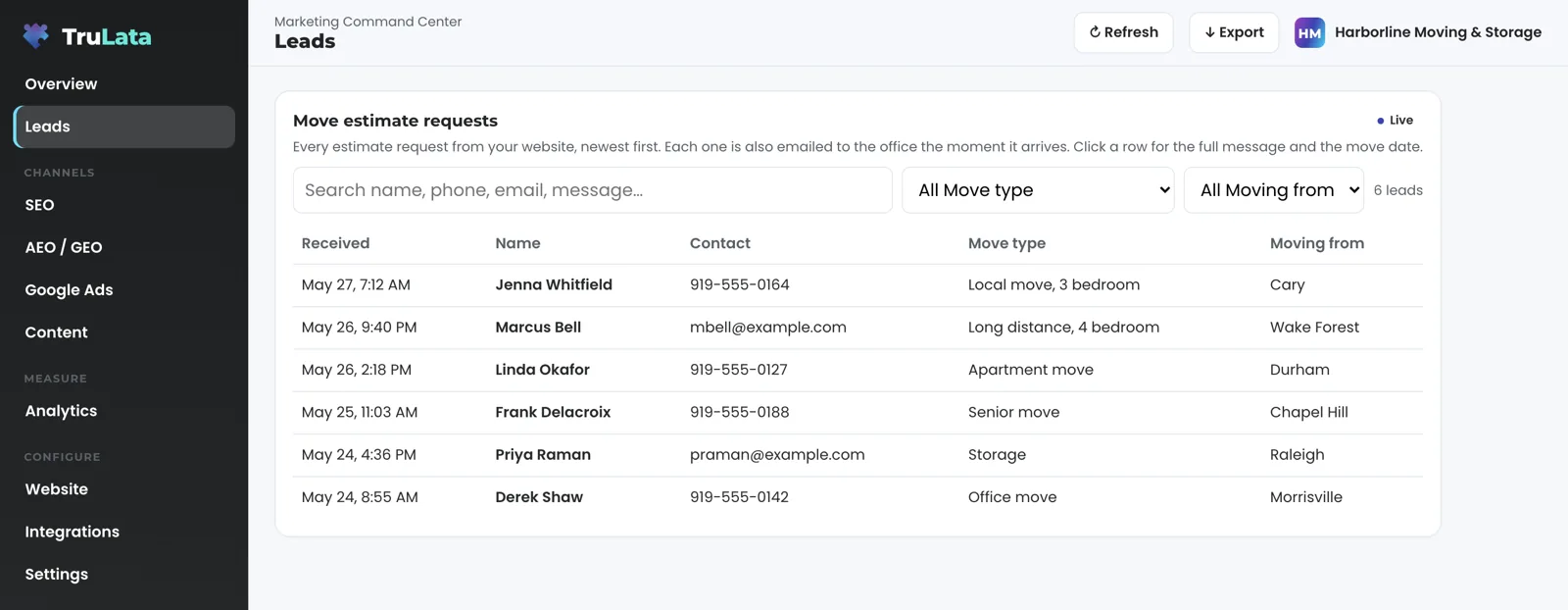
Google Business Profile gives reviews, rating and listing performance, and the reviews card sits on the search view because a family handing its furniture to strangers reads the reviews before it asks for a quote. Your website's forms feed a lead sheet: the form handler appends each submission server-side as it lands and emails your team, and the Leads view reads that sheet newest first. A two-bedroom local move, a four-bedroom move out of state and a storage request show up as rows with a time, a name, a contact and, where your form asks for it, the move date. Where your business runs on a CRM or booking platform, the Jobs view reads jobs and the job pipeline live, and shows a coming-soon card rather than a number until the data is trustworthy.
What appears is one screen for your company, at your own address on our domain, behind a sign-in. It loads last night's snapshot the instant you open it, pulls live numbers behind the request when that snapshot is older than five minutes, and stamps the header with how old the data is. On each request you set what it became: contacted, quoted, won, lost, or not a lead with the reason. The outcome stays on the row, so booked moves sit next to raw requests on the same screen, and a month of quotes that never booked is visible while there is still time to change the ads.
What runs while the trucks are out, and what waits for me?
Your Google Ads account is watched every morning. Google Ads search is managed on all tiers: our team runs your search campaigns, and a budget or bid change is made within the limits set for your engagement and lands in your account's own change history. At 7:05 Eastern the ads change watch reads that change history and the account's user list, sorts our own writes and routine noise from material changes made by anyone else, and raises the material ones the same morning, including the recommendations Google applies on its own. A long-distance campaign that quietly widened its locations or a budget that doubled in May reaches your team the next morning rather than on the invoice.
Every day at 7:20 Eastern, on an instance whose forms feed the sheet, the lead watch runs five checks across the sheet, GA4 and Ads: the tracking tag still loads, requests with no GA4 form event, paid requests with no Ads conversion, a campaign that was spending and has gone to zero, and organic traffic with no requests at all. A quote form that broke in the first week of June is flagged the next day, not after a week of peak-season requests went nowhere. Every night at 12:01 Central a fallback snapshot is baked, and a failed pull leaves the previous page up rather than an empty one.
On Launch, Growth and Command, the content engine researches and drafts on your cadence: what a binding estimate means, how to pack a kitchen, what a long-distance move costs by distance and weight. Each topic passes a demand gate on real search volume and what already occupies the result page, the research cites current sources, the dedupe reads the titles already published on your site, and each piece is filed as a Google Doc in your Drive with a featured image. Auto-publish is a per-client setting and approval is optional. On Growth and Command, Meta ads are managed alongside search. On Command, the outbound engine sources prospects weekly to the target profile set with you, for example the real estate agents, apartment communities and senior living communities that send moves every month, and drafts into a review-first queue; a person releases each send, or the queue releases on the schedule set for the engagement, and every send is logged with the draft, the mailbox and the time.
What stays with a person is the judgement: the limits on spend, the price on an estimate, and anything that answers a customer. A content piece with auto-publish off waits as a draft until someone approves it. From the screen you can set a lead outcome, request a website change, and request a content, keyword, category or targeting change; each request goes to your team as a logged ticket, and the engine's writes to your ad accounts and your site go through their APIs and land in each account's own change history. A phone call counts when your CRM records it, and a call-tracking platform you already run connects during setup like any other source with an API.
Read every morning while the trucks are out
- Your Google Ads change history and user list
- Your form lead sheet
- GA4 and Ads conversions
- A widened location or a doubled budget, raised the next morning
- A broken quote form, flagged the next day
- A campaign gone to zero, flagged the next day
- Our own writes and routine noise, set aside

Your Google Ads account is watched every morning.
Can I see it before I sign anything?
Yes, with your name and email in front of it. The demo is the same engine code every client runs, pointed at a fictional company called Meridian so it can be public. Every number is invented, and the screen says so. Open the Leads view, the Google Ads view and the search view, click a request to read the full message, and you are looking at the screen a moving company gets, with your sources in place of Meridian's.
Then picture it on your own company; that part is yours. You sell moves across a service area, whoever runs the marketing. That is the company this page, the setup and the tiers are written for, and one with several locations fits the same way; if you want the work done as a service rather than run as a system, the services side is the other door. Part of it runs on your own numbers during setup: the first pull, the answer-engine baseline and the ads watch run on your accounts in the first two weeks, before most of the engines are switched on. Starting in a quieter month means the watches are already reading your accounts when the first peak-season request lands.
One thing about the search view is worth knowing before you open it. Ranking is not earning, so the view puts the estimate requests your own forms took beside the queries and positions that earned them. A position there is Search Console's average for that query, not a rank tracker's guess. That is what the screen holds the work to: which booked moves came from which search, not where a keyword sat.
Which tier fits a moving company?
Starter includes the TruLata dashboard, full analytics, leads, search visibility, the AI visibility program, managed Google Ads search, the assistant and briefings and support tickets. The content engine is on Launch, Growth and Command. Meta ads are on Growth and Command. The outbound engine, for a mover that wants agents, apartment communities and senior living communities sending moves, is on Command. Command adds the outbound engine, ad creatives and your full marketing team, always on.
Seats are three on Starter, three on Launch, ten on Growth and unlimited on Command, so the office, the estimator and the owner can each have one. Starter is $400 a month, Launch $650, Growth $1,200, and Command is scoped per engagement. Every tier is month to month with nothing metered, and committing annually takes twenty to twenty-five percent off the monthly. The pricing page carries the same figures as every other page.
Starter is $400 a month, Launch $650, Growth $1,200, and Command is scoped per engagement.
Want it run for you?
You have two doors. Managed TruLata is our team running the program on your accounts: strategy, optimization and approvals on our side, scoped with you, and every change we make lands in your account's own change history, which the same 7:05 Eastern watch reads and sorts as ours. Local services marketing is TruLata's agency work for the same buyer, search and paid search with a daily account watch among it. Either way, your crews keep moving households and the marketing keeps running through the end-of-month rush.

What a mover's screen reads, and how fresh it is.
| What | Where it comes from | How fresh |
|---|---|---|
| Move estimate requests | Your site's forms, appended to a lead sheet server-side; the Leads view reads it newest first | Live |
| Jobs and job pipeline | Your CRM or booking platform, where the business runs on it | Live; a coming-soon card until the data is trustworthy |
| Reviews, rating, listing performance | Google Business Profile, with our Google account as a manager you can revoke | Pulled with each refresh; the header stamp says when |
| Spend, conversions, cost per conversion | Google Ads, by campaign, local and long-distance apart | Intraday lags hours; change history read daily at 7:05am ET |
| Sessions, sources, pages, key events | Google Analytics 4 | Hours behind intraday |
| Queries, impressions, clicks, average position | Search Console; its own average positions, not a rank tracker | 2 to 3 days behind |
| The page itself | Snapshot on open, live pull behind it when older than 5 minutes, nightly bake at 12:01am CT | Header stamp says when the data was pulled |
When every lease in town turns over on the same weekend, the estimate requests from your forms are live the moment they land. The Google Ads numbers run hours behind and Search Console runs two to three days behind. The header stamp says when each pull ran, and the Refresh button forces a new one and ends in a reloaded page rather than an error.
Questions, answered.
Do you count the calls from people who want a quote over the phone?
When your CRM records the call as a lead, and a call-tracking platform you already run connects during setup like any other source with an API. The requests the screen counts are submissions from your own site's forms, written to a sheet server-side as they land and read newest first.
Can I tell local moves from long-distance moves on the screen?
Where your form asks for the move type, it is on the row, and you can filter the Leads view by it. Google Ads shows spend, conversions and cost per conversion by campaign, so a local campaign and a long-distance campaign each carry their own cost per request, hours behind during the day. The sheet behind the Leads view records the page and, where the form captures them, the traffic source, the referrer and any UTM or gclid for each submission.
Will the ad budget change in peak season without me knowing?
A budget or bid change is made within the limits set for your engagement, and every change in the account lands in Google's own change history. The watch reads that history and the account's user list at 7:05 Eastern every morning and sorts each change by who made it, and recommendations Google applies on its own are raised the same way.
What happens in the slow months?
The scheduled work runs the same in January as in June: the ads change watch at 7:05am Eastern, the lead watch at 7:20am Eastern on an instance whose forms feed the sheet, the content engine on its cadence on Launch, Growth and Command, and the fallback snapshot at 12:01am Central. On Command, the weekly sourcing of agents, apartment communities and senior living communities keeps running, which is when referral relationships for next season get started.
Does it read my moving software?
Where your business runs on a CRM or booking platform, the Jobs view reads jobs and the job pipeline live, and shows a coming-soon card until that data is trustworthy. TruLata connects to anything with an API; our team connects it from the inside with access you grant during setup, and a connector not built yet is built during setup. We do not hold your passwords.
Does it replace the move leads I buy?
It counts a different kind of lead. A marketplace lead is a shared lead, the same household sold to several movers at once. The leads on the screen are submissions from your own forms; a bought lead shows on the Jobs view where your CRM records it. Whether you keep buying is your call, and the comparison on the buying leads page is on mechanism, not on a marketplace price we would have to invent.
See it running
before you decide.
The demo is the real product on a fictional company, with your name and email in front of it. Pricing is three published tiers.
Open the live demo See pricing
New here? See what TruLata is. Prefer to write? Send us the one thing you want to know.
Start here: AI marketing platform · AI marketing software · all-in-one marketing platform · marketing automation software · marketing software for small business.
- Refreshed when you open itLive data on page load, never a monthly PDF
- Counted from your own formsLeads recorded server-side, compared daily with Ads and GA4
- Seen in AI answersHow often ChatGPT, Gemini, Claude and Grok name you, measured
- Every send loggedProspect emails leave from a review-first queue, and every send is logged.