

Ship pipeline as fast as you ship product, and know which channel booked the demo.
TruLata has run a marketing agency since 2017, and software companies have been among the businesses we market. We run your search and AI answer visibility, content, paid search and paid social, outbound and email, and you watch the work on the same screen our product runs, with each demo request and trial counted from your own site.

What does a SaaS marketing agency get a software company?
Demand you can trace. Traffic is easy to buy and hard to cash. What a B2B software company needs is a demo request from a buyer with the problem your product solves, or a trial started by someone who will still be logging in on day seven. This service is the work that produces those conversions: search, AI answers, content, paid search, paid social, outbound and email. The screen is where each one is counted, from your own site rather than from an ad platform's report.
The usual moment looks like this. The team ships a release every sprint and the pipeline has not moved in a quarter. Demo requests arrive from sources nobody can name. A prospect asks an AI assistant for tools in your category and gets a list with your competitors on it. The founder still writes the launch post, approves the ad copy on a Sunday and answers the demo form between customer calls. The founder may be the marketing department today, or a small team may run it. Either way, this service works around them.
We ran a marketing agency, then turned the work into software. That order matters to you. The people running your program built the screen they report into, so what we did last week is on the screen this week, in your accounts, with a record. The demo shows the screen on a fictional company before you talk to anyone.
How do I see the work without asking for a report?
Open your dashboard. When a buyer submits the demo form on your site, the form handler appends the row to a lead sheet server-side and emails your team, and the Leads view reads that sheet newest first, with the page the request came from. Mark each one from the screen: contacted, quoted, won, lost, or not a lead with the reason. Where your pipeline lives in HubSpot, Salesforce, Pipedrive or another CRM with an API, its stages read live, so a demo request and the opportunity it became sit on one record.
Revenue reads the way software earns it. Stripe connects read only and shows payments, subscriptions and recent charges live, so a trial that converted shows up as a subscription beside the channel that started it. Google Analytics 4 adds sessions, sources, pages and key events, where the demo request and the trial start can each be a key event of their own. Search Console adds queries, impressions, clicks and average position, two to three days behind. Those positions are Search Console's own averages, not a rank tracker.
Freshness is set by each source, and the header stamp says how old the data is. The page loads last night's snapshot the moment you open it and pulls live numbers behind it when that snapshot is older than five minutes. The same screen your team reads is the one our team works from, so a question about last month's spend is answered by opening a tab.
One screen, read from your own sources
- Your lead sheet
- Your CRM
- Stripe, read only
- Google Analytics 4
- Search Console
- Demo requests, newest first
- Trials that became subscriptions
- Queries, clicks and average position
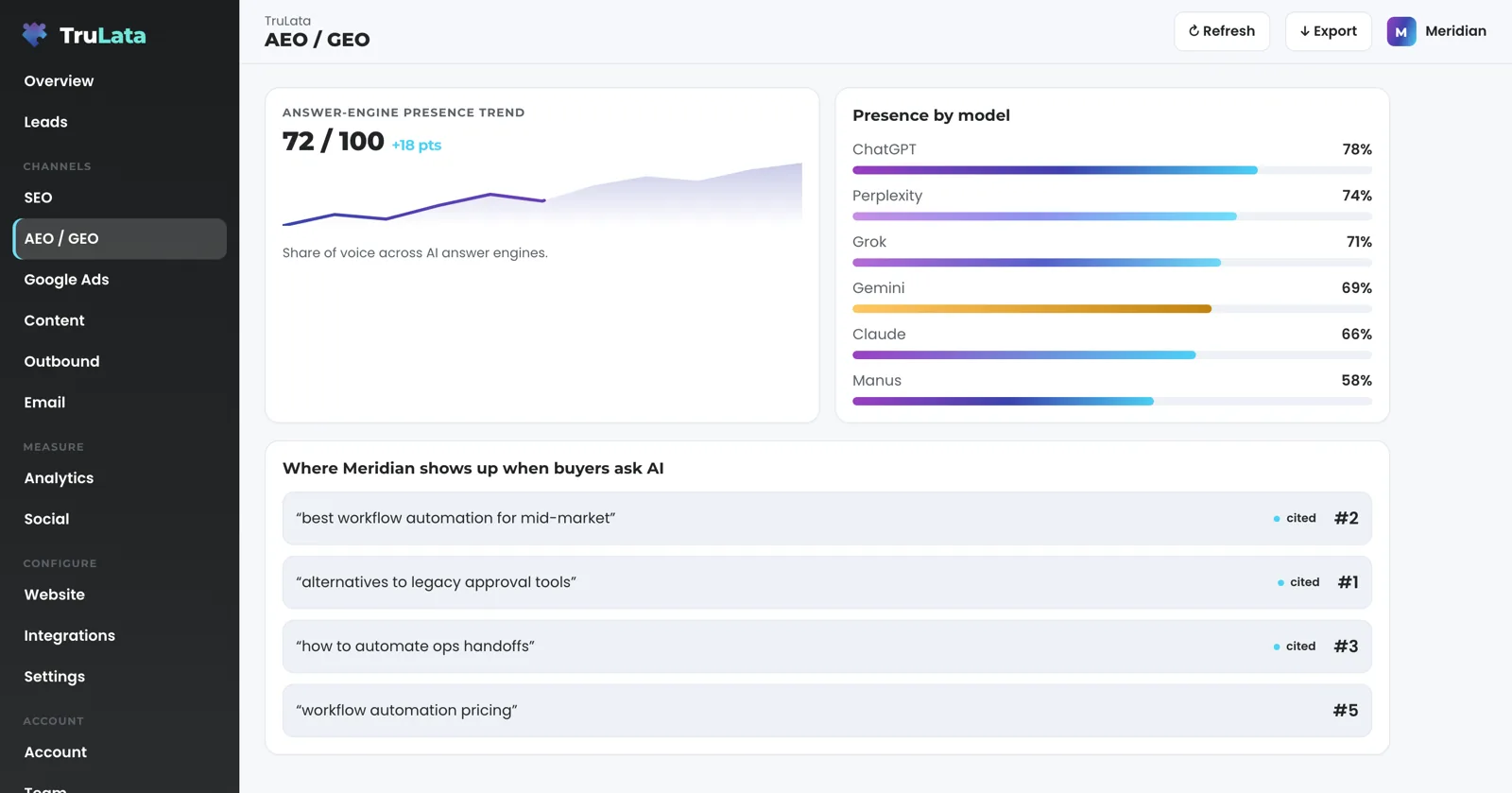
How do we get named when a buyer asks an AI which tool to buy?
Measure it first, then work it. A software buyer now asks ChatGPT, Gemini, Claude or Grok for the best tools in a category, alternatives to a product they already know, or how to solve a problem your product solves. The AI visibility view asks those engines the buyer questions set with you and reports which answers named you and which named someone else. Managed accounts are measured monthly, and the score is kept against your baseline as the program moves.
The search work sits under the same questions. Our SEO work covers the pages a software buyer reads on the way to a demo: the category page, the comparison pages, the integration pages, the use cases and the pricing page. Keyword search volumes come from Google's keyword planner, and the search view puts the demo requests your forms took beside the queries that earned the visit. Ranking is not earning, and a page that climbs for a query without a single demo reads as exactly that.
On Launch, Growth and Command, the content engine researches and drafts on your cadence. Each topic passes a demand gate on real search volume and what already occupies the result page. The dedupe reads the titles already published on your site, the research cites current sources, and each piece is filed as a Google Doc in your Drive with a featured image. Auto-publish is a per-client setting, so a piece can wait for your product lead to check the details before it goes out.
- Demand gateEach topic passes on real search volume and what already occupies the result page
- DedupeReads the titles already published on your site
- ResearchCites current sources
- Filed in your DriveA Google Doc with a featured image
- Publish or waitAuto-publish is a per-client setting, so your product lead can check the details first

Ranking is not earning.
Who runs the ads, and how do I know what changed?
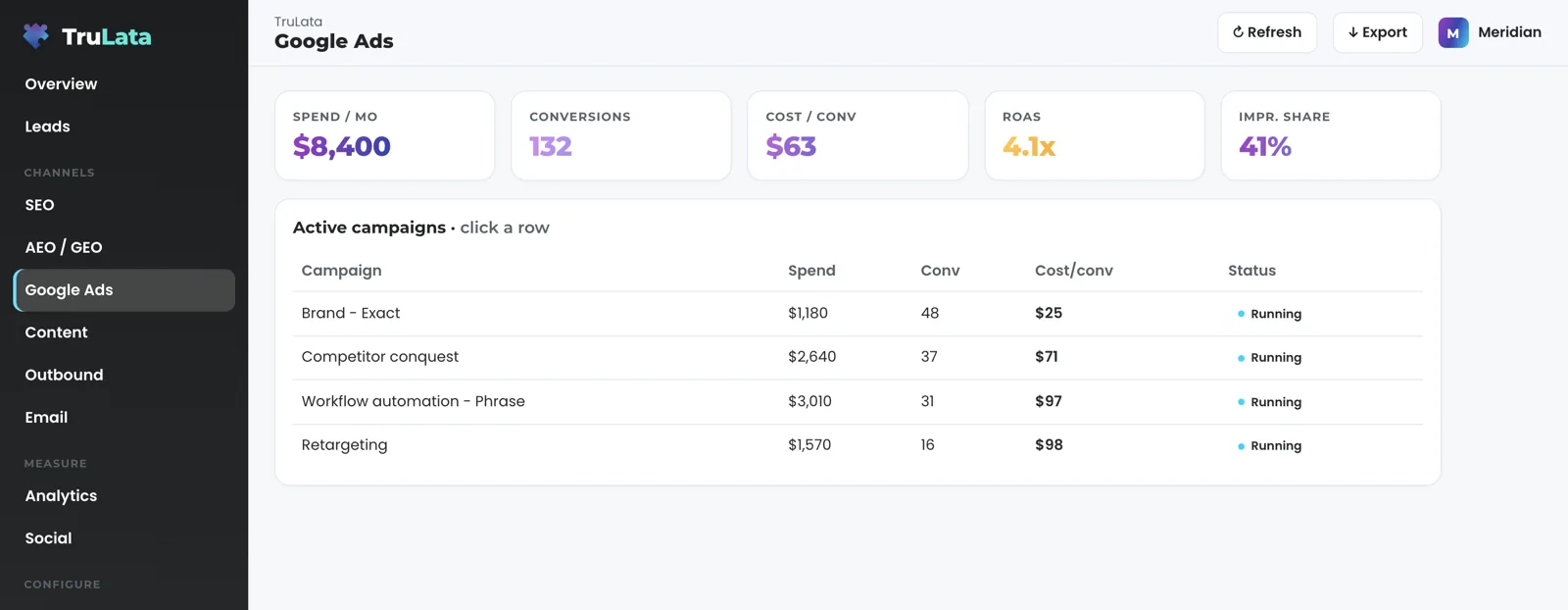
Our team runs them, and your account keeps the record. On all tiers, we manage your search campaigns: category terms, competitor alternatives, and the problem searches a buyer types before they know your name. The engine builds campaigns and creatives and publishes them through Google's API, and negative keywords are mined and added, so the student looking for a free template stops eating the budget. Our paid search page covers the work in full.
On Growth and Command, paid social runs alongside search, built and published through Meta's API, with approval on the Creative view where you want it. A LinkedIn ad account connects as a source like any platform with an API. Budgets and bids move within the limits set for your engagement, and every change lands in the account's own change history.
Every morning at 7:05 Eastern the ads change watch reads your Google Ads change history and its user list. It sets our own writes and Google's routine churn aside, and raises a material change made by anyone else to the team the same day, including a recommendation Google applied on its own. Where your demo form feeds the lead sheet, a lead watch at 7:20 Eastern checks the requests that landed against the conversions Google counted, so a broken tag after a site release is flagged the next day.
Can outbound fill the calendar without burning our domain?
It runs from a review-first queue. On Command, prospects are sourced weekly to the target profile set with you: the job titles that sign for your product, the company size your onboarding fits, the stack your integrations serve. Enrichment finds a deliverable address or routes the prospect to a contact-form path. Named tier-one accounts are reviewed by a person every time. The outbound page shows the queue.
Prospect emails leave that queue when a person releases them, or when the queue releases on the schedule set for the engagement, and every send is logged with the draft, the mailbox and the time. Replies are classified and shown. Not-interested and bounced addresses are suppressed from further sends, so the same buyer is not asked twice.
Email to the people already on your list is scoped with you: trial nurture, onboarding and the release notes that bring a quiet account back. Where you send through Mailchimp, Klaviyo, ActiveCampaign or HubSpot, the Email view reads the last 90 days of campaigns, audience size, opens, clicks and unsubscribes. That view is read only, so what goes out is set in your own platform.
- Sourced weeklyTo the target profile: job titles, company size, the stack your integrations serve
- EnrichedA deliverable address, or a contact-form path
- ReleasedBy a person, or by the queue on the schedule set for the engagement
- LoggedEvery send, with the draft, the mailbox and the time
- Replies classifiedNot-interested and bounced addresses are suppressed
Not-interested and bounced addresses are suppressed from further sends, so the same buyer is not asked twice.
What does it cost, and how much do we hand over?
Pick the channels, then the depth. Starter includes TruLata dashboard, full analytics, leads, search visibility, the AI visibility program, managed Google Ads search, the assistant and briefings and support tickets. Google Ads search is managed on all tiers, the content engine runs on Launch, Growth and Command, Meta ads on Growth and Command, and outbound on Command. Command adds the outbound engine, social media management and your full marketing team, always on, scoped per engagement. Seats are three on Starter, three on Launch, ten on Growth and unlimited on Command, so the founder, the growth lead and sales each sign in with their own. Starter is $400 a month, Launch $650, Growth $1,200, and Command is scoped per engagement. Every tier is month to month with nothing metered, and an annual commitment takes twenty percent off.
A managed strategy retainer sits on top of any tier, with strategy, optimization and approvals on our side, scoped with you and not priced on this site. The managed page says what our team takes on. In setup you invite us to Analytics, Search Console and Ads, and our team connects your CRM, Stripe, your email platform and your forms with the access you grant.
We never ask for your account password. Every connection is a grant or a key you create and can revoke, and what we store is encrypted. Every change a person makes through the screen is written to an audit log with the address, the request and the result. Open the demo to see the screen first.
Pick the channels, then the depth
- Google Ads searchall tiers
- Content engineLaunch, Growth and Command
- Meta adsGrowth and Command
- OutboundCommand
- Seatsthree on Starter, three on Launch, ten on Growth and unlimited on Command
What a software company's screen reads, and how fresh.
| What | Where it comes from | How fresh |
|---|---|---|
| Demo requests and form trials | Your site's forms, appended to a lead sheet server-side and emailed to your team | Live as they land |
| Pipeline stages | Your CRM: HubSpot, Salesforce, Pipedrive or another with an API | Live |
| Subscriptions and charges | Stripe, read only | Live |
| AI answer visibility | ChatGPT, Gemini, Claude and Grok, on your buyer questions | Monthly on managed accounts |
| Spend, conversions, cost per conversion | Google Ads, by campaign | Hours behind; change history read daily at 7:05am ET |
| Queries, impressions, clicks, average position | Search Console | 2 to 3 days behind |
| Campaigns, opens, clicks, unsubscribes | Mailchimp, Klaviyo, ActiveCampaign or HubSpot | Last 90 days, read only |
A demo request is a submission from your own site's forms, written to the sheet server-side as it lands, with the outcome you set beside it. A trial counts where your forms or your CRM record it, and a paid conversion shows as a Stripe subscription. Card data is never read.
Questions, answered.
Do you work with early-stage software companies or only larger ones?
The fit is the work, not the size. A founder-led company with one demo form and a company with a sales team read the same screen, and the tier and the channels decide the scope. Starter includes TruLata dashboard, full analytics, leads, search visibility, the AI visibility program, managed Google Ads search, the assistant and briefings and support tickets, and the engines are added as you need them.
Can you count trials, not just demo requests?
Yes, where the trial signup lands in your site's forms or your CRM. A signup through the form is appended to the lead sheet as it lands, a CRM with an API reads its stages live, and Stripe shows the subscription a trial became, read only.
Which AI engines do you check for our category?
ChatGPT, Gemini, Claude and Grok, on the buyer questions set with you: best tools in your category, alternatives to a known product, and the problem your product solves. Managed accounts are measured monthly against a baseline.
Will outbound send in our name without us seeing it?
Prospect emails leave from a review-first queue. A person releases them, or the queue releases on the schedule set for the engagement, and every send is logged with the draft, the mailbox and the time. Named tier-one accounts are reviewed by a person, and bounced or not-interested addresses are suppressed.
Do you run LinkedIn ads?
Paid social is managed on Growth and Command, built and published through Meta's API. A LinkedIn ad account connects as a source like any platform with an API, and the scope of any LinkedIn work is set with you during setup.
Will you name the software companies you have worked with?
No. We keep every client private, and this page states no results on anyone's behalf. <a href="/product/demo">The demo</a> shows the screen on a fictional company, and a call with our team walks through how the work would run on your accounts.
See it running
before you decide.
The demo is the real product on a fictional company, with your name and email in front of it. Pricing is three published tiers.
Start 7 days free Open the live demo
No card. It ends on its own after 7 days unless you add one. See pricing.
New here? See what TruLata is. Prefer to write? Send us the one thing you want to know.
Start here: AI marketing platform · AI marketing software · all-in-one marketing platform · marketing automation software · marketing software for small business.
- Refreshed when you open itLive data on page load, never a monthly PDF
- Counted from your own formsLeads recorded server-side, compared daily with Ads and GA4
- Seen in AI answersHow often ChatGPT, Gemini, Claude and Grok name you, measured
- Every send loggedProspect emails leave from a review-first queue, and every send is logged.