

Know which AI answers name your business, and which to win next.
Ask ChatGPT, Gemini, Claude, Grok, Manus, Google AI Overviews, Perplexity, Meta AI and DeepSeek the questions your buyers type, and read back which answers named you. The score, the split by engine and every question sit on one screen, with the date of the run beside them.

How many AI answers name my business?
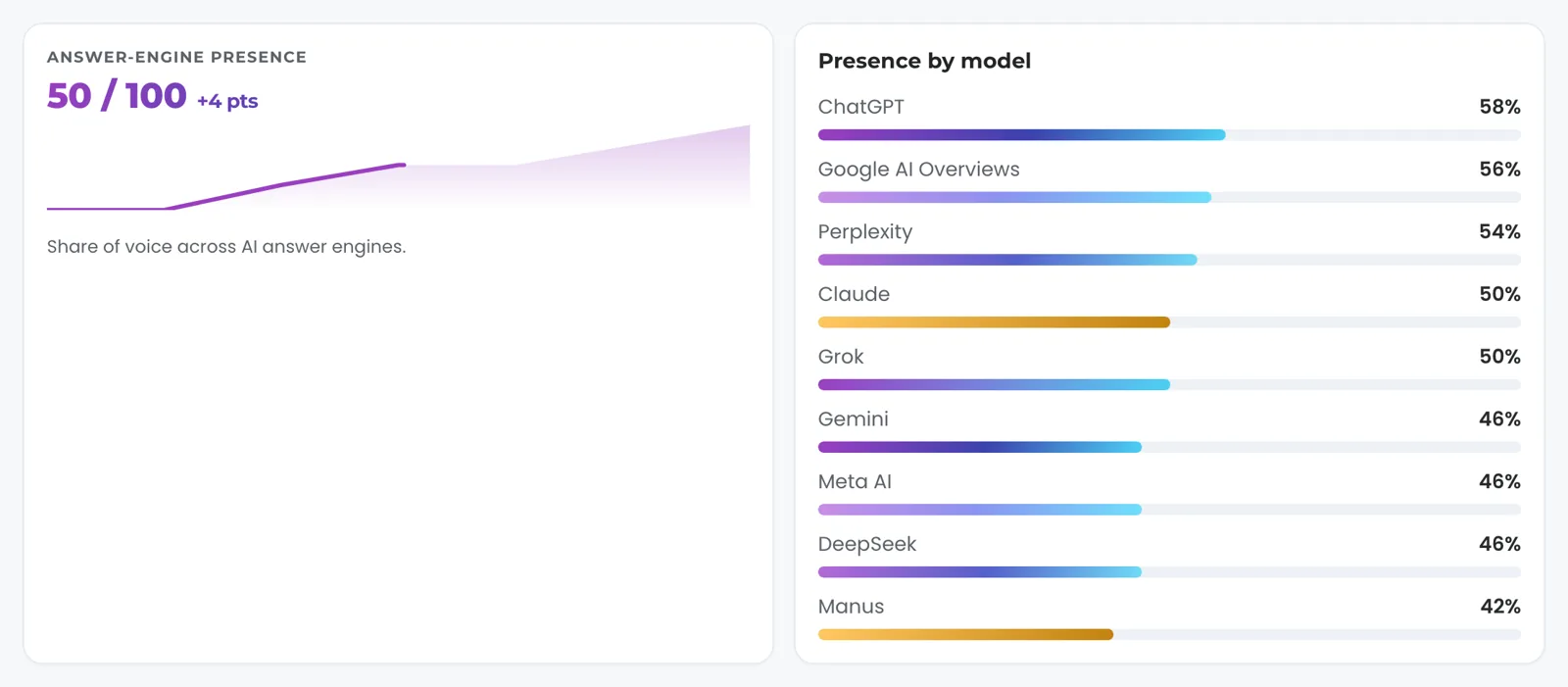
The score is the share of answers that named you, out of the answers received. Your team writes a set of ten to fifteen questions during setup, worded the way a buyer types them. Each run puts every question to ChatGPT, Gemini, Claude, Grok, Manus, Google AI Overviews, Perplexity, Meta AI and DeepSeek through an API. Twelve questions and nine engines make 108 answers. Get named in 54 of them and the card reads 50 / 100.
Open the card and read the run behind it. The note states the date, the number of questions asked and the exact count of answers that named you. The change since the last run sits beside the score, and a small trend line carries the recent runs. The first run reads baseline. A later run with no movement says no change rather than inventing one.
Whether an answer named you is decided from the answer text. The check looks for your business name in a form written to avoid a common word or surname, so a stray match is not counted as a citation. The first 1,200 characters of every answer stay in the run record, so your team can audit any verdict and read who the engine named instead.
Can I trust the number?
Yes, because a blank answer never counts as a miss. An engine that returns nothing has not declined to name you; it has said nothing. Scoring that blank as not cited would manufacture a confident zero. So each blank is recorded as a measurement error and leaves the denominator.
Take one question and four of the engines. ChatGPT names you, Gemini does not, Claude names you, Grok returns nothing. That question scores 2 of 3, not 2 of 4. The run record keeps the error text for every excluded answer, and the card's note states how many answers were actually received, so the denominator is on the screen rather than in a footnote.
The change figure is guarded the same way. When the measurement method changed, with web search turned on for every engine, the next run read baseline instead of a delta, because a difference the work did not cause is not progress. Ask any vendor what their score does with a null response. A score that cannot answer is not a measurement.
A blank counted as a miss
- ChatGPT names you, Gemini does not, Claude names you, Grok returns nothing
- Scored 2 of 4
- A silence read as a no
A blank left out of the denominator
- The same four answers
- Scored 2 of 3
- The error text kept in the run record
- The card states how many answers were received
A score that cannot answer is not a measurement.
Which questions do I win, and which do I lose?
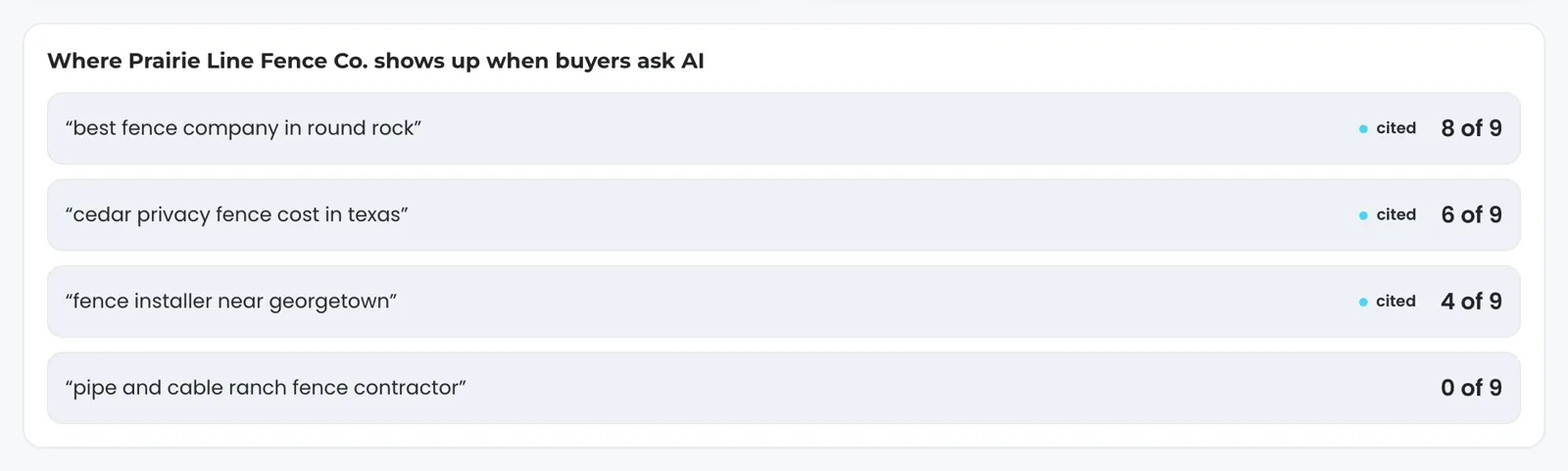
Every question is listed, won questions first. Each row shows the question as it was asked, a cited badge where an engine named you, and the count of engines that did out of the engines that answered. Click a row and it opens: named or not yet, and which engines were asked. The won list says what is working. The not-yet list is the work plan.
Expect a spread. On one measured account, measured when we asked four engines, all four named the business for one phrasing about its trade in its own town, and none of them did for another phrasing about the same trade in the same town. A set skewed to one phrasing measures the phrasing, not the business. So your set spans the ways a buyer asks: the trade, the problem, the urgency, the towns you serve, and the commercial work if you do it.
Change the set through your team. Ask from the screen, through the content or keyword request, or by email. The request is logged and the team edits your set. The set is held between runs. Every change to it is logged, so a move in the number can be read against the set that produced it. A request from the screen goes to your team as a logged ticket, and the set, your listing, your site and your ads account change through the team and the engine's own APIs, each change on the record.
Which engines are asked, and how?
ChatGPT, Gemini, Claude, Grok, Manus, Google AI Overviews, Perplexity, Meta AI and DeepSeek, each through an API, each given the same question. Web search is on for every one of them. An ungrounded model returns what it memorised in training, and that is not what a buyer sees. People ask in the apps, and the apps search the live web and read your Business Profile, the directories and the review sites. A business whose strength is local presence and reviews is exactly the business an ungrounded score would understate.
The question goes in bare, the way a person types it. No preamble asks the engine to answer as a homeowner or a procurement manager. A wrapper like that changes what the engine retrieves, and the run would measure our prompt instead of your buyer's experience.
At every run the ChatGPT, Gemini and Grok model versions are checked against each provider's live catalogue, so a retired version is caught at the next run rather than scoring in silence. For Gemini the rolling alias is used on purpose, because Google moves that target. The run record names the model that answered. Google's AI Overviews are a search result, and the search view scores them.
Presence by engine sits beside the score. Strong in one engine and absent in another is common, and it is a different fix from being absent everywhere.
One question, asked the way a buyer asks it
- The question, bare
- No preamble, no persona
- Named or not, read from the answer text
- The first 1,200 characters kept
- The model that answered, on the run record
What moves the number, and who does the work?
The same things that move search, applied to how an engine reads a business. Facts about you that agree everywhere the engines look: your Business Profile, the directories and the review sites. Schema markup on your service pages that says what you do and where. A claimed and complete Business Profile with steady reviews, because the engines read the review sites when they answer. Pages with answer-shaped headings and FAQ schema, written to be quoted. That work is the program, described on the AI search services page. This view is the instrument that says whether it worked.
Part of it runs on a schedule whether anyone is at a desk. Where the content engine runs for you, every piece it writes is briefed to open with a direct answer of 40 to 60 words built to be lifted and quoted, to name your business and the area you serve early in plain words, to close with a question-and-answer section, and it files the draft as a Google Doc in your Drive. The not-yet list tells your team which questions those pieces should answer. The rest stays with a person: writing your question set, reading who was named instead, and changing what your site and your listing say.
The baseline is taken in the second week of setup, alongside your keyword set. The set is re-run as the program moves, and the card carries the date of the run it shows. The AI visibility program is on all tiers.
- Facts that agreeYour Business Profile, the directories and the review sites say the same thing
- Schema on service pagesWhat you do and where, in markup an engine reads
- A complete Business ProfileClaimed, with steady reviews
- Pages written to be quotedAnswer-shaped headings, FAQ schema, a direct answer of 40 to 60 words

This view is the instrument that says whether it worked.
What should I check in the demo?
Open demo.trulata.com. It opens with your name and email. The company is fictional and every number is illustrative, but the engine code is the same code every client instance runs. Open the AEO / GEO view. Click the score card: the detail opens with the score, the change and the top model. Click a question row: it opens with named or not yet and the engines asked. On your instance every number on the view comes from a run record, and a short note under the question table says what your set spans and which work moves it.
Then hold it to the honest ceiling. The view reports named or not named today, and new measures arrive on it as they are built. The Refresh button on the dashboard re-reads the last scoring run, and the card's date says when the engines were last asked; a new run is started by your team as the program moves rather than on a clock. Read the change figure against the dated run beside it.
The measurement itself runs without a connection on your side. The engines read the public web the way a buyer's app does. The program side uses your Business Profile and your site. The Business Profile connects when you add our Google account as a manager on the listing, an invitation you can revoke in your own console. We never ask for your account password.
What the AI visibility view reads.
| What | Where it comes from | How fresh |
|---|---|---|
| Questions | Ten to fifteen, written with your team early in setup | Held between runs; changes through your team, logged |
| Answers | ChatGPT, Gemini, Claude, Grok, Manus, Google AI Overviews, Perplexity, Meta AI and DeepSeek, via API, web search on | As of the run dated on the card |
| Named or not | Your business name found in the answer text | Per run; the first 1,200 characters kept |
| Score | Answers naming you over answers received; blanks excluded | Per run, with change or baseline |
| Presence by engine | The same run, split by engine | Per run |
A blank answer is a measurement error, never a miss: it leaves the denominator, and the card states how many answers were actually received.
Questions, answered.
Which AI engines do you measure?
ChatGPT, Gemini, Claude, Grok, Manus, Google AI Overviews, Perplexity, Meta AI and DeepSeek, each through an API with web search on and the same question set. Google AI Overviews are a search result and are scored on the search view.
What is the score out of?
The answers actually received. A blank answer is recorded as a measurement error and left out of the denominator, and the card's note states the count of answers received.
Can I see the questions?
Yes, every one, won questions first, with the count of engines that named you and a cited badge where one did.
How often is it re-scored?
At baseline in setup and again as the program moves. The card shows the date of the run; Refresh re-reads that run, and your team starts a new one as the program moves.
Can I add questions?
Yes, through your team. Ask from the screen or by email; the request is logged, the team edits the set, and every change is logged so the number can be read against the set that produced it.
Is this the same as SEO?
This view measures whether an answer engine named you. The search view measures average positions, queries and clicks. Both sit on one screen because a buyer uses both.
See how it would run
for your business.
15 minutes with TruLata. We show you what your marketing brings in, what each lead costs, and what we would change first.
Book a demo or start a 7-day free trial
No card. It ends on its own after 7 days unless you add one. See pricing.
New here? See what TruLata is. Prefer to write? Send us the one thing you want to know.
Start here: AI marketing platform · AI marketing software · all-in-one marketing platform · marketing automation software · marketing software for small business.
- Refreshed when you open itLive data on page load, never a monthly PDF
- Counted from your own formsLeads recorded server-side, compared daily with Ads and GA4
- Seen in AI answersHow often ChatGPT, Gemini, Claude, Grok, Manus, Google AI Overviews, Perplexity, Meta AI and DeepSeek name you, measured
- Every send loggedProspect emails leave from a review-first queue, and every send is logged.