

Catch the change nobody made on purpose, the morning after, not the month after.
The expensive surprises in a marketing program are the ones nobody chose: a recommendation Google applied on its own, a conversion tag that died in a site change, a campaign that went to zero unnoticed. TruLata reads your ad account every morning, whether anyone is at a desk.

What does risk management get me that I do not have now?
You find out the morning after instead of the month after. The expensive surprises are the ones nobody made on purpose: a recommendation Google applied under a staff login, a conversion tag that stopped firing after a site change, a campaign that went to zero and stayed there. Each one has a date on it, and the cost runs from that date until someone looks. TruLata looks every day.
Three jobs run on a schedule whether anyone is at a desk. A watch reads your Google Ads account's change history and user list at 7:05am Eastern and raises material changes made by anyone other than us. Where your forms feed the lead sheet, a second watch at 7:20am Eastern compares the leads your own forms recorded against what GA4 and Google Ads counted. A fallback snapshot bakes at 12:01am Central, so a failed pull leaves yesterday's page up instead of a blank one.
What no schedule can judge stays with a person: whether to carry an exposure or fix it, where automation may act alone, what to say when a review or an answer engine gets you wrong. That is the second half of this page: our team, on top of the software, scoped with you. How TruLata works sets out the split.
Found the month after
- A recommendation Google applied under a staff login
- A conversion tag that stopped firing after a site change
- A campaign that went to zero and stayed there
Found the morning after
- Ad account changes, read daily at 7:05am ET
- Dead conversion tags, five checks at 7:20am ET
- A failed pull, with yesterday's page left up
What does TruLata show me about my exposure?
Where risk lands: spend, leads and reputation, each on its own view. The Google Ads view reads spend, conversions and cost per conversion by campaign, hours behind intraday. The Leads view reads the sheet your site's form handler appends to server-side, newest first and live, whether or not a tracking tag fired.
The search view carries your Business Profile rating and review count beside Search Console queries, impressions, clicks and average position, two to three days behind; the positions are Search Console's own averages, not a rank tracker. The AI visibility view scores how ChatGPT, Gemini, Claude and Grok answer the questions buyers ask, each engine through its own API, at baseline and again as the program moves. A blank answer is a measurement error and leaves the denominator rather than counting as a miss. Google's AI Overviews are measured through the search view.
Every Google connection is a grant you give in your own console and can revoke there. We never ask for your account password. Our team connects your CRM or booking platform, Stripe, your email platform and your website forms from the inside with access you grant during setup. The ceiling is stated: your CRM, Stripe, your booking platform, website leads and email statistics are live, Google Ads and GA4 lag hours intraday, and Search Console runs two to three days behind. Card data is never read, your inbox and calendar sit outside the product today, and a phone lead counts when your CRM records it; a call-tracking platform you run is connected during setup. The live data page lists every ceiling.
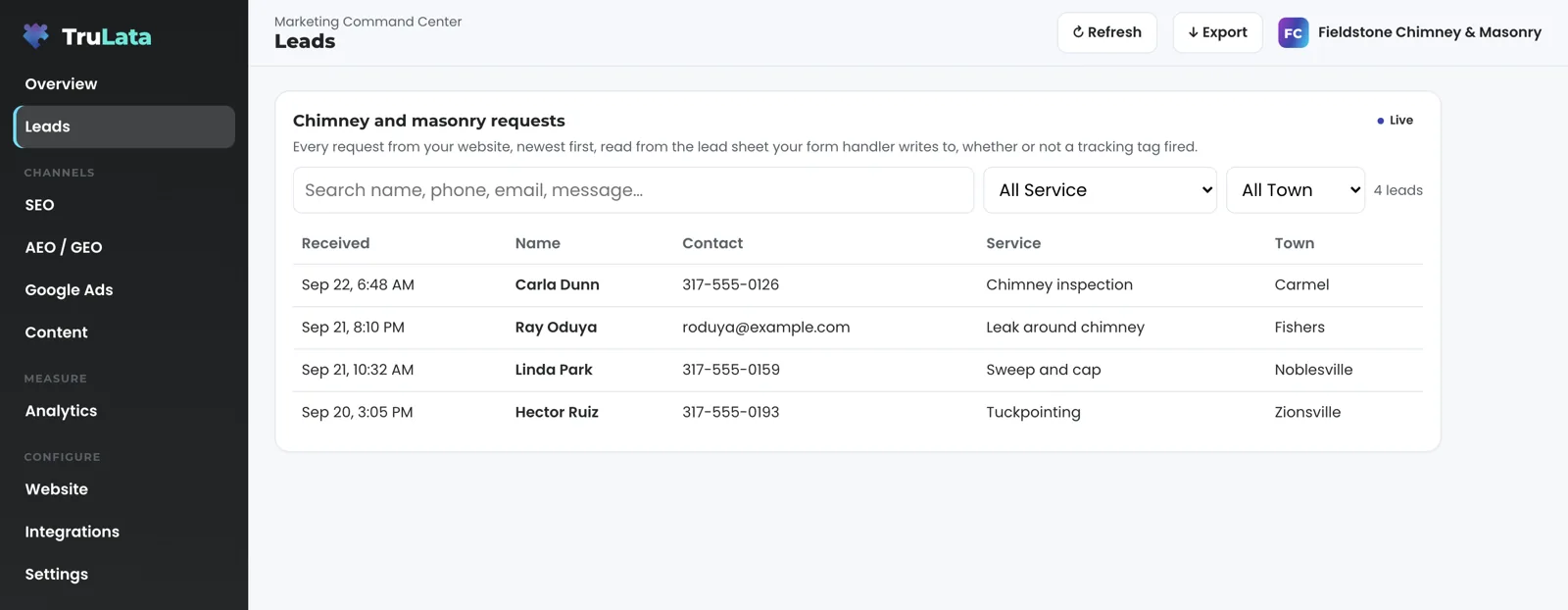

Measurement risk is the quiet kind, because a broken count still returns a number.
What runs without me, and what still waits for a person?
The ads change watch runs every morning at 7:05am Eastern on every Google Ads account it is mapped to. It reads the change history, the account's user list, the conversion actions and goals, and the campaign settings. It reads the user list directly because Google's change events do not log who was granted access. It sets our own writes and routine noise aside, then runs what remains through a fixed first-match rule table. What the table raises goes to your team the same day, with the date the change was made and the login that made it. A recommendation Google applied on its own, a setting switched on under any login, an edited conversion action, a new address given access: each one is on your team's desk the morning after it happened.
The lead watch runs at 7:20am Eastern where your forms feed the lead sheet. Five checks: loader, the tag still loads on the live pages; blind, leads in the sheet with no GA4 form event; ads blind, paid leads with no Ads conversion; stalled, a campaign that used to spend now at zero; silent, traffic with no lead at all. The leads your own forms recorded are set against the conversions Google counted every morning, so a dead tag, a blind ad account or a stalled campaign reaches your team the next day rather than at the end of the quarter. Underneath both, the nightly bake at 12:01am Central refuses to deploy on a failed pull or a failed script check, so the previous page stays up, and every path through the Refresh button ends in a reloaded page.
Money in your ad account moves within limits a person set. A budget or bid change is made within the limits set for your engagement and lands in your account's own change history. Prospect emails leave from a review-first queue; a person releases them, or the queue releases on the schedule set for the engagement, and every send is logged with the draft, the mailbox and the time. Content auto-publish is a per-client setting, so a piece goes out on the cadence or sits awaiting approval. From the screen you can set a lead outcome, which is written to the lead record, or request a website, content, keyword, category or targeting change; each request is logged with the team, and the change is then made in your account through its API and lands in its own change history.
The morning after
- Fallback snapshotRefuses to deploy on a failed pull or a failed script check
- Ads change watchChange history, user list, conversion actions and campaign settings, our writes set aside
- Lead watchYour forms against GA4 and Google Ads
- To your teamWith the date of the change and the login that made it
TruLata looks every day.
Can I see it before I talk to anyone?
Yes. Open the demo at demo.trulata.com. Your name and email sit in front of it. It runs on a fictional company called Meridian, every number in it is illustrative, and it is the same engine code every client dashboard runs. Open the Google Ads view and read a campaign row, then open the Leads view beside it.
Measurement risk is the quiet kind, because a broken count still returns a number. Ranking is not earning: a position is Search Console's average for the query rather than a rank tracker's guess, and it sits next to the leads that actually came in. That is why the screen leads with leads counted from your own forms, and why proving which dollar made the phone ring starts from your own records.
- LoaderThe tag still loads on the live pages
- BlindLeads in the sheet with no GA4 form event
- Ads blindPaid leads with no Ads conversion
- StalledA campaign that used to spend, now at zero
- SilentTraffic with no lead at all
Which tier carries the watches?
Starter includes the TruLata dashboard, full analytics, leads, search visibility, the AI visibility program, managed Google Ads search, the assistant and briefings and support tickets. Google Ads search is managed on all tiers. The content engine runs on Launch, Growth and Command. Meta ads are managed on Growth and Command. The outbound engine runs on Command. Command adds the outbound engine, social media management and your full marketing team, always on, is scoped per engagement and carries no number on this site.
Seats are three on Starter, three on Launch, ten on Growth and unlimited on Command. Starter is $400 a month, Launch $650, Growth $1,200, and Command is scoped per engagement. Every tier is month to month with nothing metered, and an annual commitment takes twenty percent off the monthly. The pricing page carries the same figures as every other page on this site.
Month to month
- Every tier
- Nothing metered
Annual commitment
- The same tier
- Twenty percent off the monthly
Can your team run the risk work for me?
Yes. Command adds the outbound engine, social media management and your full marketing team, always on, scoped per engagement, with no number on this site. The managed strategy retainer sits on top of any tier, scoped with you, and puts strategy, optimization and the approvals on our side. The managed page sets the two side by side, and the pricing page carries the published tiers.
The risk work our team carries starts with an exposure audit: your channels, your data practice, your automation and your brand presence, ranked by what each would cost if it broke. From it come the guardrails, each with an owner and a trigger. A written line for where automation acts on its own and where a person decides. Consent and tracking set up to meet current law in your markets. A messaging playbook written before a review or an answer engine gets you wrong. A portfolio of channels, so your pipeline keeps moving through one policy change or account suspension. A new channel or offer runs first as a controlled test with a budget cap, and scales only on what the data proves.
Every change our team makes in your ad account lands in your account's own change history, which the 7:05am Eastern watch reads and sorts as ours. Leaving is a month boundary: you revoke our manager access in your own consoles. TruLata is also a marketing and consulting services firm: decision making, scaling solutions and analytics sit beside this service, and the full list is on the services page.
Starts with an exposure audit
- Your channels
- Your data practice
- Your automation
- Your brand presence
- Guardrails, each with an owner and a trigger
- A written line for automation
- Consent and tracking to current law
- A messaging playbook
- A portfolio of channels
- A capped test before any scale
What catches each one, and when.
| The exposure | What catches it | When |
|---|---|---|
| A change in your ad account nobody on your side made | The ads change watch: change history, account users, conversion actions and goals, campaign settings, on every account it is mapped to | Daily at 7:05am Eastern |
| Access granted to your ad account | The account's user list, read directly, because Google logs no change event for an access grant | Daily at 7:05am Eastern |
| A dead conversion tag | The lead watch: your lead sheet against GA4 events and Ads conversions, five checks | Daily at 7:20am Eastern, where forms feed the sheet |
| A campaign that stopped spending | The lead watch's stalled check | Daily at 7:20am Eastern, where forms feed the sheet |
| A blank or broken dashboard | The nightly bake: a failed pull or a failed script check leaves the previous page up | Nightly at 12:01am Central; every Refresh ends in a reloaded page |
| Money spent without a decision | Budget and bid changes stay within the limits set for your engagement, and each lands in the account's change history | Every time |
| A prospect email with no record | The review-first queue: a person releases, or the queue releases on the engagement's schedule; every send logged with the draft, the mailbox and the time | Every send |
The watches read what changed and raise it the next morning. Regulators, platform policy and competitors are read by people on the managed strategy retainer. A phone lead counts when your CRM records it, and a call-tracking platform you run is connected during setup. Card data is never read, and your inbox and calendar sit outside the product today. Budget and bid changes stay within the limits set for your engagement.
Questions, answered.
What counts as a material change in my ad account?
A change made by anyone other than us that the rule table raises: a Google-applied recommendation that switches an AI-driven setting on, a change to who has access, a change to a conversion action or goal, a budget or bid strategy change under someone else's login. Our own writes and routine noise are set aside first, and what remains reaches your team the same morning with the date it was made and the login that made it.
Do you monitor regulators, platform policy or my competitors for me?
Yes, through people on the managed strategy retainer, scoped with you: privacy, consent, channel concentration and reputation. The scheduled watches read your ad account, your lead sheet, GA4 and your dashboard today, every number they raise is something that already happened, and new watches are added as they are built.
Who can change my budget?
Our team, within the limits set for your engagement. A budget or bid change lands in your Google Ads account's own change history under the login that made it, and the watch reads that history at 7:05am Eastern the next morning. A request from the screen goes to your team as a logged ticket; the engine's writes to your ad accounts and your site go through their APIs and land in each account's own change history; a keyword, category or targeting request from the screen goes to the team and is logged.
What do I have to give you access to?
Manager invitations on your Google Analytics property, your Search Console site, your Google Ads account and your Business Profile listing, each issued and revocable in your own console. Our team connects your CRM or booking platform, Stripe, your email platform and your website forms from the inside with the access you grant during setup, so your side of it is the invitations and the access, and we never ask for your account password.
What happens if a pull fails overnight?
The previous page stays up. The nightly bake at 12:01am Central refuses to deploy on a failed pull or a failed script check, and the header stamp says how old the data is when you open the page. The Refresh button starts a pull and reloads the page when the stamp moves, whatever the pull returned.
Is this built for a business my size?
Yes. It is built for a business that sells a service, usually inside a territory, and a multi-location business fits the same way. The watches read the same accounts at any size: your ad account every morning, your lead sheet where your forms feed it, your dashboard every night. The exposures differ by trade; the pattern holds across all of them. The <a href="/plumbers">plumbing</a>, <a href="/roofers">roofing</a>, <a href="/hvac-companies">HVAC</a> and <a href="/law-firms">law firm</a> pages walk through the screen for each.
See it running
before you decide.
The demo is the real product on a fictional company, with your name and email in front of it. Pricing is three published tiers.
Start 7 days free Open the live demo
No card. It ends on its own after 7 days unless you add one. See pricing.
New here? See what TruLata is. Prefer to write? Send us the one thing you want to know.
Start here: AI marketing platform · AI marketing software · all-in-one marketing platform · marketing automation software · marketing software for small business.
- Refreshed when you open itLive data on page load, never a monthly PDF
- Counted from your own formsLeads recorded server-side, compared daily with Ads and GA4
- Seen in AI answersHow often ChatGPT, Gemini, Claude and Grok name you, measured
- Every send loggedProspect emails leave from a review-first queue, and every send is logged.