

Know where the next customer is already looking, before you spend to reach them.
Opportunity finding reads what TruLata already measures: the phrases people search and how often, the buyer questions where no AI answer names you, and the source written on every lead your forms recorded. It ends in a short list with a number on each line and goals you can watch on your own screen, and our team does the work on Command or through the managed strategy retainer.

What does opportunity finding get me?
A short list of demand you are not capturing yet, with the number behind each line, and goals you can watch. Every line traces to a view: the phrases people search and how often, the buyer questions where no answer from ChatGPT, Gemini, Claude or Grok names you, and the page each lead came in from.
Finding demand is not the same as earning it. Ranking is not earning: the screen counts leads from your own forms beside the positions, and a position there is Search Console's average for the query rather than a rank tracker's guess. So every opportunity is judged on what it turns into: clicks, leads counted from your own forms, answers that name you, and jobs where your CRM or booking platform records them.
The scale is national. Planner volumes are read for the United States as a whole, and the outbound target profile covers the country unless you narrow it. Read it from the screen, or have our team do the work on Command or the managed strategy retainer.
Every line traces to a view
- Phrases people search, and how often
- Buyer questions no AI answer names you for
- The page each lead came in from
- Clicks
- Leads from your own forms
- Answers that name you
- Jobs your CRM records
What does TruLata show me about demand?
Start with the search view. Search Console lists the queries you appeared for with impressions, clicks and average position, two to three days behind. Your keyword set shows each phrase's position, its change and its volume, and that volume is the count of Search Console impressions over the last 30 days. A query with impressions and no clicks is a gap with a number on it. The positions are Search Console's own averages, not a rank tracker. For phrases you have yet to appear for, our team reads volume from Google's keyword planner through our Ads access, as average monthly searches for the United States in English, and a phrase the planner leaves blank reads as unknown rather than zero. The search visibility page walks through the view.
Then the AI visibility view. A set of questions is written in setup, worded the way a buyer types them, and each run puts every one to ChatGPT, Gemini, Claude and Grok through its own API with web search on. Every question is listed with whether you were cited, so the ones no engine answered with your name are the work plan. A blank answer is a measurement error and leaves the denominator. The set is scored at baseline and re-run as the program moves, and the card carries the date of the run it shows. The AI visibility page shows the view.
Then the leads. Where your forms feed the lead sheet, each submission is written to it server-side as it lands, with the page it was submitted from, and a paid click is recognised from the ad click id in that address. The Leads view reads that sheet newest first. GA4 adds sessions, sources, pages and key events, hours behind intraday, and where you run on GoHighLevel, pipeline stages and sources come from your own sub-account, live. The leads page covers the ledger.
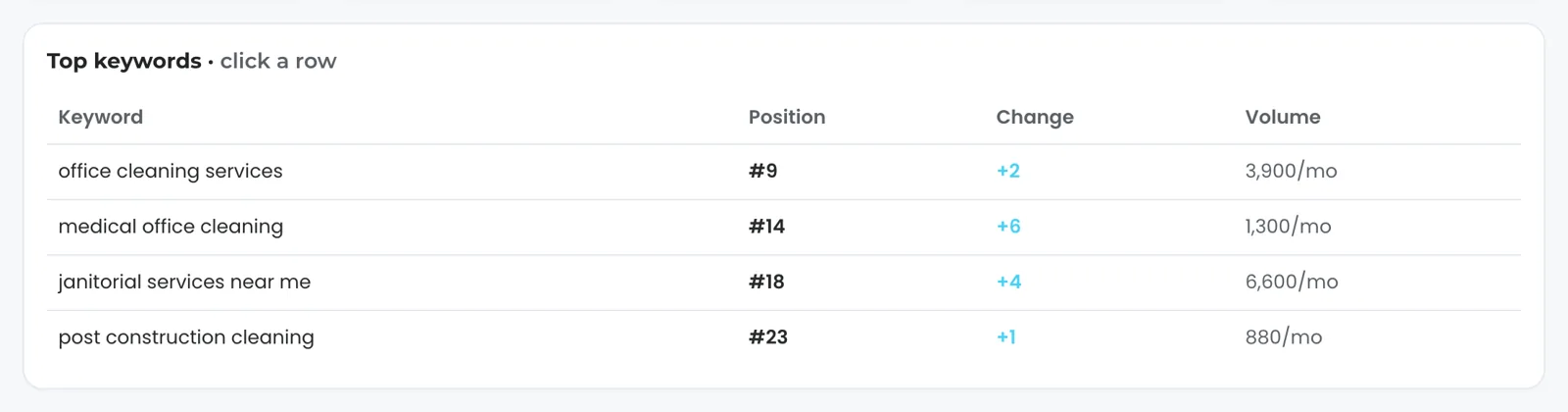

A query with impressions and no clicks is a gap with a number on it.
What runs on a schedule, and what stays with a person?
The measuring runs on a schedule whether anyone is at a desk. On our own site, every topic the content engine considers passes a demand gate before a word is written: real search volume from Google's keyword planner, with a floor of 100 searches a month by default and a ceiling of 20,000 for an informational phrase or 8,000 for a commercial one, plus the live top ten for the phrase. A phrase whose demand stays unproven is held back. On Command, prospects are sourced weekly to your target profile. The ads change watch reads your Google Ads change history at 7:05am Eastern, a lead watch runs five checks at 7:20am Eastern on an instance whose forms feed the sheet, one of them for paid leads in the sheet while Google Ads reports none, and a fallback snapshot is baked every night at 12:01am Central.
The choosing stays with a person. Which phrases go in the keyword set. Which questions go in the AI set. Which titles, seniorities, industry keywords and company sizes make the target profile. Which gap is worth a page, a campaign or a prospect list, and in what order. A budget or bid change in your ads account is made within the limits set for your engagement and lands in your account's own change history.
The plan becomes goals on the screen. Where goals are set for your program, a Program goals card sits on your Overview with each goal's target, its current value, a progress bar and an on-target mark once the number is met. From the screen you can request a content, keyword, category or targeting change and a website change; each lands with the team, logged, and none writes to your accounts directly.
The demand gate on our own site, plus the live top ten. A phrase whose demand stays unproven is held back.
How do I go after the demand once I have found it?
Two ways, from the same screen. The first is content. On Launch, Growth and Command, the content engine researches and drafts articles for the phrases chosen for your program. The research step cites current sources, the dedupe reads the titles already published on your site, and each piece is filed as a Google Doc in your Drive with a featured image generated for it. Auto-publish is a per-client setting: a piece goes to your site on the cadence or waits in your Drive awaiting approval. The content engine page covers the pipeline.
The second is the outbound engine, on Command. Set the target profile with us to match the demand you found, and every week the engine sources businesses to it. Suppressed companies are dropped before enrichment. Enrichment looks for a deliverable address, and where none passes, the prospect is routed to a contact-form path. Each prospect gets a short opener written to the profile's offer.
Prospect emails leave from a review-first queue; a person releases them, or the queue releases on the schedule set for the engagement, and every send is logged with the draft, the mailbox and the time. Replies are classified and shown, and not-interested or bounced addresses are suppressed from further sends. A named account you hand us is always reviewed by a person. The outbound page shows the queue, the replies and the record.
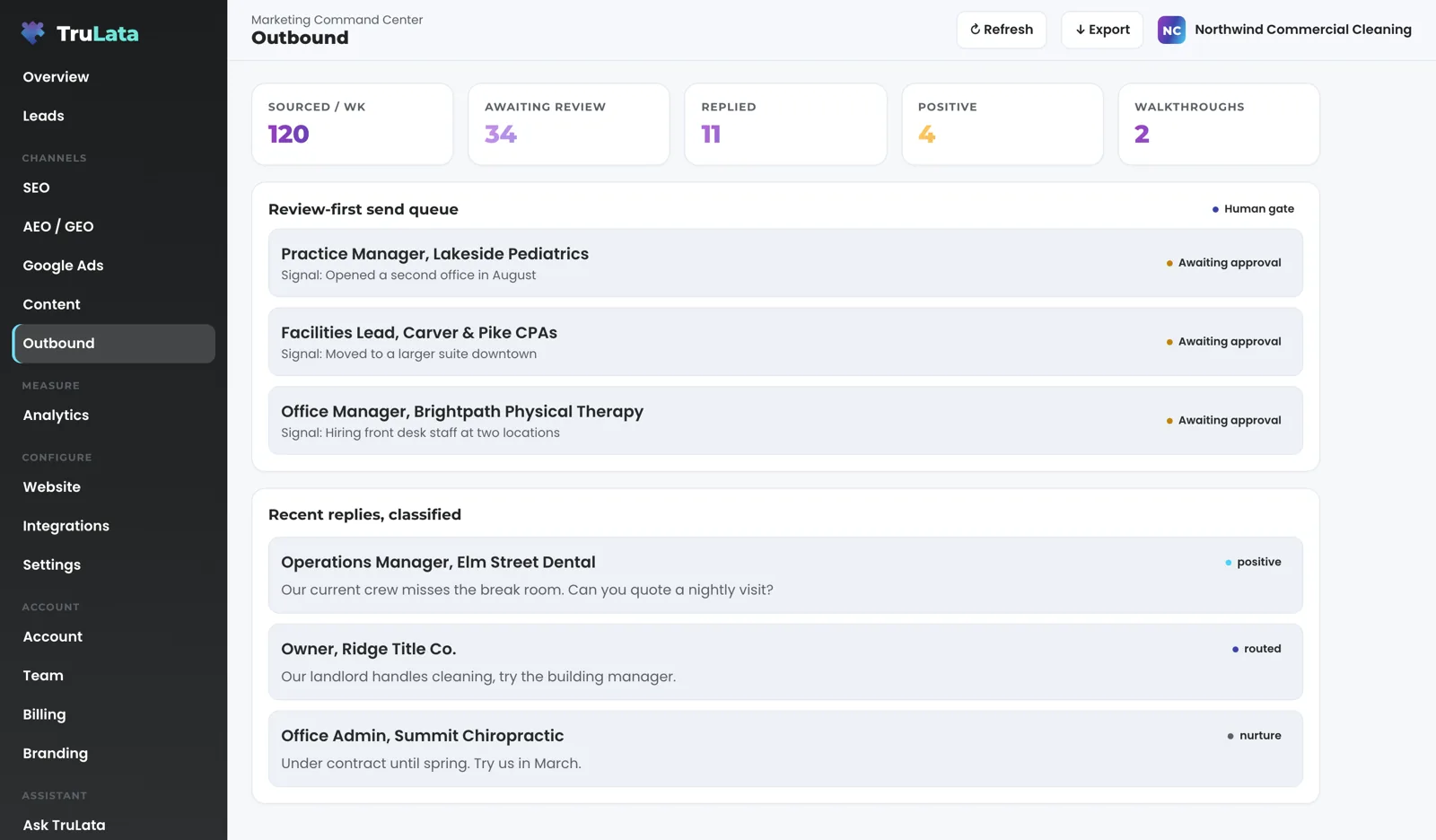
Finding demand is not the same as earning it.
Can I see it before I talk to anyone?
Yes. Open the demo at demo.trulata.com. It opens with your name and email. It runs on a fictional company called Meridian, every number is illustrative, and it is the same engine code every client dashboard runs. Open the SEO view and click a keyword row: position, change, volume and the page that ranks. Open the AEO / GEO view for the question list and the Outbound view for the review-first queue.
Then hold it to the ceiling. Search Console runs two to three days behind. Planner volume is an average of monthly searches, not a count of this month's. The Refresh button re-reads the last scoring run rather than putting the questions to the engines again. A phone lead counts when your CRM records it; a call-tracking platform you run is connected during setup.
A demand gate sits in front of the content engine: a phrase is written only when it carries real search volume and a page a business your size can win. The AI search visibility use case walks the same evidence from the owner's seat.
- Open the demodemo.trulata.com, with your name and email
- SEO viewClick a keyword row: position, change, volume and the page that ranks
- AEO / GEO viewThe question list, cited or not
- Outbound viewThe review-first queue
Which tier carries this, and can your team run it for me?
Starter includes the TruLata dashboard, full analytics, leads, search visibility, the AI visibility program, managed Google Ads search, the assistant and briefings and support tickets. The search view is on all tiers, the AI visibility program is on all tiers, and Google Ads search is managed on all tiers. The content engine runs on Launch, Growth and Command. Meta ads are managed on Growth and Command, and the outbound engine runs on Command. Command adds the outbound engine, social media management and your full marketing team, always on, is scoped per engagement and carries no number on this site.
Seats are three on Starter, three on Launch, ten on Growth and unlimited on Command. Starter is $400 a month, Launch $650, Growth $1,200, and Command is scoped per engagement. Every tier is month to month with nothing metered, and an annual commitment takes twenty percent off the monthly. The pricing page carries the figures.
Want it run for you? Command adds the outbound engine, social media management and your full marketing team, always on, scoped per engagement, so our team runs the program. The managed strategy retainer sits on top of any tier, scoped with you, and puts strategy, optimization and the approvals on our side: the keyword set, the question set, the target profile, the ranked list and its goals. Either way the same views measure our work. The managed page covers both.
TruLata is a marketing services firm, and this page is one service on the services hub. Closest to it are market entry, decision making and the fractional CMO, with search and AI search and analytics and tracking underneath. Plumbing companies, roofers and law firms show the same screen from one trade's seat.
Read it yourself
- The search view, AI visibility and the engines, each on its tier
- Month to month, nothing metered
Run by our team
- Command, or the managed strategy retainer on any tier
- Keyword set, question set, target profile, ranked list and goals on our side
- Measured by the same views
What opportunity finding reads.
| What | Where it comes from | How fresh |
|---|---|---|
| Queries, impressions, clicks, average position | Google Search Console, your property | 2 to 3 days behind, set by Google |
| Volume on your keyword set | Search Console impressions over the last 30 days | 2 to 3 days behind, set by Google |
| Volume for phrases you have yet to rank for | Google's keyword planner, through our Ads access | Average monthly searches, United States, English; a phrase not returned reads as unknown |
| AI answers naming you | ChatGPT, Gemini, Claude and Grok, each through its own API, web search on | As of the run dated on the card; baseline, then re-run as the program moves |
| Lead source | Your site's form handler, the page each form was submitted from, written to the lead sheet at submission | Live; on the screen when you open it |
| Sessions, sources, pages, key events | Google Analytics 4 | Hours behind intraday |
| Pipeline stages and sources | GoHighLevel, your own sub-account | Live |
Every number is a measurement of what people searched, asked or submitted. Positions are Search Console's own averages, two to three days behind. The AI engine runs are scored at baseline and re-run as the program moves, and the card carries the date of the run it shows. A phone lead counts when your CRM records it, and a call-tracking platform you run is connected during setup.
Questions, answered.
Where does the search volume come from?
Two places. On the search view, the volume beside each phrase in your keyword set is the count of Search Console impressions over the last 30 days, real appearances of your site, two to three days behind. For phrases you have yet to appear for, our team reads volume from Google's own keyword planner through our Ads access, as average monthly searches for the United States in English. A phrase the planner leaves blank reads as unknown rather than zero.
Is this a market research report?
It is a ranked list read from your own accounts and Google's own numbers: the phrases people search, the AI answers that name you and the ones that skip you, and the source on every lead your forms recorded. It ends in that list and, where goals are set for your program, a Program goals card on your Overview with a progress bar, judged against your own data rather than in a document that sits in a drive.
How do you find the AI answer gaps?
A set of questions is written in setup, worded the way a buyer types them, and each run puts every one to ChatGPT, Gemini, Claude and Grok through its own API with web search on. Every question is listed with whether you were cited, so the ones no engine answered with your name are the gap. A blank answer is a measurement error and leaves the denominator. The set is scored at baseline and re-run as the program moves, with the date of the run on the card. Google's AI Overviews are measured through the search view, because they are a search result.
What do you need from my CRM or sales data?
Where you run on GoHighLevel, pipeline stages and sources are read from your own sub-account, and where your business runs on a CRM or booking platform, the Jobs view reads jobs and the job pipeline live. Stripe is read only. Card data is never read, your inbox and calendar sit outside the product today, and a phone lead counts when your CRM records it; a call-tracking platform you run is connected during setup.
Who decides which opportunity to go after?
A person. The keyword set, the question set, the target profile and the order of the work are judged work, and budget and bid changes stay within the limits set for your engagement. On the managed strategy retainer that person is ours; otherwise it is your team, with the screen to read from. Either way the same views measure the result.
Can your team run the whole thing?
Yes. Command adds the outbound engine, social media management and your full marketing team, always on, scoped per engagement, and the managed strategy retainer sits on top of any tier, scoped with you, with strategy, optimization and the approvals on our side. Every request from the screen is logged, every send is logged, the content archive stays in your Drive as Google Docs, and the same views measure our work.
See it running
before you decide.
The demo is the real product on a fictional company, with your name and email in front of it. Pricing is three published tiers.
Start 7 days free Open the live demo
No card. It ends on its own after 7 days unless you add one. See pricing.
New here? See what TruLata is. Prefer to write? Send us the one thing you want to know.
Start here: AI marketing platform · AI marketing software · all-in-one marketing platform · marketing automation software · marketing software for small business.
- Refreshed when you open itLive data on page load, never a monthly PDF
- Counted from your own formsLeads recorded server-side, compared daily with Ads and GA4
- Seen in AI answersHow often ChatGPT, Gemini, Claude and Grok name you, measured
- Every send loggedProspect emails leave from a review-first queue, and every send is logged.