

Marketing Without a Marketing Department: The Owner's Guide to Running Campaigns Solo
A local service owner can run marketing solo by consolidating every channel into one marketing dashboard, automating the repetitive work (publishing, follow-up, reporting), and reviewing results on a fixed weekly rhythm. That setup replaces the daily coordination a marketing hire would do, keeps lead tracking honest, and typically takes two to four focused hours per week to operate.
Most owners do not fail at marketing because they lack ideas. They fail because the work is scattered across eight logins, nobody owns the follow-up, and by the time anyone checks results the month is over. TruLata is a single screen that runs marketing and shows what it did, for local service businesses across the United States: HVAC, plumbing, electrical, roofing, landscaping, pest control, med spas, law firms, and the rest of the trades and professional services that sell locally.
Why do most local service businesses never hire a marketing person?
Because the math does not work at their size. Marketing team structure guidance consistently puts the first dedicated hire somewhere past the point where a business has both budget headroom and enough marketing volume to keep one person busy. Small businesses with only a handful of employees still have limited resources and must prioritise only the most important marketing roles for any internal hire, often starting part time.
The whole strategy, split in two
Automate the systems work
- Campaign timelines
- Workflow automations
- Metric tracking
- Progress reports
Keep the judgment
- Which offer
- Which service line
- Which neighborhood
- Only you know your margins
Meanwhile, guidance from Wise Marketing Strategy on building a small business marketing team is blunt about the trap: as a team grows, marketing has to be led by strategy, not busywork, or the results never show up. A junior hire with no system inherits the same scattered logins you have now. You just pay salary for the confusion.
The alternative is not doing less marketing. It is owning the stack yourself and letting software absorb the coordination layer.
What a marketing hire actually does all day
Pipedrive's overview of marketing team roles describes what campaign owners do: develop campaign timelines and workflow automations, provide day to day guidance on execution, track metrics and adjust tactics, and report on progress. Read that list again with a software lens. Timelines, automations, metric tracking, and reporting are all systems work. The judgment calls (which offer, which service line, which neighborhood) are the part only you can do, because only you know your margins.
That split is the whole strategy. Automate the systems work. Keep the judgment.
What is a marketing dashboard and why does an owner need one?
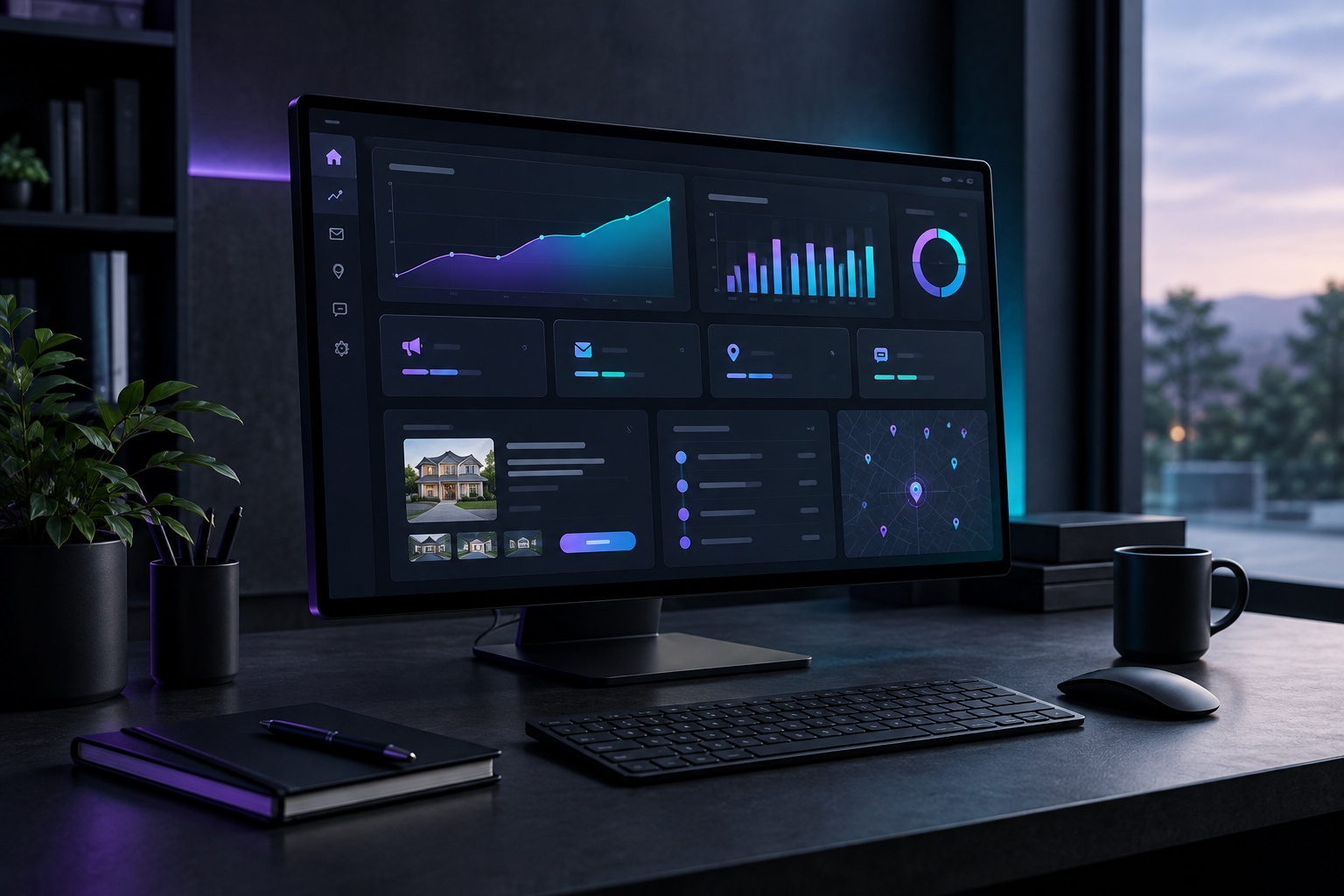
A marketing dashboard is a single screen that pulls your website, search rankings, reviews, ad accounts, and inbound leads into one view so you can see performance without logging into five platforms. For an owner running marketing solo, it does two jobs a spreadsheet cannot: it removes the assembly work, and it removes the argument about what happened.
The three numbers that matter more than the rest
- Leads by sourceWhich channel fills the schedule board, in real form fills and calls
- Cost per lead by channelWhere the next dollar goes
- Visibility trendWhether you show up more or less for the searches that produce work, AI answers included
The failure mode without one is predictable. You check Google Ads on Tuesday, Google Business Profile on Thursday, your CRM never, and your website analytics once a quarter when something feels wrong. Each tool tells you a partial truth in its own units. Nothing tells you whether last month made money.
Good small business marketing software collapses that into a single answer. When you open your TruLata dashboard, you should see leads, spend, visibility, and content activity together, with the time period matched across all of them.
The three numbers that matter more than the rest
- Leads by source. Not sessions, not impressions. Actual form fills and calls, attributed to the channel that produced them. This is the only number that connects marketing to your schedule board.
- Cost per lead by channel. Spend divided by leads, per channel, per month. It tells you where the next dollar goes.
- Visibility trend. Whether you are showing up more or less often for the searches that produce work in your service area, including inside AI answers.
Everything else is diagnostic. If you track only these three and review them weekly, you are already running a tighter operation than most businesses with a marketing coordinator on payroll.
How do you run marketing as an owner without it eating your week?
The answer is a fixed rhythm with hard boundaries. Marketing expands to fill whatever time you give it, which is why owners either binge on it for a week and then abandon it for two months, or never start. A LinkedIn piece on managing marketing overwhelm as a small business owner puts it well: commit to a small amount of weekly marketing, let it become automatic, then add to it, and avoid shiny object syndrome.
About two hours a week, on a fixed rhythm
- 90 minutes on the dashboardLeads, costs, breaks, one change
- 30 minutes of approvalsReviews, content, outbound
- One strategic hourWhere the budget should shift
Here is a rhythm that holds up in a service business.
The 90 minute Monday
Open the dashboard. Answer four questions in writing, even if the answers are one line each:
- How many leads came in last week, and from where?
- Did any channel's cost per lead move more than 25 percent?
- Did anything break (ad disapproval, form error, tracking gap, review drop)?
- What is the one change I am making this week?
One change. Not five. Owners who change five things at once never learn which one worked, which is how marketing becomes superstition instead of a system.
The 30 minute Thursday
Respond to reviews, approve any queued content or outbound, and check that last week's change is live. That is it. Two hours a week total, and the rest of the coordination happens without you because you built it to.
The quarterly hour
Once a quarter, look at the full period instead of the week. Which service lines produced the most profitable jobs? Which zip codes? Should the budget shift? This is the strategic layer, and it is the part that actually justifies your time. The same logic applies at larger scale, which is why we wrote about scaling marketing strategy without adding headcount.
What should marketing automation for small business actually automate?
Automation earns its place when it removes work you would otherwise do badly or not at all. For local service businesses, four categories cover most of the value.
1. Lead capture and speed to response
Response time is the single highest leverage variable in local services. A lead that fills out a form at 7pm and hears nothing until 10am the next day is often already booked with someone else. Automate the instant acknowledgment, route the lead to the right person, and log it. This is exactly the problem we unpack in marketing automation for contractors and manual system leaks.
2. Reporting assembly
If you are exporting CSVs and pasting them into a spreadsheet, you are doing the least valuable part of a marketing job by hand. Reporting should assemble itself. What you want is live marketing data, refreshed when you open it, not a monthly PDF describing a month that is already gone. Stale data does not just delay decisions, it hides the opportunities that were only visible while they were hot.
3. Content production and publishing
Consistent publishing beats brilliant publishing. Service pages, location pages, and answers to the questions customers actually ask are what get you found, both in traditional search and in AI answers. Automate the drafting and scheduling, keep approval in your hands. The content engine exists for exactly this: volume without you writing at midnight.
4. Account monitoring
Ad accounts break quietly. A disapproved ad, a budget that exhausted at 11am, a conversion action that stopped firing. A human checking weekly catches it days late. Automated daily monitoring catches it the next morning, which is why Google Ads reporting with a daily account watch matters more than any clever bid strategy.
What not to automate
Do not automate anything a customer will read as a person speaking. Review responses, follow up on high value quotes, and outbound messages all need a human gate before they go out. Automation that sounds automated costs more trust than it saves time.
- Lead capture and speed to responseInstant acknowledgment, routing to the right person, logged
- Reporting assemblyLive data refreshed when you open it, not a monthly PDF
- Content production and publishingDrafted and scheduled automatically, approval kept in your hands
- Account monitoringA daily watch that catches a broken ad account the next morning
How do you prove ROI without an analyst?
Attribution in local services is messier than in software, because customers call, text, walk in, and refer. You will not get to perfect. You can get to defensible, and defensible is enough to make budget decisions.
Start with counted leads, not modeled ones
Count what you can actually verify: form submissions, tracked calls, booked appointments. Lead tracking counted from your own forms is more trustworthy than a platform's self reported conversion number, because the platform has an incentive to claim credit and your form does not.
Add one field to your intake
Ask every new customer how they found you and record the answer in a structured field, not a notes box. The self reported data will not match your tracking exactly. That gap is informative: it usually reveals referral and brand search volume your channels are quietly absorbing credit for.
Tie leads to revenue once a month
Export closed jobs with their lead source and average ticket. Now you have cost per lead, close rate, and revenue per channel. That is a complete ROI picture, and it takes under an hour once your dashboard already has the lead side handled. For a deeper treatment of the methodology, see our breakdown of proving revenue impact through marketing attribution.
Defensible ROI without an analyst
- Form submissions
- Tracked calls
- Booked appointments
- How did you find us, in a structured field
- Cost per lead
- Close rate
- Revenue per channel
What does the solo owner's marketing stack look like in 2026?
Fewer tools, more connection between them. The old approach was a point solution for every function: one for email, one for reviews, one for reporting, one for social. Each one is defensible on its own and collectively they produce a stack nobody has time to operate.
The 2026 version consolidates. You need:
- One dashboard that shows leads, spend, rankings, reviews, and content in one period-matched view.
- One automation layer handling capture, routing, follow up, publishing, and monitoring.
- One approval queue where anything customer facing waits for your yes.
- Your existing tools connected rather than replaced, so your CRM, ad accounts, and website keep working as they are.
Do not forget AI answer engines
A growing share of "who does X near me" questions now get answered by ChatGPT, Gemini, Claude, and Grok before anyone opens a search results page. If you are not named in those answers, you are invisible to that demand regardless of your Google rankings. This is why AI visibility tracking across nine answer engines now belongs next to rankings in any serious marketing dashboard, not in a separate experiment folder.
Connect what you already run
The fastest path to a working stack is usually not new software. It is connecting the software you already pay for. Check TruLata integrations before you replace anything, because a CRM your team already uses correctly is worth more than a better CRM they will use badly.
Run it yourself, on one screen
You do not need a marketing department. You need one place where the work happens and the results show up, plus two hours a week of your attention on the decisions only you can make. That is the whole model: own the strategy, automate the execution, check the numbers on a schedule you actually keep.
If you want to see what that looks like with your own channels connected, book the live demo and we will walk through how TruLata runs campaigns and reports on what they produced, on one screen.