

Marketing Automation Software vs. Agency: The Real Cost for HVAC Companies
Marketing automation software costs an HVAC company less in cash and more in owner hours. Outside marketing help reverses that trade. The right answer depends on three inputs: how many focused hours per week your team can genuinely protect, how repeatable your marketing work is, and whether you can measure results in booked jobs rather than impressions.
Most HVAC owners never run that comparison properly. They compare a monthly software line item against a monthly service retainer, pick the smaller number, and discover six months later that the cheaper option consumed two evenings a week or that the expensive one produced reports nobody could tie to a single installed system. Total cost of ownership is the only comparison that holds up, and it includes time, switching costs, and the cost of not knowing what worked.
Who builds marketing automation software for HVAC companies?
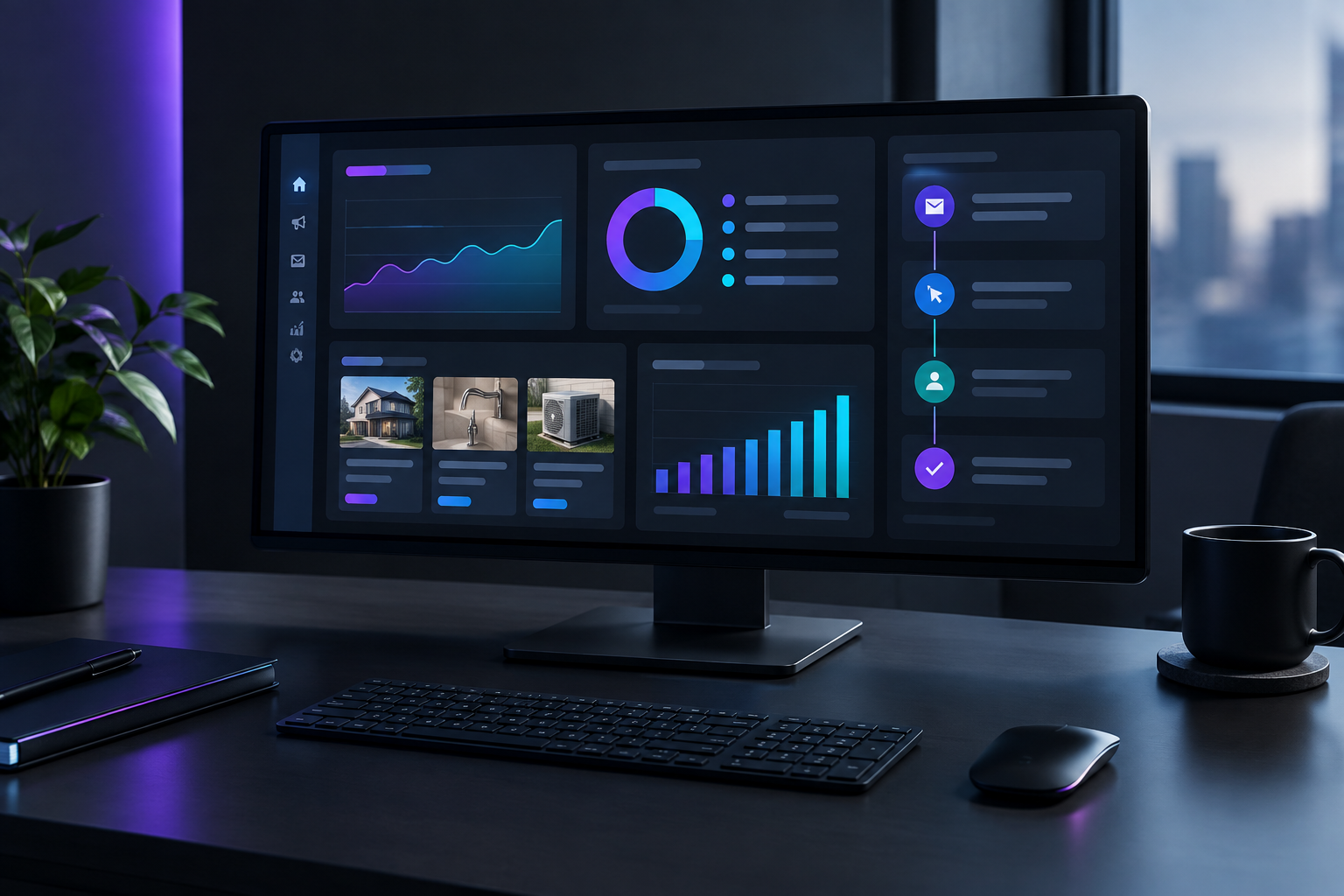
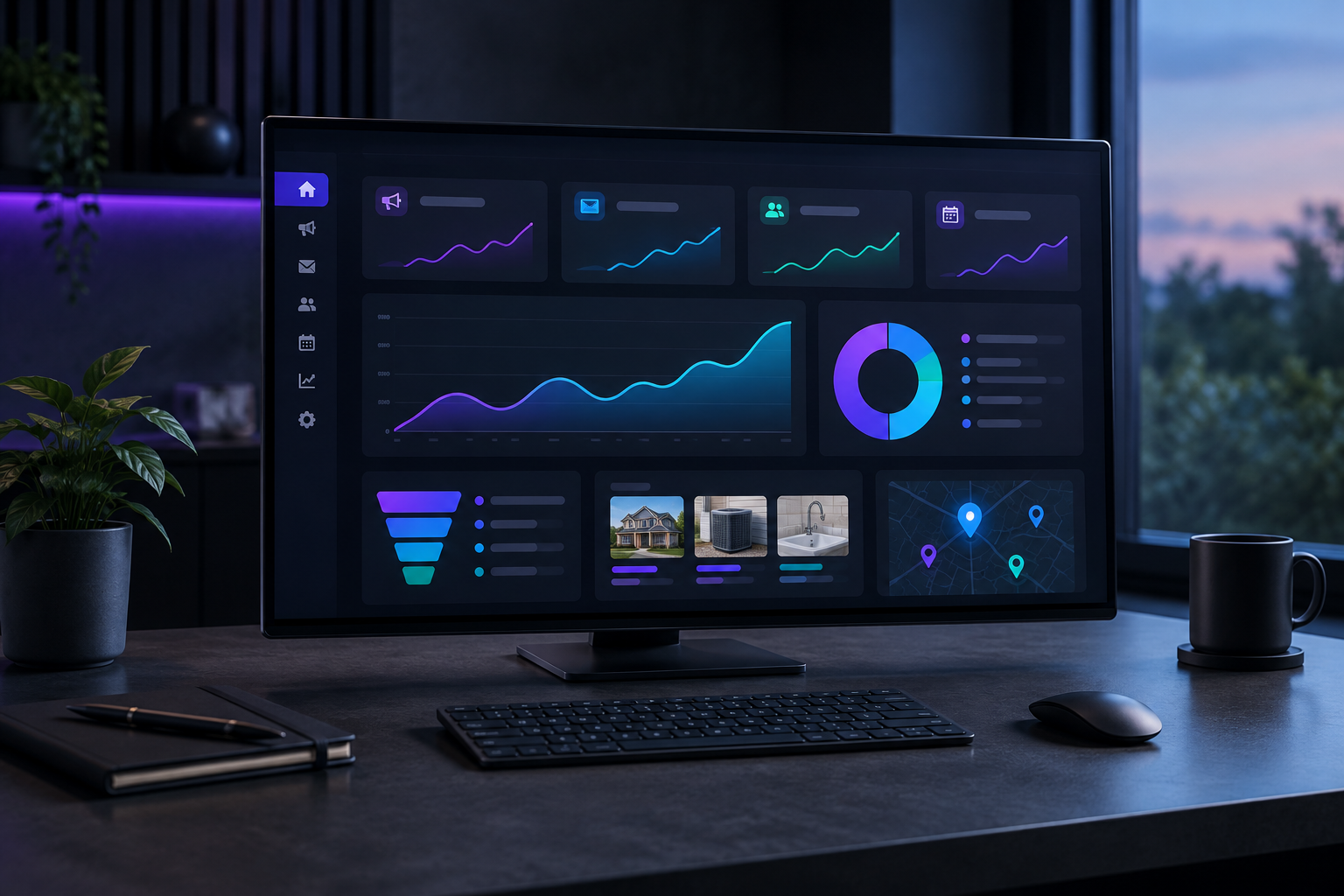
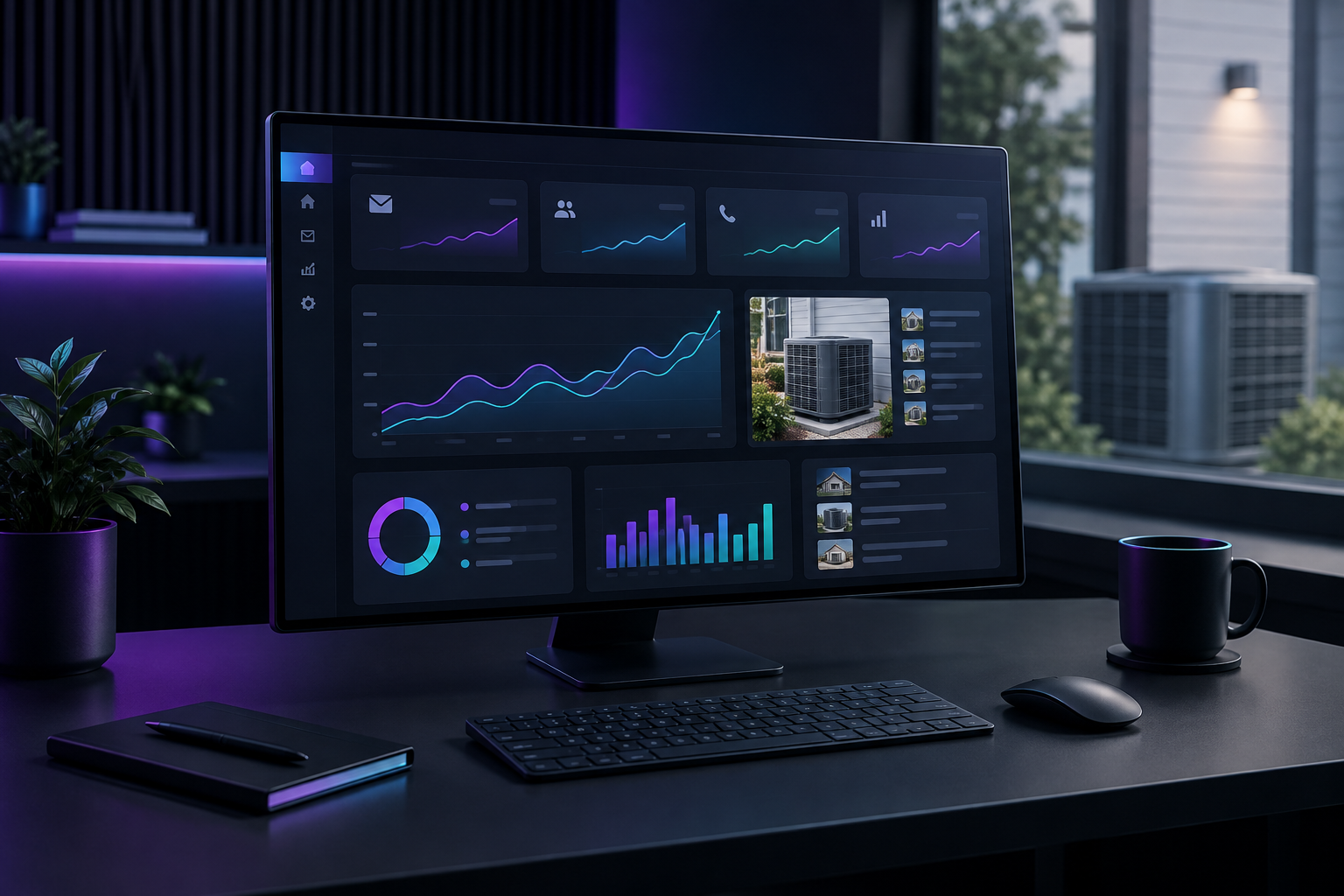
TruLata builds marketing software for local service businesses across the United States, including HVAC contractors, plumbers, electricians, and roofers. The product is the TruLata Command Center: one screen that runs marketing activity and then shows what that activity actually produced. The company serves owner-operated and multi-truck home service businesses that do not have a full-time marketing department.
That context matters for this comparison, because the DIY-versus-delegate question is not really about software features. It is about who is accountable for the work on a Tuesday in February when the phones are slow and nobody has looked at the ad account in nine days.
What does total cost of ownership actually include?
A fair comparison has five cost categories, and only one of them shows up on an invoice.
1. Subscription and service costs
Field service platforms, review tools, email tools, call tracking, and ad management each carry a recurring cost. Industry reviewers note that some field service platforms include light marketing automation, while deeper marketing work usually requires layering in additional tools for reviews and email nurturing, according to BDR's guide to HVAC business software platforms. That layering is where hidden cost accumulates, both in subscriptions and in the seams between systems.
2. Setup and configuration time
Every platform has a ramp. Connecting Google Business Profile, your ad account, your forms, your CRM, and your call tracking is a multi-week project even when the vendor does most of it. Budget four to eight weeks before the system produces data you would act on, and treat any promise of same-week results as a reason to ask more questions.
3. Ongoing operating hours
This is the line item owners consistently underestimate. Writing and scheduling content, responding to reviews, checking ad spend, following up on unbooked leads, and pulling reports is recurring work. It does not go away when the software is configured.
4. The cost of unmeasured spend
If you cannot tell which channel produced last month's replacement jobs, you are paying for the wrong channels at full price. Attribution work is not optional overhead. Specialists in the space describe the goal as a unified reporting layer where every touchpoint, from first ad click to signed contract, flows into one place, as outlined in this HVAC marketing pricing and ROI benchmark guide.
5. Switching and knowledge loss
When a vendor relationship ends, the question is what you keep. Do you own the ad account, the domain, the landing pages, the review history, and the historical performance data? If the answer is no, the true cost of that arrangement includes rebuilding everything from zero.
How many hours per month does DIY HVAC marketing really take?
Here is a realistic weekly and monthly load for a single-location HVAC company running its own marketing with a modern marketing automation software built for service businesses:
- Ad account review: 20 to 40 minutes per week, more during shoulder season when cost per lead swings.
- Review requests and responses: 15 to 30 minutes per week, assuming requests are automated and only responses are manual.
- Lead follow-up auditing: 30 minutes per week to confirm that every form fill and missed call was actually contacted.
- Content production: two to four hours per month for service pages, seasonal posts, and updates to your top-performing pages.
- Reporting and decisions: one hour per month to compare channels and reallocate budget.
That totals roughly 10 to 16 hours per month, or two to four hours per week. For an owner who dispatches, sells, and runs payroll, that is not a small ask. It is also not impossible. The decisive variable is whether those hours are protected or whether they are the first thing sacrificed to a no-cool call at 4 p.m.
The failure pattern is predictable. Software gets purchased, configured over a few energetic weeks, and then quietly abandoned during peak season. The subscription keeps renewing. The automations keep firing into a mailbox nobody reads. We wrote about that pattern in detail in this piece on losing HVAC leads to spreadsheets, and the root cause is almost never the tool.
When does DIY marketing software make sense for an HVAC company?
Building in-house with software is the stronger choice when most of the following are true:
Your marketing work is repeatable
If your growth comes from tune-up campaigns, maintenance agreement renewals, review generation, and a steady local search presence, that work is rule-based. Rule-based work is exactly what automation handles well. You are not buying creative strategy, you are buying consistent execution.
You have one person who owns the screen
Not necessarily the owner. An office manager, a dispatcher with capacity, or a service coordinator can run a marketing system if the system is one screen instead of seven logins. The requirement is a named person with recurring calendar time, not a job title.
Your service area is tight
Single-market HVAC companies have a manageable keyword footprint, a finite competitor set, and a short list of high-value pages. Multi-market operators face budget allocation and reporting complexity that scales faster than a solo operator's available hours.
You want to own the asset
Every review, ranking, landing page, and historical data point built inside your own accounts compounds. Independent comparisons of DIY versus delegated approaches make a related point about scale: the math changes dramatically with company revenue, and a one-truck operation has a different calculus than a twenty-truck one, as discussed in this HVAC marketing DIY comparison.
You need to see results without asking anyone
If you want to check performance at 6 a.m. before the first call, you need marketing data refreshed when you open it, not a monthly PDF summarizing a period that already closed. Owners who make weekly budget decisions cannot operate on a 30-day reporting lag.
When does DIY not make sense?
Be honest about the disqualifiers. In-house software is the wrong call when:
- Nobody can protect the hours. If the realistic answer to "who opens this every Monday" is "we'll figure it out," the subscription becomes a sunk cost within a quarter.
- You are entering multiple new markets at once. Simultaneous market entry requires concentrated strategic work that exceeds what a part-time internal owner can produce.
- Your offer is unclear. Automation amplifies whatever message you feed it. If your positioning against the three other companies in your ZIP code is undifferentiated, more sending volume will not fix it.
- Your ad spend is large and unmonitored. Platforms change settings automatically, and those changes can quietly redirect budget. We covered the mechanics in why contractors lose money on auto-applied recommendations. Unwatched spend is expensive regardless of who is technically responsible for it.
How do you compare the two options on the same scorecard?
Stop comparing monthly cost. Compare these five columns instead, and fill them in for every option on your shortlist.
Column 1: Hours required from your team per month
Ask the vendor directly. A credible answer is a number with a range, not "almost none." Every arrangement requires your time for approvals, photos, job details, and decisions. Something that requires zero hours from you will also produce content that sounds like it was written by someone who has never been in an attic in July.
Column 2: Time to first measurable result
Distinguish between leading indicators (impressions, rankings, review velocity) and lagging indicators (booked calls, closed tickets). Ask which one you will see at 30 days, at 60 days, and at 90 days.
Column 3: Unit of measurement
Insist on booked jobs or qualified leads, counted from your own forms and phone numbers. A quality lead tracking counted from your own forms setup removes the interpretation layer entirely. You are not debating whose number is right, because there is only one number.
Column 4: Ownership on exit
Write down which accounts are in your name. Ad accounts, analytics, Google Business Profile, domain, hosting, and content. Ownership is a cost input, not a legal footnote.
Column 5: What happens in the busy season
Marketing systems fail in July and January, not in April. Ask what the operating model looks like when your team has zero spare capacity. If the plan depends on you having time, it is not a plan.
Is there a middle option between DIY and full delegation?
Yes, and for most HVAC companies with three to fifteen trucks, it is the practical answer. The model is: software runs execution, a human owns judgment, and the owner keeps the accounts.
In practice that means automation handles review requests, follow-up sequences, content publishing, ad monitoring, and reporting. A person, internal or external, spends a few hours a month on decisions: which service lines to push, where to shift budget, which competitor moved, what the seasonal plan looks like. Those two things are different jobs, and conflating them is why so many comparisons go wrong.
Tool reviewers increasingly frame the decision around which automation tasks a platform performs natively, because native coverage determines how much of your follow-up process you can genuinely set and forget, as this review of HVAC marketing automation software lays out. The narrower the native coverage, the more human hours you are quietly signing up for.
How do you run a 90-day test before committing?
Do not sign a year-long anything on a demo. Run a structured 90-day test instead.
- Days 1 to 14: Connect your accounts and establish a baseline. Record current monthly leads by source, review count, average rating, and cost per lead. You cannot prove improvement without a starting line.
- Days 15 to 45: Automate the highest-frequency, lowest-judgment work first. Review requests after every completed job, immediate response to every form fill, and missed-call follow-up. These produce the fastest measurable lift and require almost no creative input.
- Days 46 to 75: Add content and search visibility work. Publish or rewrite your top three service pages and your two highest-value city pages. Track rankings weekly.
- Days 76 to 90: Evaluate honestly. Compare lead volume, lead quality, and hours spent against your baseline. Then decide whether to expand, change the operating model, or stop.
One more evaluation note: comprehensive field service platforms and dedicated marketing platforms solve different problems, and reviewers covering digital marketing tools for HVAC companies generally separate the two categories for that reason. Your dispatch software is not a marketing platform, and expecting it to be one is a common and expensive mistake.
See what one screen actually looks like
If you are weighing HVAC marketing software against every other way to get this work done, the fastest way to decide is to see the system running with real data instead of a slide deck. Book the live demo of the Command Center and we will walk through your current lead sources, what is measurable today, and what your realistic monthly hour commitment would be. No decision required in the room.