

How to Get Your Local Business Cited by ChatGPT: A Step-by-Step Guide
To rank in ChatGPT, a local service business needs four things working together: LocalBusiness schema markup with accurate name, address, phone, hours and services; consistent listings across Google Business Profile, Bing Places, Yelp and industry directories; a visible review profile; and crawlable HTML pages with OAI-SearchBot permitted in robots.txt. Without those, ChatGPT has nothing to cite.
Here is the part most contractors miss entirely: ChatGPT has a search function. It browses the live web, pulls sources, and names businesses by name with a link. When a homeowner types "who is the best roofer near Cedar Park for hail damage," ChatGPT does not guess from training data. It runs a search, reads a handful of pages and directory profiles, and returns two or three companies. One of those slots belongs to somebody. It might as well be you.
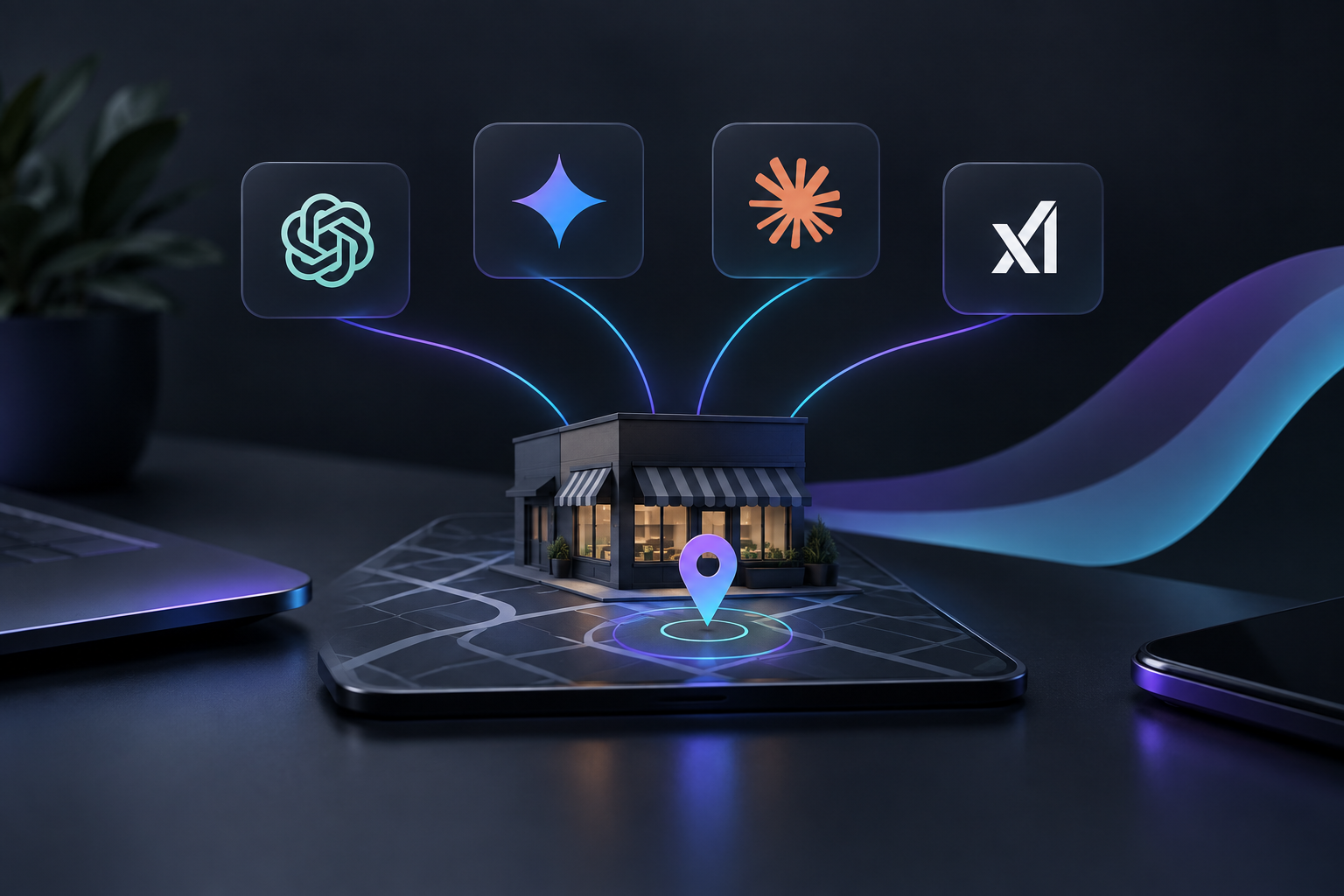
TruLata builds AI search visibility for local service businesses across the United States, tracking whether ChatGPT, Gemini, Claude and Grok name your company when buyers in your service area ask. This guide walks through the exact data structures and signals that make a citation possible, with examples from roofing, HVAC and plumbing operators.
What Is ChatGPT Search and Why Do Contractors Not Know About It?
ChatGPT Search is the browsing layer inside ChatGPT that retrieves live web results and cites them inline. It looks nothing like a page of ten blue links. A user asks a question in plain language, and the model returns a short written recommendation with source links attached.
Contractors miss this because the behavior change happened on the consumer side, not the marketing side. Nobody sent an announcement to the trades. Meanwhile, homeowners who used to open Google and scroll now open a chat window and ask a full sentence: "my AC is blowing warm air and I need someone today in north Phoenix, who should I call."
The critical distinction: ranking and being cited are different wins. You can hold position three in Google Maps and still be invisible in ChatGPT, because the retrieval logic weighs different signals. Answer engines want machine-readable facts and corroboration across multiple independent sources. Google will forgive a messy site if the backlinks are strong. ChatGPT often will not, because it needs to state a fact about you confidently enough to put it in an answer.
How a Citation Actually Gets Chosen
When ChatGPT answers a local query, it typically retrieves a mix of directory pages, review platforms, local news, and business websites. It then looks for agreement. If your phone number is one string on your website, a second string on Yelp, and a third on an old Angi profile, the model has three competing facts and low confidence. As one detection guide on ChatGPT citations puts it, multiple sources create the redundancy ChatGPT needs to cite you confidently. Contradiction is the enemy. Redundancy is the goal.
How Do I Make My Website Readable to ChatGPT?
Start with technical access, because none of the content work matters if the crawler cannot reach the page. HubSpot's guidance on showing up in ChatGPT results lists three prerequisites: your key pages are indexed in Google and Bing, OAI-SearchBot is allowed in your robots.txt, and your content loads in crawlable HTML rather than relying entirely on client side JavaScript.
That third point catches a surprising number of contractor sites. Page builders that render service lists, service areas and hours through JavaScript widgets often deliver an empty shell to a crawler. Open your homepage, view source, and search for your phone number. If it is not in the raw HTML, an answer engine may never see it.
The Checks to Run This Week
- View source on your homepage and every service page. Confirm your business name, phone, city list and service names appear as plain text.
- Open your robots.txt file. Confirm OAI-SearchBot is not blocked, along with the other AI crawlers.
- Verify indexing in both Google Search Console and Bing Webmaster Tools. Bing matters more than contractors expect for AI retrieval.
- Check that each service area you claim has a real page with real content, not a template with the city name swapped.
What Schema Markup Do I Need to Get Cited by AI Search?
LocalBusiness schema in JSON-LD is the single highest-leverage technical change most service companies can make. Schema is structured data written for machines, not humans. It removes ambiguity by labeling every fact explicitly.
Boostability's breakdown of capturing AI citations makes the point plainly: your schema must accurately list name, address, phone number, opening hours, price range, and exactly what services you offer. Without schema, an AI sees "9-5" sitting on a page and has to infer what that means. With schema, the hours are declared in an unambiguous format the model can quote.
The Fields That Matter Most for Contractors
- Correct schema subtype. Use Plumber, HVACBusiness, RoofingContractor or Electrician rather than the generic LocalBusiness type where a specific one exists.
- NAP fields. Name, streetAddress, addressLocality, addressRegion, postalCode, telephone. These must match your Google Business Profile character for character.
- areaServed. List every city, county or ZIP you actually cover. This is what lets the model connect "near me" to you.
- hasOfferCatalog. Break out individual services: emergency drain clearing, tankless water heater installation, hail damage inspection, ductwork replacement. Vague "plumbing services" gives the model nothing to match a specific query against.
- aggregateRating and review. Where legitimate and sourced from real reviews, this gives the model a number to cite when a user asks who is highly rated.
- openingHoursSpecification. Especially important if you advertise 24/7 emergency service, because "who is open right now" is a common AI query.
A roofing company in a hail market, for example, should have areaServed listing every suburb it dispatches to, an offer catalog naming hail damage inspection and insurance claim support separately, and hours that reflect storm-season availability. That structure lets ChatGPT match a query like "roofer who handles insurance claims in Round Rock" to a specific declared service rather than hoping to infer it from paragraph text.
The eSEO Space guide on making ChatGPT recommend your local business frames this as building a private knowledge graph using JSON-LD schema, defining your business, services, and location as clear entities. That framing is useful. You are not decorating a page. You are publishing a machine-readable profile of your company.
Where Does ChatGPT Get Its Information About Local Businesses?
Mostly from places you do not control directly, which is why listings work is not optional. Bigeye's guide to AI search visibility notes that when ChatGPT provides local recommendations, it often mentions "highly rated" or "top-reviewed" businesses, and that this is not accidental. Review volume and rating are retrievable facts. The model uses them because they are easy to verify across sources.
The Citation Surfaces to Claim and Align
- Google Business Profile. Complete every field, including services, service areas, attributes and hours. Post regularly.
- Bing Places. Underused by contractors and disproportionately valuable, since Bing's index feeds several AI retrieval paths.
- Yelp and BBB. Both are frequently retrieved for local service queries.
- Trade directories. Angi, Thumbtack, HomeAdvisor, plus manufacturer and certification directories (Carrier, Trane, GAF, Owens Corning, NATE, state licensing boards).
- Local institutions. Chamber of commerce, neighborhood associations, local news coverage, supplier partner pages.
Consistency across these is the whole game. Same legal business name, same suite number format, same phone. An HVAC company operating as "Summit Heating and Air" on Google and "Summit Heating & Air LLC" on three directories is generating noise, not signal.
Third-Party Mentions Beat Self-Description
A SitePoint community discussion on getting recommended on ChatGPT makes an important point: there is no direct way to submit your business to ChatGPT. These systems use publicly available information and strong online signals to decide which businesses to mention. Businesses that earn recognition have clear branding, consistent information across the web, positive reviews, and content that demonstrates genuine expertise.
Practically, that means a plumbing company quoted in a local news story about a freeze event, listed on a manufacturer's certified installer page, and holding 300 Google reviews has three independent corroborations. A competitor with only a website has one, and it is self-reported. The model treats those very differently.
What Content Actually Earns AI Citations for Contractors?
Answer engines extract passages, not pages. The content that gets lifted is short, specific, self-contained, and directly answers a question a buyer asked out loud. That is a different writing discipline than the 2,000-word keyword pages many contractors were sold.
Write to the Question, Then Answer It in the First 50 Words
If a page is titled "How much does a furnace replacement cost in Denver," the first paragraph should answer it in two or three sentences with a real range and the variables that move it. Scene-setting kills extractability. This is the same principle behind the hybrid approach we cover in our breakdown of SEO and AEO working as one search strategy: rank for the query and be quotable inside the answer.
Build a Real FAQ Layer
Take the twenty questions your dispatchers answer every week and publish them as question-shaped headings with 40 to 60 word answers. Warranty length. Emergency response window. Whether you work with insurance adjusters. Permit handling. Financing availability. Each one is a potential extracted span.
Publish Local Specificity That Cannot Be Templated
Reference the actual conditions in your market: code requirements in your county, common failure patterns in homes built in a particular era, seasonal load patterns. A roofing company that writes about local storm cycles and insurance timelines gives an answer engine something no national competitor can match. Our guide to seasonal roofing demand and off-season marketing covers how that timing plays into broader campaign planning.
How Do I Know If ChatGPT Is Citing My Business?
Ask it. Then ask it again next week, and the week after, across the queries your customers actually use. HubSpot recommends running your brand through ChatGPT, Perplexity and Google AI Mode for commercial queries in your space, and treating outdated reviews or incorrect directory data in the responses as a signal to go fix those listings.
Manual spot checks work for a handful of queries. They break down fast at scale, because answers vary by phrasing, by session, and by engine. A homeowner asking "best HVAC company in Mesa" and one asking "who can replace my AC unit fast in Mesa" may get different names. That is why TruLata runs AI visibility tracking across four answer engines, checking ChatGPT, Gemini, Claude and Grok on a repeating schedule against a defined query set so you can see whether you are named, who is named instead, and whether the trend is moving.
What to Measure
- Mention rate. What percentage of your target queries name your business across each engine.
- Competitive share. Which competitors appear when you do not, and what sources the engine cited for them.
- Source attribution. Which pages and directories the engine pulled from. That tells you where to invest next.
- Query coverage. Emergency queries, comparison queries, cost queries and brand queries behave differently and need separate tracking.
Pairing that with search visibility: rankings, queries and reviews gives you the full picture, because traditional ranking data and AI citation data explain different parts of the same funnel. Owners running marketing without a dedicated team can see both in the TruLata Command Center rather than stitching together four tools.
A 30-Day Sequence to Start Earning ChatGPT Citations
Week 1: Audit and access. Check robots.txt for OAI-SearchBot. Confirm HTML rendering of core facts. Verify indexing in Google and Bing. Run 15 to 20 buyer queries through ChatGPT and record who gets named.
Week 2: Schema. Deploy LocalBusiness JSON-LD using the correct subtype, with full NAP, areaServed, hasOfferCatalog and openingHoursSpecification. Validate it. Add FAQPage schema to your question pages.
Week 3: Listings alignment. Pull every directory profile you can find. Standardize name, address, phone, hours and service descriptions to match your schema exactly. Claim anything unclaimed. Kill duplicates.
Week 4: Content and reviews. Publish five question-shaped pages answering your most common sales questions with direct answers up front. Launch or tighten a review request process so new reviews arrive steadily rather than in bursts.
Then re-run your query set and compare. Citation movement is usually slower than ranking movement because it depends on multiple external sources updating and being re-crawled. Expect to measure in months, not days, and keep the monitoring running the whole time.
Get Your AI Search Visibility Measured
You cannot fix a citation gap you cannot see. TruLata tracks whether ChatGPT, Gemini, Claude and Grok name your local service business for the queries your customers actually ask, shows which competitors are taking the slot, and tells you which sources the engines are pulling from. Book the live demo to see your current AI visibility against your market.