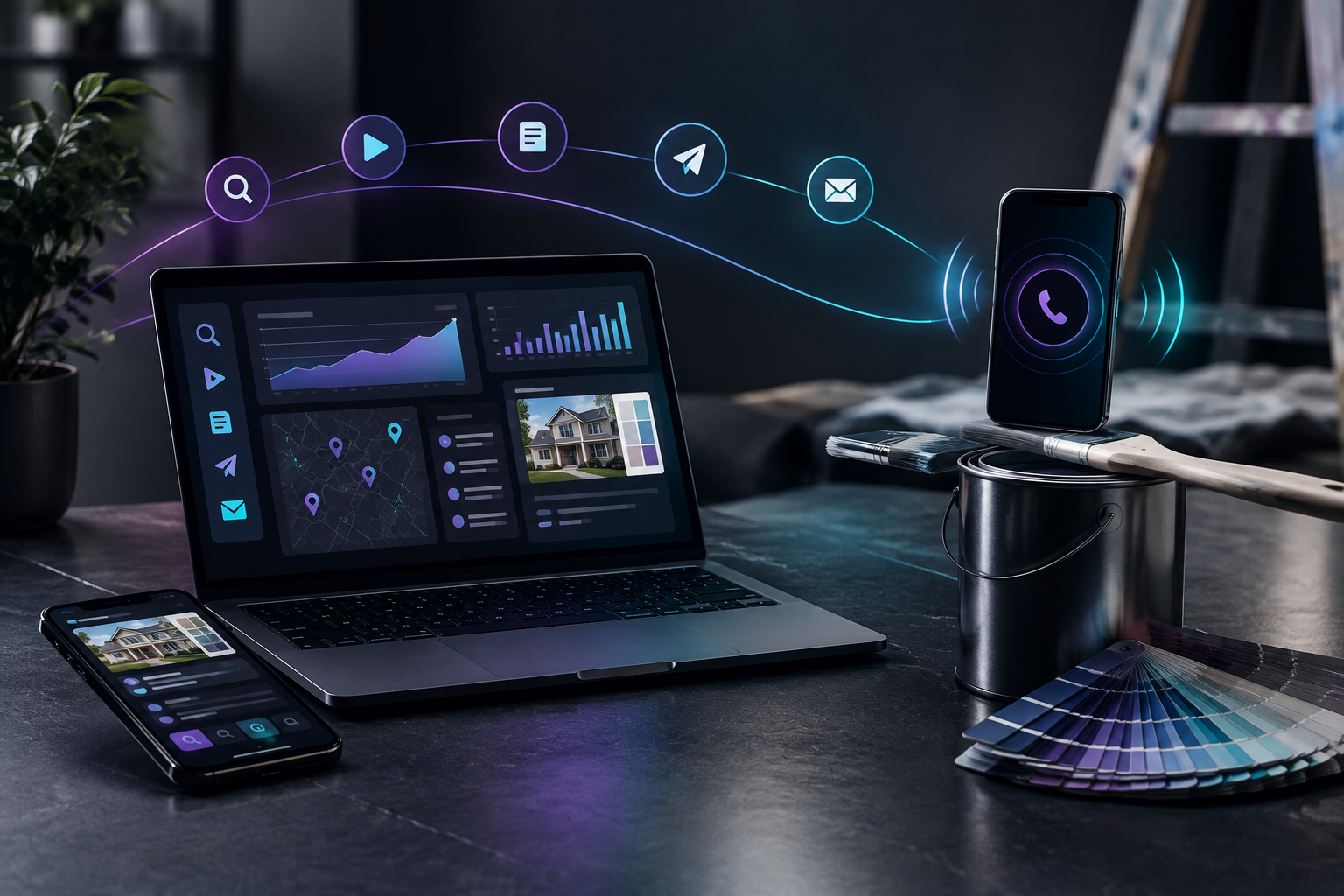

The best digital marketing for local businesses brings in calls and form fills from people nearby who need the job done now. It also tells you which channel sent each one. For most trades, home services and practices, that means local search, paid ads, steady content, follow-up email, and one place where every lead is counted with its source.
Field service software, CRMs, all-in-one platforms, agencies and doing it yourself all promise more jobs, and they solve different problems. Below is what each option is, who it fits, and where it falls short.
TruLata is one of those options. It is an AI marketing platform for local service businesses. It runs search, Google and Meta ads, content, outbound and email on a schedule, and it counts every lead from your own site along with its source. The team behind it ran a marketing agency and turned that work into software.
What does digital marketing for local businesses actually include?
For a service business, digital marketing comes down to a few jobs. First, you need to show up when someone nearby searches for what you do, in maps, in organic results, and more often now inside AI answers. Second, you buy attention when organic reach is too slow, usually through Google Ads for people with urgent intent and Meta ads for awareness and offers. Third, you publish pages and posts that answer the questions customers ask before they call. Fourth, you follow up with past customers and open quotes by email. The last job is the one most often skipped: counting what came in and where it came from.
- Show upAppear in maps, organic results and AI answers
- Buy attentionGoogle Ads for urgent intent, Meta ads for awareness
- PublishPages and posts that answer pre-call questions
- Follow upEmail past customers and open quotes
- CountTrack what came in and where from
That last job decides whether the rest improves. If you can't say whether last month's calls came from ads, your Google Business Profile or a referral, you can't tell which spend to cut and which to raise. Our broader guide to online marketing strategies for small business covers each channel in more depth.
What makes marketing different for local service businesses
A local service business doesn't sell to a national audience. It sells within a drive radius, often to someone with a burst pipe, a dead furnace or a sore tooth. That shapes both timing and budget. Demand in many service trades is seasonal. As a Forbes Business Council piece on fluctuating demand notes, some businesses get a rush across the summer while others peak in the winter months. An HVAC company feels both ends of that, and a landscaper or pool service mostly feels one.
Busy season
- Capacity is strained
- Extend hours, add seasonal help
- Full-volume ad spend wastes money
Slow season
- Phone goes silent if marketing stops
- Write service pages
- Collect reviews and build email lists
The busy season also strains capacity. ACCA, the trade association for HVAC contractors, advises members to plan for the holiday season as a peak, to extend hours, and to bring on seasonal help. Full-volume ad spending while the schedule is booked solid wastes money. Marketing that goes quiet in the slow months leaves the phone silent right when you have open slots.
A Forbes Coaches Council article on summer slowdowns recommends using the industry-specific lull to refine systems, document processes and bring in tools, including AI, that reduce future workload. For marketing, that means writing service pages, collecting reviews and building email lists before demand returns.
Local economics differ too. The U.S. Small Business Administration points out that costs such as wages, rent, insurance and licensing fees vary significantly by location. The same holds for advertising: what a click or a top map position takes depends on your town and how many competitors bid there. A plan copied from a contractor in another market won't fit yours as is.
What are the real options, and how do they compare?
Here are the options local service owners usually weigh. Some are software, some are people, and a few blend the two. Where the details of a specific product aren't something we can verify, we describe the category it belongs to rather than guess.
Categories of options
Field service software
- Jobber
- Housecall Pro
- ServiceTitan
CRM and all-in-one platforms
- HubSpot
- GoHighLevel
- Thryv
Messaging and reviews
- Podium
People you hire
- Scorpion
- A marketing agency
| Option | What it is | Best for | One honest limit |
|---|---|---|---|
| Jobber | Field service management software | Scheduling, quoting and invoicing for smaller crews | Built around running jobs, not running ad campaigns |
| Housecall Pro | Field service management software | Home service teams that want dispatch and billing in one app | Marketing features sit beside operations, not at the center |
| ServiceTitan | Field service management software aimed at larger operators | Established trade companies with dispatchers and multiple trucks | A heavier system to set up and learn than a small shop may need |
| HubSpot | CRM and marketing software | Businesses with a long sales process and someone to run it | Software only, so someone still has to build and run campaigns |
| GoHighLevel | All-in-one marketing platform, often resold by agencies | Owners or agencies who want to build their own funnels | Does what you configure, so results depend on who sets it up |
| Scorpion | Marketing services provider for local businesses | Owners who want a provider to handle marketing for them | As with any provider, check how leads and results are reported |
| Thryv | Small business software for customer management and marketing | Small teams wanting basic tools in one login | Broad toolset, so depth in any one channel varies |
| Podium | Customer messaging and review software | Businesses focused on reviews and text conversations | Covers part of the funnel, not search or ads |
| A marketing agency | People you hire to run your marketing | Owners who want it fully handed off | Quality and reporting vary widely between firms |
| Doing it yourself | You run the profiles, ads and posts | Very new businesses with time to spare | Competes with the hours you bill for jobs |
| TruLata | AI marketing platform that runs channels and counts leads | Service businesses that want marketing run and measured in one place | Counts leads from your own site, so it needs your forms connected |
Jobber, Housecall Pro and ServiceTitan
These three are field service management platforms. They handle scheduling, dispatch, quotes, invoices and customer records. If your bigger problem is the office (missed appointments, slow invoicing, lost paperwork), start here. They are less suited to the work of getting found and getting called. Most owners who use them still need something or someone to run search and ads.
ServiceTitan is generally positioned toward larger trade companies. Jobber and Housecall Pro are more common with smaller and mid-sized crews.
HubSpot
HubSpot is CRM and marketing software built around pipelines, contact records and email. It suits businesses with a sales process long enough to need stages and follow-up sequences. For a plumber whose customer decides in ten minutes, much of that structure goes unused. The software also doesn't run your ads or write your pages for you.
GoHighLevel
GoHighLevel is an all-in-one platform that many agencies resell under their own brand. It gives you funnels, forms, texting and automations. If you or your agency like to build, it is flexible. If nobody is building, you have the parts and no finished campaigns.
Scorpion and marketing agencies
Scorpion is a marketing services provider focused on local businesses. A general marketing agency sits in the same category: people do the work for you. The benefit is that you hand it off. The risk is that you only see what the provider chooses to report. Before signing, ask how leads are counted and whether you own your ad accounts. Our guide to choosing an advertising agency for small business lists the questions to ask.
Thryv and Podium
Thryv is small business software that bundles customer management with marketing tools. Podium focuses on messaging and reviews. Both are useful for part of the job, especially reputation and conversations with customers who already found you. Neither is mainly built to run search and paid campaigns across channels.
Doing it yourself
Many owners start by managing their own Google Business Profile, boosting a few Facebook posts and asking happy customers for reviews. That works early and costs only time. It stops working when the hours you spend on marketing are hours you aren't on a job, or when results are flat and you can't tell why.
TruLata
TruLata runs search, Google and Meta ads, content, outbound and email on a schedule. Every lead from your own site is counted with its source, and what happened and what it cost appear together on your TruLata dashboard. Prospect emails go out from a review-first queue, and every send is logged. TruLata also tracks whether your business is named in AI answer engines, not only where it ranks on Google. The team built it after years of running a marketing agency, so the software does the work that agency staff used to do by hand. You can read how TruLata works step by step.
The honest limit is that TruLata counts leads from your own forms and site. To get accurate numbers, those need to be connected at setup.
Which one should you choose?
Pick based on where your business is losing work right now, not on feature lists.
Match your gap to an option
- Schedule and invoicing are a messJobber, Housecall Pro or ServiceTitan
- Long multi-step sales processHubSpot
- You like building your own funnelsGoHighLevel
- Reviews and texting are the gapPodium or Thryv
- Hand everything offAn agency or Scorpion
- New, more time than budgetDo it yourself
- Want every lead counted with sourceTruLata
Which one to choose if...
- Your schedule and invoicing are a mess: start with field service software such as Jobber, Housecall Pro or, for larger operations, ServiceTitan. Fix operations before you add more leads.
- You run a long, multi-step sales process with a dedicated salesperson: a CRM like HubSpot fits that structure.
- You or your agency like building your own funnels: GoHighLevel gives you the parts.
- Reviews and customer texting are your main gap: Podium or Thryv cover that piece.
- You want to hand everything to people and check in monthly: a marketing agency or a provider like Scorpion, provided you get clear lead reporting and keep ownership of your accounts.
- You're brand new and have more time than budget: do it yourself for now, starting with your Google Business Profile and reviews.
- You want search, ads, content, outbound and email run for you, and you want every lead counted with its source: TruLata.
Many businesses end up combining two of these: field service software to run the jobs and a marketing option to fill the calendar. One tool runs the jobs and the other brings in the calls. If automation is part of your decision, our piece on choosing a marketing automation company covers what to check.
How should you get started this month?
Complete your Google Business Profile with accurate service areas, hours and photos, and reply to every review. Write one page for each core service, answering the questions people ask on the phone. Make sure every form on your site records where the visitor came from. Without that, you can't compare channels later.
Your first month, then your season
- Google Business ProfileAdd service areas, hours, photos; reply to reviews
- Service pagesOne page per core service
- Source trackingEvery form records where visitors came from
- Raise spendIncrease ad spend and content ahead of the peak
- Publish and follow upGather reviews, email past customers about maintenance
Then plan for your season. Raise ad spend and content output ahead of your peak, not during it, and ease spend when the schedule is full. Use the slow months to publish, gather reviews and email past customers about maintenance. If you want to see how one system handles all of this, the live demo shows TruLata running on real campaign data, including the lead count with sources.