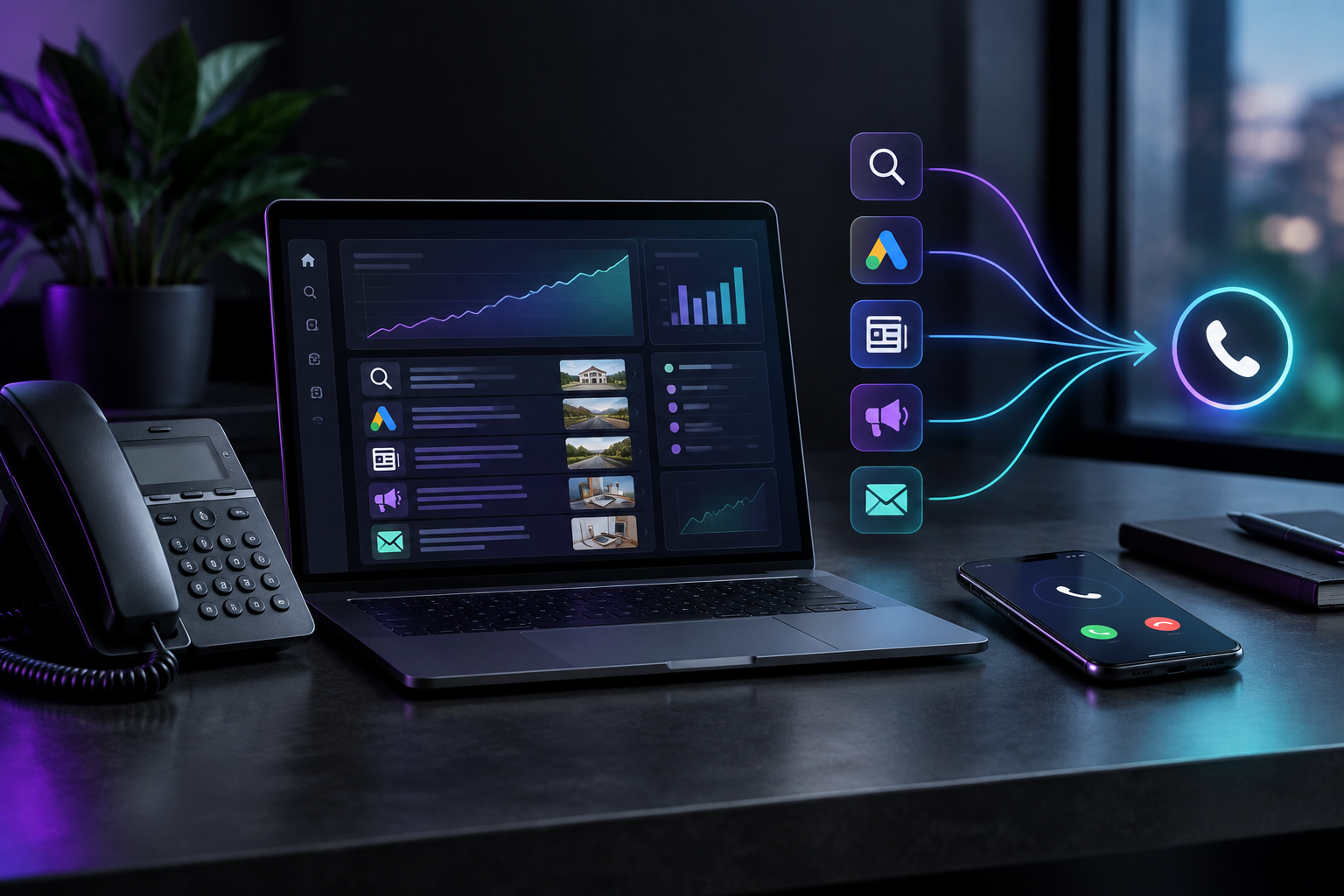

The solar power advertising that works for a local business pairs Google Search ads aimed at homeowners already looking for an installer with a complete Google Business Profile and fast follow-up on every inquiry. Whatever tool or team runs it, track each lead back to the channel that produced it, then move budget toward what books consultations.
The rest of this page covers the channels worth paying for, what makes marketing for local service businesses different from national brand campaigns, and an honest comparison of the ways owners run all of this. One of those options is TruLata, an AI marketing platform for local service businesses, including solar installers. It runs search, Google and Meta ads, content, outbound and email on a schedule, and it shows every lead with its source on one dashboard.
Why is solar power advertising harder than it looks?
Solar is not an emergency purchase. Nobody books an installer at midnight the way they call a plumber about a burst pipe. A homeowner considering panels compares quotes, reads reviews, asks neighbors, and often goes quiet for a while before deciding. That means a single ad rarely closes the deal. Your advertising has to show up when they first search, stay visible while they compare, and be easy to contact when they are finally ready.
Urgent purchase like a plumber
- Called at midnight
- One call decides it
- Quick choice
Solar purchase
- Compare quotes and reviews
- Ask neighbors
- Goes quiet before deciding
- Many touchpoints before a form
The second problem is attribution. A homeowner might see a Meta ad, search your company name a week later, read a blog post, and then fill in a form. If each of those channels reports separately, every one of them claims the lead, and you cannot tell which spend actually worked. Most wasted solar budgets come from this blind spot, not from bad creative. If you want the wider strategy behind the ads, our guide to solar power marketing for installers covers positioning, reviews and content in more depth.
Which channels should a solar business advertise on?
Start with the channels that catch existing demand, then add the ones that create it. Google's own advertiser guidance lays out the main campaign types plainly: Search reaches people searching for the products or services you offer, Demand Gen is built to create and convert new customer demand, YouTube ads build connections with engaged viewers, and Performance Max spreads campaigns across Google channels, according to Think with Google. For a local installer, those map to a clear order of priority.
- Google Search adsBid on high-intent searches, split ad groups by service
- Business Profile and Local campaignsFill every field, add install photos and reviews
- Meta and video adsBuild demand with proof, target by geography
Here is how to sequence them so each dollar has a job.
1. Google Search ads for high-intent searches
Bid on searches that signal a buyer, such as "solar installer near me," "solar panel installation" plus your city, and "solar company reviews." Write a separate ad group for each service you offer (residential panels, battery storage, commercial systems) so the ad matches the search. Add negative keywords for job seekers, DIY kits and free panel scams to stop paying for clicks that will never book.
2. A complete Google Business Profile and Local campaigns
Google recommends that businesses connect with local customers by creating a Business Profile and running a Local campaign. Fill in every field: service areas, hours, services, photos of real installs, and a steady flow of reviews. For many solar buyers, the profile is the first thing they see, and it is free.
3. Meta and video ads to build demand
Facebook, Instagram and YouTube reach homeowners before they start searching. Use them for proof: short videos of a finished roof, a customer walking through their system, or an explainer on how net metering works in your area. Target by geography and homeownership signals rather than broad interests, and send traffic to a page with one clear form.
4. Content that answer engines can quote
Homeowners now ask ChatGPT, Gemini and Google's AI results questions like "is solar worth it in my area" or "how long does solar installation take." Pages that answer those questions directly, with specifics about your market, are the ones that get cited. Publish them on your own site so the visibility builds an asset you own.
5. Email follow-up and outbound for long decisions
Because solar decisions take time, the leads you already have are often worth more than new clicks. A scheduled email sequence (what to expect at a site visit, financing basics, recent installs) keeps you in the conversation. For commercial solar, targeted outbound to property owners and facility managers can open doors that ads alone will not.
What makes marketing different for local service businesses
National brands can run awareness campaigns for months and measure success in surveys. A local service business lives or dies on whether the phone rings this month, in a defined service area, against a handful of competitors who are bidding on the same searches. That changes how you plan, budget and measure.
Shared local lead problems
Market pressure
- Intense local competition
- Difficulty standing out
Visibility and budget
- Limited online visibility
- Limited marketing budgets
Timing
- Seasonal swings in demand
- Keeping up with trends
A few documented facts about home service trades shape how solar advertising should be planned:
- Home-related demand follows the calendar. The National Association of Realtors reports that housing market activity advances during the spring and summer months, and that the West is the region least affected by seasonality, according to its seasonal perspective on the housing market. Solar is a decision about a home, so it is worth watching how your local season moves.
- Neighboring energy trades already plan around predictable rhythms. One HVAC contractor writing in ACHR News describes a busy summer starting around Memorial Day, a slowdown in August, furnace inquiries after the first snowfall, a wave of calls after New Year, and a push for tune-ups in March and April. Solar has its own rhythm in each market, and your search data is the honest place to read it.
- The lead generation problems are shared across trades. The Air Conditioning Contractors of America lists the common challenges for HVAC firms as intense competition in local markets, limited online visibility, seasonal swings in demand, limited marketing budgets, difficulty standing out, and keeping up with marketing trends, in its guide to building an HVAC customer base. Most solar installers will recognize every item.
- Customers find providers locally first. Google's guidance to advertisers points local businesses toward a Business Profile and Local campaigns, which is a strong signal of where local buyers start their search.
The practical takeaway: plan your solar power advertising budget by season, protect your visibility in search during your slow months rather than going dark, and judge every channel by booked consultations in your service area, not by impressions.
What are your options for running solar power advertising?
Owners usually weigh some mix of doing it themselves, hiring an agency, or adopting software. Each option below gets a plain description, who it tends to fit, and one honest limit. Where a specific detail about a company is not something we can verify, we describe the category it belongs to instead.
Option and its honest limit
- Doing it yourselfHigh time cost, split reporting
- Marketing agencyResults shown through chosen reports
- Field service softwareBuilt for operations, not ad campaigns
- HubSpot or GoHighLevelSomeone must build and run campaigns
The table summarizes the comparison, and the short sections after it add context.
| Option | What it is | Best for | One honest limit |
|---|---|---|---|
| Doing it yourself | Owner sets up the Business Profile, ad accounts and content directly | Owners with time and a willingness to learn ad platforms | Time cost is high and reporting is split across many tools |
| A marketing agency | An outside team that runs campaigns on your behalf | Owners who want campaigns handled by someone else | You see results through the reports the agency chooses to share |
| Scorpion | A marketing provider focused on local and home service businesses | Service businesses that want a managed, industry-focused provider | As with any managed provider, visibility and control depend on the arrangement |
| Field service software (Jobber, Housecall Pro, ServiceTitan) | Software category for scheduling, quoting, dispatch and invoicing | Running jobs and crews once work is booked | Built around operations, not around running ad campaigns |
| HubSpot | CRM and marketing software category | Teams with a sales pipeline and someone to configure it | A toolset; someone still has to build and run the campaigns |
| GoHighLevel | All-in-one marketing and CRM toolkit category | People comfortable building their own funnels and automations | Setup and ongoing campaign work fall on whoever runs it |
| Thryv | Small business management and marketing software category | Owners who want customer management and marketing tools in one place | Provides tools rather than someone running your campaigns |
| Podium | Reviews and customer messaging software category | Businesses focused on reviews and fast replies to inquiries | Search, ads and content usually need another tool or team |
| TruLata | AI marketing platform that runs search, Google and Meta ads, content, outbound and email on a schedule | Service businesses that want campaigns run and every lead traced to its source | A marketing platform, not field service software, so scheduling and invoicing stay in your existing tools |
Doing it yourself
Plenty of installers start here: a Business Profile, a Search campaign, a few Meta ads. It fits owners who enjoy the work and have evenings to spare. The limit is that the data ends up in five places, and without clean tracking you will struggle to tell which channel produced the jobs.
A marketing agency
An agency takes the work off your plate entirely. It fits owners who want someone else accountable for execution. The honest limit is visibility: you see what the monthly report shows, on the agency's schedule.
Scorpion
Scorpion is a marketing provider that focuses on local and home service businesses. It suits owners who want a managed provider that knows the trades. Like any managed arrangement, how much you see and control depends on the terms.
Field service software: Jobber, Housecall Pro, ServiceTitan
These belong to the field service management category: scheduling, quoting, dispatching crews and invoicing. They are valuable once a job is booked. They are built around operations, so they are not designed to be where your solar ad campaigns are planned and run.
HubSpot
HubSpot sits in the CRM and marketing software category. It fits businesses with a defined sales pipeline and someone to set it up and maintain it. It is a toolset, so the campaigns themselves still need a person or team to create and run them.
GoHighLevel
GoHighLevel is an all-in-one marketing and CRM toolkit. It suits people who like building funnels, forms and automations themselves. The work of setting it up and running campaigns falls on whoever operates it.
Thryv
Thryv belongs to the small business management and marketing software category. It fits owners who want customer records and marketing tools under one roof. Like other toolsets, it gives you the tools rather than running campaigns for you.
Podium
Podium sits in the reviews and customer messaging category. For solar, where trust drives the decision, reviews matter a great deal. Its core focus means search, ads and content usually need a separate tool or team.
TruLata
TruLata runs search, Google and Meta ads, content, outbound and email on a schedule. It counts every lead from your own site with its source, and it shows what happened and what it cost on one dashboard. Prospect emails leave from a review-first queue and every send is logged. It was built by a team that ran a marketing agency and turned that work into software. You can read how TruLata works in practice before deciding. Its limit: it is a marketing platform, so scheduling, dispatch and invoicing stay in the tools you already use.
Which one to choose if...
There is no single right answer, only the right fit for how your business runs today. Match your situation to the option that solves your actual bottleneck, not the one with the longest feature list.
Match your bottleneck to an option
- Do it yourselfSet up conversion tracking on day one
- Agency or ScorpionComfortable with monthly reports
- Field service softwareJobber, Housecall Pro, ServiceTitan
- PodiumReviews and messaging tool
- TruLataEvery lead linked to source and cost
- You have time, a small service area and want to learn the platforms: do it yourself, and set up conversion tracking on day one.
- You want someone else fully accountable and are comfortable with monthly reports: a marketing agency or a managed provider such as Scorpion.
- Your real problem is scheduling crews and invoicing, not getting leads: field service software like Jobber, Housecall Pro or ServiceTitan.
- You have a defined sales process and someone to configure software: HubSpot, GoHighLevel or Thryv.
- Reviews and fast replies are your weakest link: a reviews and messaging tool like Podium.
- You want search, ads, content, outbound and email run on a schedule, with every lead tied to its source and cost: TruLata.
Many installers combine two: field service software for operations plus one option for marketing. That is a sensible split. The mistake is stacking three marketing tools that each report their own version of the truth.
How do you know if your solar advertising is working?
Measure booked consultations by channel, not clicks or impressions. To do that, you need to count every lead from your own website forms and calls, record where each one came from, and line that up against what each channel cost. When the numbers come from your own site rather than each ad platform's self-reported conversions, double counting disappears. TruLata does this with lead tracking counted from your forms, so each inquiry carries its source.
Tracking leads to spend
- Website forms
- Phone calls
- Booked consultations by channel
- Pause weak campaigns
- Shift budget to winners
Then review spend weekly, not quarterly. Search terms drift, competitors change bids, and a broken form can quietly cost a week of leads. A daily watch on your Google Ads account catches wasted spend before it compounds. Pause what is not producing consultations, and shift that budget to the campaigns that are.
Ready to see where your solar leads come from?
Good solar power advertising is not about being everywhere. It is about showing up where homeowners search, staying visible while they decide, and knowing exactly which channel booked each consultation. Get those three right and budget decisions become simple.
Get these three right and budget decisions become simple.
If you want search, Google and Meta ads, content, outbound and email run on a schedule, with every lead and its cost on one dashboard, walk through the live demo and see how TruLata would run marketing for your solar business.