

Answer engine optimization: be the business the AI names.
A buyer asks ChatGPT, Gemini, Claude, Grok, Manus, Google AI Overviews, Perplexity, Meta AI or DeepSeek who to call, and the engine names a few businesses. AEO is the work that puts yours in that answer, and the measurement that tells you whether it did.

What is answer engine optimization?
Answer engine optimization (AEO) is the work of making a business the one an AI assistant names when a buyer asks it a question. SEO earns a place in a list of links. AEO earns a place in the answer itself, across engines such as ChatGPT, Gemini, Claude, Grok, Manus, Google AI Overviews, Perplexity, Meta AI and DeepSeek.
Your buyer never sees a list. A search engine shows a list and the buyer picks from it. An answer engine gives one answer, names a few businesses, and the buyer calls one of them. Miss the answer and you are not ranked low. You are out of the conversation. AEO puts you in the answer, then measures whether you are.
- A buyer asksWho should I call for this, near me
- The engine answersAnd names a few businesses
- The buyer calls one of themThey never see a list
- AEO asksIs yours one of them?
Miss the answer and you are not ranked low. You are out of the conversation.
How is AEO different from the SEO I already do?
They count different things. SEO earns a position on a results page. You measure it in impressions, clicks and average position, which Search Console reports two to three days behind. AEO earns a mention inside an answer. You measure it by asking the question and reading what comes back. The work overlaps: the same facts about your business everywhere an engine looks, pages that answer the buyer's literal question, structured data that says what you are and where, reviews and citations that agree. The count does not overlap.
Rank third and you can still win the click. Miss the answer and you never get the chance. TruLata keeps both instruments on one screen: the search view for queries and average position, and the AI visibility view for whether you were named. The search and AI search services page covers the program that moves both.
Two instruments, one screen
SEO counts
- Impressions, clicks, average position
- A place in a list of links
- Search Console, 2 to 3 days behind
AEO counts
- Answers that name the business
- A place in the answer itself
- Nine engines, asked directly
Do I need GEO as well as AEO?
One program covers both. AEO asks whether your business is named in the answer a buyer receives. GEO asks whether the pages you publish are the material the engine draws on to build that answer. One is the name in the result, the other the source behind it.
The two terms describe the same list of work, so TruLata's view carries both names. The number you see answers the AEO question, whether your business was named, because that is the outcome a buyer acts on. The GEO entry covers where the two part.
Which engines get asked about my business?
ChatGPT, Gemini, Claude, Grok, Manus, Google AI Overviews, Perplexity, Meta AI and DeepSeek, each asked the same question through an API. Live web search is on for every engine. An ungrounded model returns what it memorised in training, and your buyer never sees that. People ask in the apps, and the apps search the live web and read Business Profile listings, directories and review sites. Measure the ungrounded surface and you understate any business whose strength is local presence and reviews, which is exactly the business TruLata is built for.
Every question is asked bare, the way a person types it, with no persona preamble. A wrapper changes what the engine retrieves, and then the run measures our prompt instead of your buyer's experience. Google AI Overviews are in the set too: each question is searched on Google and the AI Overview at the top of the results is read, cited sources included.
Each engine, through an API
- ChatGPT
- Gemini
- Claude
- Grok
- Manus
- Google AI Overviews
- Perplexity
- Meta AI
- DeepSeek
- Business Profile listings
- Directories
- Review sites

People ask in the apps.
How do I know the score is honest?
Ask what it does with a blank answer. The score is cited answers divided by answers received. When an engine returns nothing, that blank is a measurement error and it leaves the denominator. It is never counted as a miss. An engine that returned nothing did not decline to name you. It said nothing, and folding a blank into 'not cited' manufactures a confident zero.
A run where one engine failed on three questions is scored out of the answers that exist, and the question row shows the smaller count. Put the same question to any vendor. A number that cannot answer it is not a measurement.
A blank counted as a miss
- ChatGPT: cited
- Gemini: not cited
- Claude: cited
- Grok: blank, counted against you
- Scored 2 of 4
A blank left out
- ChatGPT: cited
- Gemini: not cited
- Claude: cited
- Grok: no response, excluded
- Scored 2 of 3
How do I know it is working?
Ask the same questions again and read the change. The question set has to cover every way buyers in your area ask. On one measured account, measured when we asked four engines, all four named the business for one phrasing of a question, and far fewer did for another phrasing of the same need in the same city. A set skewed to one phrasing measures the phrasing, not your business.
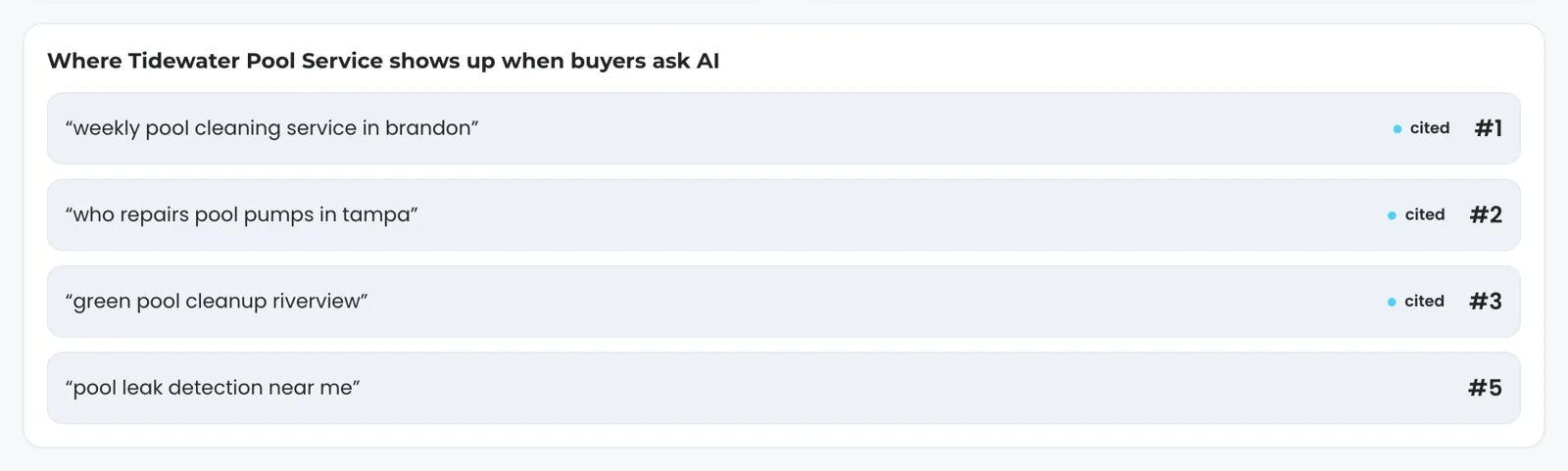
You get a baseline during setup and a re-run as the program moves, with the date of the last run stamped on the view. The score sits beside a per-engine breakdown and the literal list of questions, cited and not cited. The cited list shows what works. The not-cited list is your work plan.
How you know it is working
- Baselinethe question set scored for the first time
- Re-runthe same questions, asked the same way
- Datedthe date of the last run stamped on the view
- What works
- Your work plan
SEO, AEO and GEO in one table.
| Term | The question it answers | How TruLata measures it |
|---|---|---|
| SEO | Does a search engine rank my page for this query | Search Console queries, impressions, clicks and average position, 2 to 3 days behind |
| AEO | Does an answer engine name my business when a buyer asks | ChatGPT, Gemini, Claude, Grok, Manus, Google AI Overviews, Perplexity, Meta AI and DeepSeek asked through their APIs; cited answers over answers received |
| GEO | Does a generative engine draw on my pages to build its answer | Same run, same view; the number reported is whether the business was named |
| AI Overviews | Does Google's AI answer at the top of the results name me | Through the search view, because it is a search result |
| Blank answers | What happens when an engine returns nothing | Left out of the denominator and recorded as an error, never a miss |
A blank answer is a measurement error, never a miss, and the question row shows the smaller count.
Questions, answered.
Is AEO the same as SEO?
SEO earns a position on a results page, measured in impressions, clicks and average position. AEO earns a mention in an answer, measured by asking the question and reading whether your business was named. The work overlaps; the count does not.
Is AEO the same as GEO?
Nearly. They are one program. AEO asks whether your business is named in the answer; GEO asks whether the pages you publish are what the engine draws on. TruLata's view carries both names and reports whether you were named.
Which engines count as answer engines here?
ChatGPT, Gemini, Claude, Grok, Manus, Google AI Overviews, Perplexity, Meta AI and DeepSeek, each asked through an API with live web search on. Google AI Overviews are a search result, so you read them in the search view.
What is the denominator rule?
The score is cited answers over answers received, and a blank answer leaves the denominator. It is recorded as an error, never scored as a miss, and the question row shows the smaller count.
How often is AEO re-scored?
At baseline during setup and again as the program moves, and the run date is stamped on the view.
Which tier includes the AEO program?
The AI visibility program, the work that moves the number, is on all tiers. The tiers are on the pricing page.
See how it would run
for your business.
15 minutes with TruLata. We show you what your marketing brings in, what each lead costs, and what we would change first.
Book a demo or start a 7-day free trial
No card. It ends on its own after 7 days unless you add one. See pricing.
New here? See what TruLata is. Prefer to write? Send us the one thing you want to know.
Start here: AI marketing platform · AI marketing software · all-in-one marketing platform · marketing automation software · marketing software for small business.
- Refreshed when you open itLive data on page load, never a monthly PDF
- Counted from your own formsLeads recorded server-side, compared daily with Ads and GA4
- Seen in AI answersHow often ChatGPT, Gemini, Claude, Grok, Manus, Google AI Overviews, Perplexity, Meta AI and DeepSeek name you, measured
- Every send loggedProspect emails leave from a review-first queue, and every send is logged.