

Generative engine optimization: get named in the answer, not ranked on a page.
When a buyer asks ChatGPT, Gemini, Claude, Grok, Manus, Google AI Overviews, Perplexity, Meta AI or DeepSeek who to call, GEO is the work that puts your business in the answer. Read the term defined, how it differs from answer engine optimization and Google AI Overviews, and the count that tells you whether it worked.

What is GEO, and what does it get my business?
GEO gets your business named when a buyer asks an AI engine a buying question. A search engine returns a page of links and the buyer picks one. A generative engine writes one answer, names a handful of businesses, and the buyer calls one of them. Generative engine optimization is every change to your public footprint that puts your name in that answer.
Count mentions in the generated text, not positions on a page. That is the whole difference from search engine optimization. The same facts, pages and reviews feed both. The two are measured with different instruments.
A search engine
- Returns a page of links
- The buyer picks one
- Success is a position
A generative engine
- Writes one answer
- Names a handful of businesses
- Success is your name in the answer
Count mentions in the generated text, not positions on a page.
Do I need GEO and AEO, or are they the same thing?
Treat them as one job seen from two angles. Answer engine optimization asks whether you are named in the answer a buyer receives on one question. Generative engine optimization asks whether the pages you publish are the material the engine draws on to write that answer. One is the name in the result. The other is the source behind it.
TruLata puts both on one view, labelled AEO / GEO, because the measurement is identical: ask the question a buyer would ask, read the answer, record whether you are named. Read the companion entry on earning the citation for the narrower term.
Two angles, one measurement
- AEO: are you named in the answer?
- GEO: are your pages the material behind it?
- Cited or not cited
- Per engine, per question
Do Google AI Overviews count toward my GEO score?
Yes. Google AI Overviews are the generated answer at the top of a Google results page, and they are one of the nine engines in the score. Each question in your set is searched on Google and the AI Overview it returns is read, cited sources included, alongside the eight chat engines. A search that shows no AI Overview counts as not named.
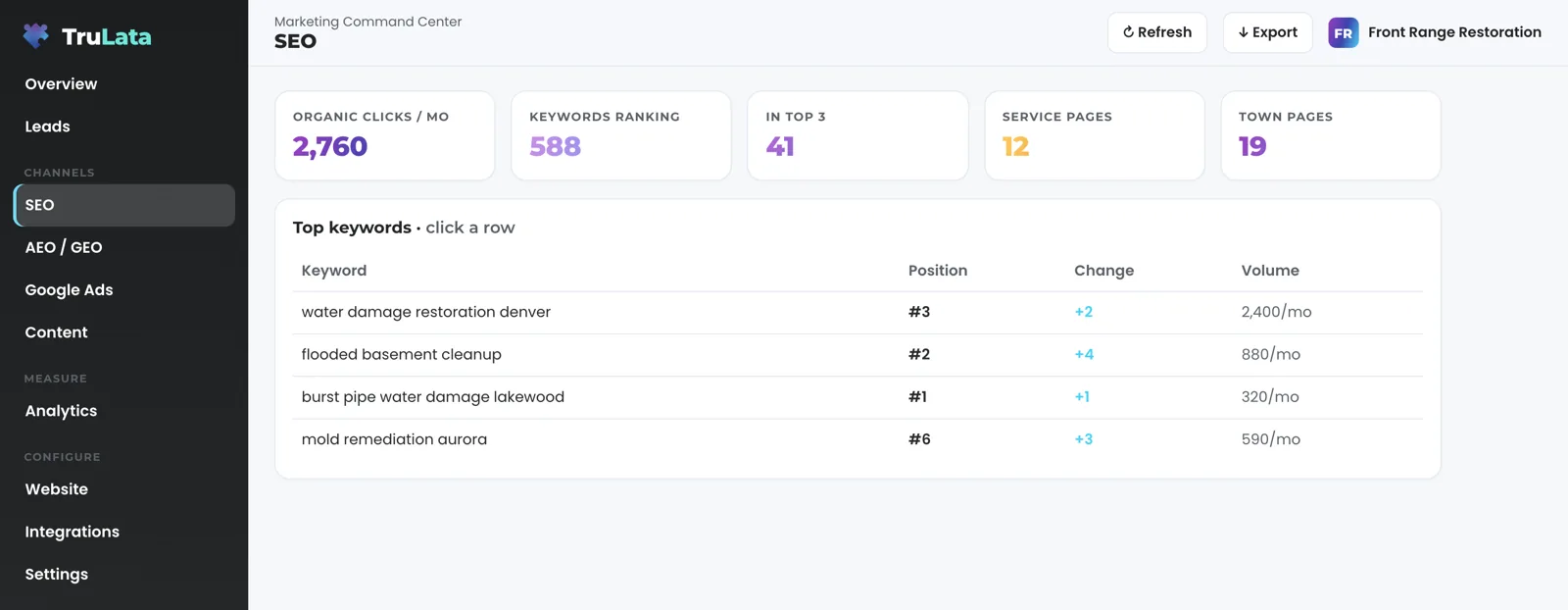
Your Google rankings stay on the search view, which reads Search Console: the queries you appeared for, impressions, clicks and average position, published two to three days behind. Keep the two apart and each number stays honest: the answer-engine score says whether the answers name you, the search view says where you rank.
How do I know whether the engines are naming me?
Ask and count. A fixed set of questions, written the way your buyers type them, goes to ChatGPT, Gemini, Claude, Grok, Manus, Google AI Overviews, Perplexity, Meta AI and DeepSeek through an API with live web search on. That is how a real person uses them, and an ungrounded model only recites what it memorised. Each question is asked bare, with no persona or preamble, because a wrapper changes what the engine retrieves and measures our prompt instead of your buyer's experience.
Every answer is read for your business name and recorded as cited or not cited, per engine, per question. The score is cited answers over answers received. A blank answer is a measurement error and leaves the denominator, staying out of the miss count, because an engine that returned a blank has not declined to name you. Open the view and you get the score, its change since the last run, the per-engine split and the literal list of questions where you were cited and where you were not. The score is taken at baseline and re-run as the program moves, and the date of the last run is stamped on the score detail.
- Ask the question bareThe way a buyer types it, no persona or preamble
- Web search onFor ChatGPT, Gemini, Claude, Grok, Manus, Google AI Overviews, Perplexity, Meta AI and DeepSeek alike
- Read each answerFor your business name: cited or not cited
- Score itCited answers over answers received; a blank leaves the denominator

Ask and count.
What do I change to get named more often?
Make the facts about your business agree everywhere an engine looks. Grounded engines read your Business Profile, directories and review sites directly, so the inputs that move search move this number too: pages that answer the buyer's literal question in plain words, structured data that says what you are and where you work, reviews and citations that agree with each other, and copy on your own site written to be quoted rather than skimmed.
Phrasing is the input most people miss. On one measured account, the same business in the same city was named by all four engines measured at the time for one wording of a question and by two of the four for a neighbouring wording. A question set skewed to one phrasing measures the phrasing, not the business, so the set spans the buyer's vocabulary before the number is worth moving. That work is the program behind the score, on all tiers, and the answer-engine view tells you whether it worked.

GEO, AEO, AI Overviews and SEO, in one table.
| Term | What it means | Where it is measured |
|---|---|---|
| Generative engine optimization (GEO) | Being the material a generative engine draws on to write its answer, across a category of buyer questions | Answer-engine view, per run, stamped with the run date |
| Answer engine optimization (AEO) | Being named in the answer a buyer receives on one question | The same view and the same measurement |
| Google AI Overviews | A generated summary at the top of a Google results page | Search view, via Search Console, 2 to 3 days behind |
| Search engine optimization (SEO) | Ranking on the results page and earning the click | Search view: average position, queries, impressions, clicks |
| The score | Cited answers over answers received; blank answers excluded | Per run, with change since the last run |
| Engines | ChatGPT, Gemini, Claude, Grok, Manus, Google AI Overviews, Perplexity, Meta AI and DeepSeek, each through an API | Fixed set, so runs are comparable |
Your GEO score is the share of answers received that name you, on a fixed set of questions your buyers ask, with the date of the last run on it.
Questions, answered.
Is generative engine optimization the same as answer engine optimization?
Close enough that TruLata measures both in one view. AEO is the citation on one question; GEO is how engines describe and recommend you across a whole category. The instrument is the same: ask, read, count.
Which engines count as generative engines?
ChatGPT, Gemini, Claude, Grok, Manus, Google AI Overviews, Perplexity, Meta AI and DeepSeek, each asked through an API with live web search on. The set is fixed so the score compares from one run to the next.
Are Google AI Overviews part of the GEO score?
Yes. Each question is searched on Google and the AI Overview at the top of the results is read, cited sources included, as one of the nine engines. A search with no AI Overview counts as not named. Your Google rankings stay on the search view.
How often is it re-scored?
At baseline and as the program moves. The score carries the date of its last run.
Does GEO replace SEO?
Buyers still use both, so the same screen carries a search view for average position, queries and clicks and an answer-engine view for citations. The facts, pages and reviews that feed one feed the other.
What does a good score look like?
One that moved for a reason you can open. The score is the share of answers received that named you, on a fixed question set, and every question behind it shows how many of the nine engines named you.
See how it would run
for your business.
15 minutes with TruLata. We show you what your marketing brings in, what each lead costs, and what we would change first.
Book a demo or start a 7-day free trial
No card. It ends on its own after 7 days unless you add one. See pricing.
New here? See what TruLata is. Prefer to write? Send us the one thing you want to know.
Start here: AI marketing platform · AI marketing software · all-in-one marketing platform · marketing automation software · marketing software for small business.
- Refreshed when you open itLive data on page load, never a monthly PDF
- Counted from your own formsLeads recorded server-side, compared daily with Ads and GA4
- Seen in AI answersHow often ChatGPT, Gemini, Claude, Grok, Manus, Google AI Overviews, Perplexity, Meta AI and DeepSeek name you, measured
- Every send loggedProspect emails leave from a review-first queue, and every send is logged.