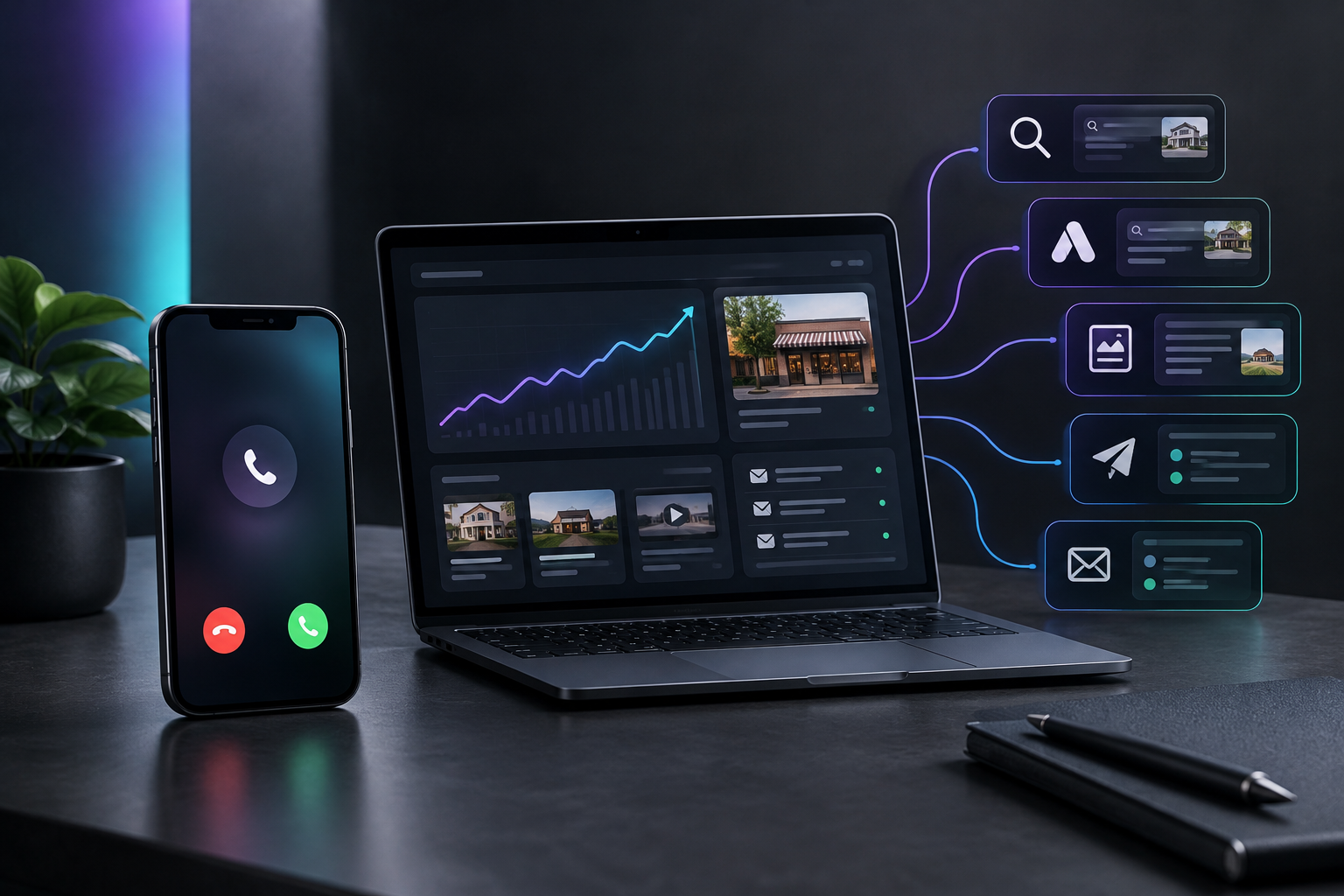

Contractor marketing services are the work that gets a trade business found and called: search visibility, Google and Meta ads, website content, reviews, email and outreach to new prospects. They help when they produce calls and form fills you can trace to a source, and when someone keeps the work running through busy and slow seasons.
Most contractors buy these services in one of three ways. They hire an agency, they use software and do the work themselves, or they use a platform that does the work and reports on it. This page explains what the services include, how the common options compare, and which one suits which kind of owner.
What do contractor marketing services include?
The label covers a lot. In practice it usually means some mix of the following, whether one company provides all of it or you assemble it from several vendors:
Each service and what it does
- Search visibilityGoogle Business Profile, local rankings, reviews
- Paid adsGoogle Search ads and Meta ads
- ContentService pages, project pages, articles
- Email and follow-upPast customer reminders, tune-ups, quiet quotes
- OutboundProperty managers, builders, commercial accounts
- TrackingWhich calls and forms came from which channel
- Search visibility: your Google Business Profile, local rankings for the jobs you want ("water heater replacement near me," "roof repair"), and reviews.
- Paid ads: Google Search ads for people already looking, and Meta ads (Facebook and Instagram) for homeowners in your service area who are not searching yet.
- Content: service pages, project pages and articles that answer what homeowners ask Google and AI assistants.
- Email and follow-up: reminders to past customers, seasonal tune-up campaigns, and follow-up on quotes that went quiet.
- Outbound: reaching out to property managers, builders or commercial accounts directly.
- Tracking: counting which calls and forms came from which channel, so you know what to keep paying for.
Tracking matters most and gets the least attention. Without it, an owner cannot tell whether the ads, the rankings or a referral filled last month's schedule. If you are weighing search work in particular, our guide to contractor SEO services and how they help covers that piece in more depth.
What makes marketing different for contractors?
Contractor marketing has to follow the calendar of the trade. Demand comes from weather, the season and the condition of the house, so the plan and the budget should move with it. A few facts from the industry press show what that looks like.
The contractor year follows the weather
- Summer gets busySend the summer message before the wave arrives
- Tune-up seasonNeeds a different message
- Furnace calls pick upWeather drives the peak
- Tune-ups before summerShoulder months when phones go quiet
- Quiet phoneResult of relaxing marketing in the busy season
Demand comes in waves you can predict. One HVAC owner writing in ACHR News on managing seasonality describes a year that will be familiar to most residential contractors. Summer is busy starting around Memorial Day. Tune-up season follows in August. Furnace calls pick up after the first snowfall, and March and April go to tune-ups before the next summer rush. Each of those waves calls for a different message, and the message should go out before the wave arrives.
Peak months are driven by weather. ACHR News reported that the July 2026 weather outlook pointed to higher cooling loads, stubborn humidity and weather-driven service calls. The article also noted that contractors increasingly face uneven demand across different climate patterns at the same moment. Ad budgets and messages that sit unchanged for a quarter fall behind conditions like these.
Many owners pull back on marketing at the worst time. Contracting Business notes that a common response is to relax marketing during the busy season and turn it up in the off-season. The result is a quiet phone in October. Busy months are also when crews hear the most from customers, which is useful material for reviews, project pages and follow-up lists.
Slow seasons can be planned for. The Air Conditioning Contractors of America describes the shoulder months between heating and cooling season as the time when phones go quiet. It recommends shifting teams from waiting for calls to making them. Outbound and email to past customers do that work.
Jobs vary widely in scope. The EPA's analysis of its renovation rule uses examples such as opening part of a wall to repair pipes or wiring, and replacing twelve windows in a single-family home. A contractor's marketing usually covers small repair jobs and larger projects at once, and each kind needs its own pages and its own ads.
What are the options, and how do they compare?
Most local service businesses choose from software they already know, all-in-one platforms, agencies, doing it themselves, or a newer kind of platform that does the work. The table summarizes each option. The notes underneath add context. Descriptions are kept at the category level where we cannot verify vendor specifics.
Option types and their limits
Field service software
- Jobber, Housecall Pro, ServiceTitan
- Built to run jobs
- Marketing is secondary
General platforms
- HubSpot, GoHighLevel
- Need someone to build campaigns
- Results depend on configuration
Agencies
- Scorpion or another agency
- Work handed to an outside team
- You see what reports show
Point tools and DIY
- Podium covers reviews and texts
- Doing it yourself suits very small shops
- Each covers only part of marketing
| Option | What it is | Best for | One honest limit |
|---|---|---|---|
| Jobber | Field service management software | Scheduling, quoting and invoicing for small crews | Built to run jobs, not to run ads or search |
| Housecall Pro | Field service management software | Home service teams that want dispatch and payments in one place | Marketing is secondary to operations |
| ServiceTitan | Field service management software aimed at larger contractors | Multi-truck operations with office staff | Someone still has to plan and run campaigns |
| HubSpot | CRM and marketing software | Teams with someone to build and maintain campaigns | A general business tool, not built around the trades |
| GoHighLevel | All-in-one marketing and CRM platform, often used by agencies | Owners or agencies who want to build their own setup | Results depend on whoever configures it |
| Scorpion | Marketing agency serving service businesses | Owners who want the work handed to an outside team | Agency model: you see what the reports show |
| Thryv | Small business software | Local businesses that want basic tools bundled together | Broad tool set, not specific to contractor demand |
| Podium | Customer messaging and reviews software | Getting reviews and replying to texts quickly | Covers one part of marketing, not ads or search |
| A marketing agency | An outside team that runs some or all channels | Owners who want to delegate fully | Quality varies by account manager |
| Doing it yourself | The owner or office manager runs the channels | Very small shops with time in the slow months | Stops when the busy season starts |
| TruLata | A platform that runs search, ads, content, outbound and email and reports on every lead | Service businesses that want the work done and want to see where every lead came from | Built for marketing, so you keep your job management software |
Field service software: Jobber, Housecall Pro, ServiceTitan
Many contractors already pay for one of these, and that is the right call for scheduling, dispatch and invoicing. These are operations tools. Some include marketing add-ons, but they do not plan a seasonal ad calendar or keep up your search rankings.
Keep the one you have. Ask a separate question about who generates the jobs that end up on its schedule.
General marketing platforms: HubSpot, GoHighLevel, Thryv
These give you the tools to build campaigns, forms and email sequences. HubSpot is a general CRM. GoHighLevel is widely used by agencies that resell it under their own brand. Thryv bundles basic tools for small businesses.
All three assume someone will do the building. With a capable office manager, that can work. If nobody has the hours, you end up paying for software that sits unused.
Point tools: Podium
Review and messaging tools do one job well. Reviews matter in local search, so the category earns its place. It is still one piece of marketing, and it will not run your ads or write your service pages.
Agencies, including Scorpion
An agency takes the work off your plate, and a good one knows the trades. The tradeoff is visibility. You see what the monthly report shows, and you have to trust that the leads in it are counted the way you would count them. Our breakdown of the best digital marketing agencies for small business covers the questions to ask before you sign.
Doing it yourself
Plenty of owners started this way, and in a slow month it is workable. The seasonal pattern above is why it fails. The weeks you most need marketing running are the weeks you are on roofs and in attics.
TruLata
TruLata is an AI marketing platform for local service businesses. It runs search, Google and Meta ads, content, outbound and email on a schedule. It counts every lead from your own website along with its source, and it shows what happened and what it cost on one dashboard. Prospect emails go out from a review-first queue, and every send is logged. The team behind it ran a marketing agency and turned that work into software. You can see the full sequence in how TruLata works.
Leads are counted from your own forms, not from an ad platform's claims, so the number you see is the number that reached you. More on that is in our page on lead tracking counted from your own forms. TruLata does not replace your scheduling or invoicing software, and it is not meant to.
Which one should you choose?
The right choice depends less on features than on two questions. Who will do the work every week, including in July? And how will you know which channel produced which job? Match your answers to the list below.
Match your situation to a choice
- Problem is running jobsField service software
- Someone in the office has hoursHubSpot or GoHighLevel
- Reviews and text replies are the gapA point tool such as Podium
- Want to hand off everythingAn agency
- One-truck shop, slow seasonDo it yourself
- Want scheduled work, traced leadsTruLata
- If your problem is running jobs, not finding them: field service software (Jobber, Housecall Pro or ServiceTitan, depending on size).
- If you have someone in the office with hours to build campaigns: a general platform such as HubSpot or GoHighLevel.
- If reviews and fast text replies are your gap: a point tool such as Podium.
- If you want to hand off the work entirely and are comfortable with a monthly report: an agency, Scorpion or otherwise.
- If you are a one-truck shop with a slow season to fill: do it yourself, starting with your Google Business Profile and reviews.
- If you want the work run on a schedule and every lead traced to its source: TruLata, alongside the job software you already use.
Whatever you pick, plan it around your season. Start tune-up and maintenance messages before the shoulder months. Keep ads and content running through the peak. Use the slow weeks for outreach and past-customer email. For trade-specific detail, our page on contractor marketing for construction companies covers how that plays out by trade.
How do you tell if contractor marketing services are working?
Ask for three numbers every month: how many calls and form fills came in, which channel each one came from, and what each channel cost. If a provider cannot give you all three from your own website data, you are paying for activity, not results.
- Count leadsCalls and form fills each month
- Trace the sourceWhich channel each one came from
- Check the costWhat each channel cost
- Compare to seasonOctober and July drops differ
- Move the budgetAct before a slow month becomes a slow quarter
Then compare those numbers against the season. A drop in October means something different from a drop in July. The point of tracking is to spot when a channel stops pulling its weight and move the budget before a slow month turns into a slow quarter. In TruLata, those numbers sit on your TruLata dashboard next to what each channel cost.
If you want to see that for your own business, book a walkthrough with TruLata. We will show you the dashboard, how leads are counted, and what a seasonal schedule would look like for your trade.