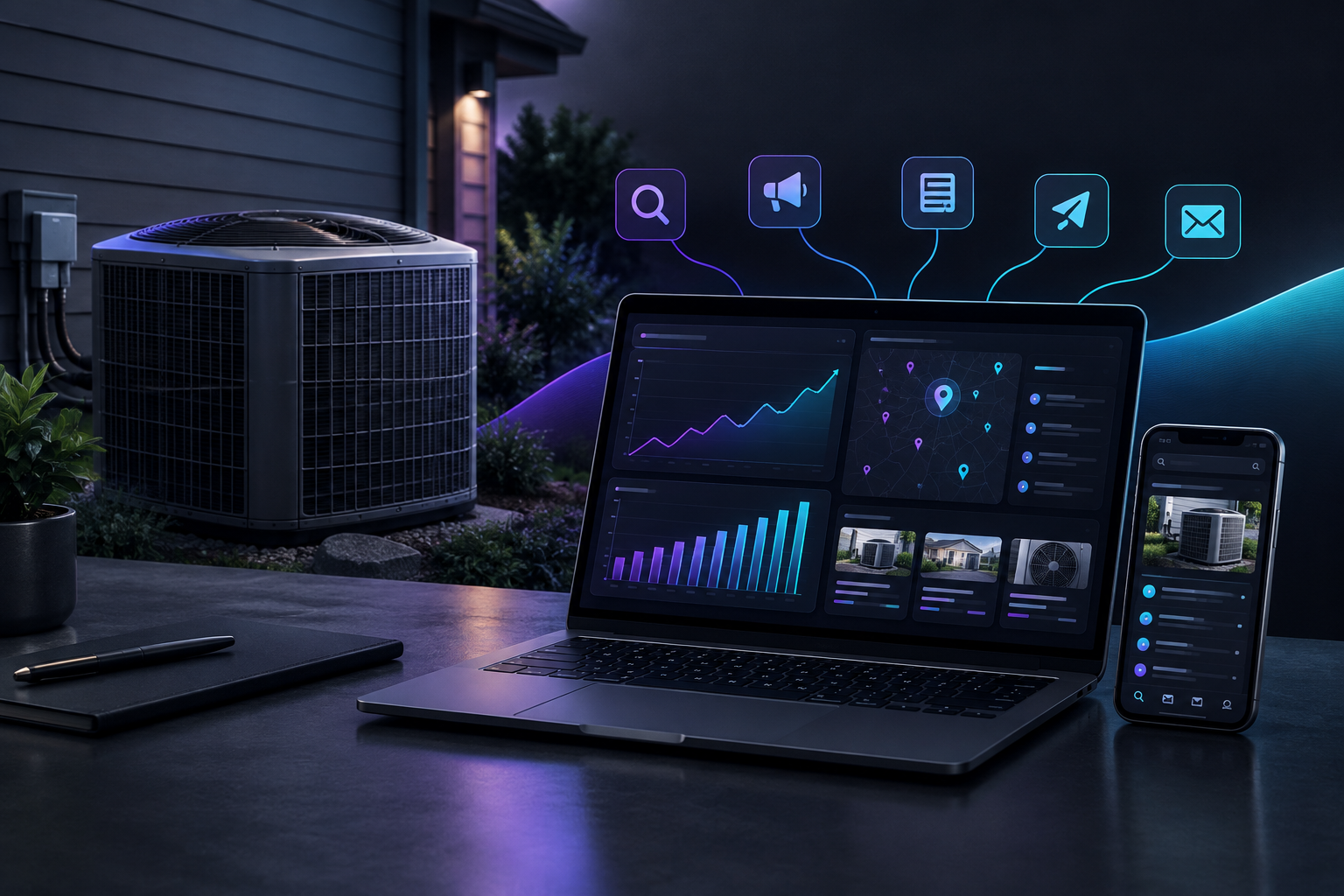



Yes, video marketing for small business is worth it when the videos answer the questions your customers already ask and sit where they look: your website, your Google listing, your ads and your social pages. Start with short, phone-shot clips of real jobs, publish them on a steady schedule, and track which ones lead to calls and form fills.
That is the whole answer. The rest of this guide covers what to film, who can make the videos, and how to tell whether they bring in work. It is written for plumbers, electricians, HVAC contractors, landscapers, cleaners, roofers and practices that need the phone to ring, not a viral moment. TruLata is an AI marketing platform for local service businesses. It runs search, Google and Meta ads, content, outbound and email on a schedule, and it counts every lead from your own site along with where that lead came from.
Why does video work for local service businesses?
A homeowner deciding who to let into their house wants proof before they call. A 40 second clip of your tech explaining a failed water heater, or a before and after of a cleaned patio, shows your crew, your trucks and how you talk to customers. A paragraph of copy can't do that. Video turns "a company near me" into "the people I just watched."
What a service business should film
Job walkthroughs
- Problem, fix, finished result
- Under a minute
Answer clips
- One common question per video
- Breaker tripping, lawn aeration
Meet the crew
- Short introductions
- Customers know who is coming
Customer reactions
- Happy customer on camera
- Permission first
Video also does more than one job. One clip can run as a Meta ad, sit on a service page, appear on your Google Business Profile and get cut into a short for social. When you plan video as part of your broader content, not as a separate project, each shoot pays off several times. Our guide to content marketing for small businesses covers how those pieces fit together.
What should a service business actually film?
Skip the brand film. The videos that earn calls tend to be plain and specific:
- Job walkthroughs: the problem, what you did, and the finished result, in under a minute.
- Answer clips: one common question per video, such as "Why is my breaker tripping?" or "When should I aerate my lawn?"
- Meet the crew: short introductions so customers recognize who is coming to the door.
- Customer reactions: a happy customer on camera, with their permission, beats any written claim.
- Process explainers: what happens at an estimate, how scheduling works, what to expect on install day.
Where should the videos go?
Post each video on the page that answers the same question, on your Google Business Profile, and on the social channel your customers use. Then test the strongest clips as ads. A video that already earns comments and saves organically is usually a better ad candidate than one made specifically for advertising. If social is your main channel, our guide to social media marketing for plumbers applies to most trades.
What makes marketing different for small businesses
Local service businesses don't sell on a smooth, year-round curve, and their video plan shouldn't assume they do. A few facts about how the trade works should shape what you film and when you publish it.
Film slow, publish ahead of the rush
- Film and edit a backlogDemand is lowest, so crews have time
- Publish aheadSearch interest rises before the work does
- Publish steadilyNobody has time to shoot
- Keep the format simpleA crew lead captures footage without stopping work
- Demand is seasonal, and cash follows it. The U.S. Small Business Administration has run sessions on planning for winter cashflow for owners who have a busy summer and then watch their balance shrink through the slow months. Many trades have that same strong-season, lean-season pattern.
- Search interest rises before the work does. Search Engine Land's guide to SEO seasonality uses a landscaping company as its example: it pauses new content in December and January, when demand is lowest, and refreshes its spring lawn care pages so they rank when more homeowners need the service in March. Video works the same way. Film in the slow season and publish ahead of the rush.
- Competitors set the pace in a seasonal market. An SBA workshop on competition in seasonal markets notes that competitors shape customer expectations, pricing and the pace of demand, and that every customer interaction carries outsized weight when demand rises and falls. Video lets customers compare you before they call.
- Labor is usually the largest cost. According to Forbes Advisor's small business statistics, labor is on average the biggest cost for businesses. Every hour a tech spends filming is an hour off the schedule, so a simple, repeatable shoot matters more than polish.
The practical takeaway is to use the slow season to film and edit a backlog, then publish steadily through the busy season when nobody has time to shoot. Keep the format simple enough that a crew lead can capture footage on a job without stopping work.
Who can make and run your videos? Comparing the options
Most owners weigh the same handful of paths: shoot it yourself, hire a freelancer, hand it to an agency or a social media management company, use an all-in-one local marketing suite or field service app, or use a platform like TruLata alongside your own footage. Each one solves a different problem, and none of them solves everything.
Produces the video
- Doing it yourself
- Freelance videographer
- Marketing agency
Runs and places it
- Social media management company
- All-in-one suite or field service app
- TruLata with your own footage
The table below gives the short version. The sections after it explain each option and the honest limit to plan around.
| Option | What it is | Best for | One honest limit |
|---|---|---|---|
| Doing it yourself | You or your crew film on a phone and post the videos yourselves | Owners who are comfortable on camera and want authentic job footage | Consistency drops as soon as the busy season starts |
| Freelance videographer | An independent shooter and editor hired per project | Polished hero videos, homepage clips, recruiting videos | Produces assets, not a publishing or tracking plan |
| Marketing agency | An outside firm that plans, produces and often places video and ads | Owners who want to hand off strategy and production together | Results reporting depends on the agency, and you rely on their schedule |
| Social media management company | A service that posts and manages content on your social channels | Businesses whose customers find them mainly on social | Usually focused on social rather than search, ads and lead tracking |
| All-in-one local marketing suite or field service app | Software built around scheduling, reviews, messaging or a CRM, with some marketing features | Owners who want operations and some marketing in one login | Video production and multi-channel campaigns are rarely the core product |
| TruLata | An AI marketing platform that runs search, Google and Meta ads, content, outbound and email on a schedule, and counts every lead from your own site with its source | Service businesses that want campaigns running consistently and every lead and cost on one dashboard | It is not a film crew, so your on-site footage still comes from you |
Doing it yourself
A modern phone, a clip-on microphone and decent daylight are enough for most job footage. DIY video tends to feel the most genuine because it is your crew on your jobs. The risk is consistency. When the phone rings all day in peak season, filming is the first thing to slip.
Freelance videographer
A freelancer makes sense for the handful of videos that should look polished: a homepage introduction, a recruiting video, a flagship service explainer. You get high-quality files. You don't get a plan for where those files go, how often they're published or whether they produce calls.
Marketing agency
An agency can handle strategy, production and ad placement in one engagement. That suits owners who want the whole thing off their plate. The limit is visibility and pace, since what you see and when you see it depends on how the agency reports. Our guide to what to expect from a marketing consultant lists questions to ask before signing.
Social media management company
These services post and manage your channels, often turning your raw clips into edited shorts. They fit businesses where social drives most enquiries. Most focus on social media itself, so search, paid campaigns and tracking calls back to a video are often handled elsewhere or not at all.
All-in-one local marketing suite or field service app
This category includes software built around job scheduling, invoicing, review requests, customer messaging or a CRM, with marketing features added. It keeps operations tidy. Video and multi-channel campaign work usually aren't what these tools are built around, so you'll likely still need another approach for the marketing itself.
TruLata
TruLata runs search, Google and Meta ads, content, outbound and email on a schedule. It counts every lead from your own site with its source, and it shows what happened and what it cost on one dashboard. The team behind it ran a marketing agency and turned that work into software. Your clips can feed the content engine and your ad campaigns, and lead tracking counted from your own forms shows which channel each enquiry came from. Outbound prospect emails leave from a review-first queue, and every send is logged. The honest limit is that TruLata doesn't send a camera operator to your job site, so the footage still comes from you or a videographer.
Which one to choose if...
The right choice depends less on video quality than on who will keep publishing when you're slammed, and whether you can see the results. Match your situation to the closest line below.
- Name your situationDecide who will keep publishing when you are slammed
- Match the closest linePick the option that fits that situation
- Combine if neededPhone footage, one professional shoot a year, a partner to publish
- Decide how you will measureSettle this before you start
- You enjoy being on camera and have a steady slow season: do it yourself, batch-film in the quiet months, and schedule the posts ahead.
- You need a few polished videos for the website or hiring: hire a freelance videographer for a one-time shoot.
- You want strategy, production and ads handed off entirely: a marketing agency, as long as reporting is spelled out up front.
- Your customers find you mostly on social media: a social media management company that edits and posts your clips.
- Your bigger problem is scheduling, invoicing or reviews: an all-in-one suite or field service app first, with marketing handled separately.
- You want search, ads, content and email running on a schedule, with every lead and its cost in one place: TruLata, with your own footage feeding the campaigns.
Many owners combine options. A common setup is phone footage from the crew, one professional shoot a year, and a platform or partner that keeps everything published and measured. Whichever you pick, decide in advance how you'll know whether the videos are working.
How do you measure whether video brings in jobs?
Views and likes are easy to count and rarely matter. What matters is whether someone who watched a video then called, booked or filled in a form. Put each video on a page with a clear call to action, use distinct landing pages for video ads, and record the source of every enquiry.
From a video to a measured job
- Video on a page with a call to action
- Video ad on its own landing page
- Which topics brought enquiries
- Which ads drew calls
- What each channel cost
Review results monthly. Look at which topics brought enquiries, which ads drew calls and what each channel cost. With your TruLata dashboard, leads, ad spend and content activity sit side by side, so you can film more of what works and drop what doesn't. If paid video is part of the mix, Facebook advertising for small businesses covers how to set up those campaigns.
Ready to turn your videos into booked jobs?
Video gets you noticed, but consistency and measurement are what turn it into work on the calendar. TruLata runs your search, ads, content, outbound and email on a schedule, counts every lead from your own site with its source, and shows what happened and what it cost on one dashboard.
What TruLata keeps running
- Search, ads, content, outbound, emailRun on a schedule
- Leads from your own siteCounted with their source
- One dashboardWhat happened and what it cost
- Your own footageKept working all year
Bring your footage, and let the platform keep it working all year, including the slow months. See how it fits your business and book a walkthrough at how TruLata works.