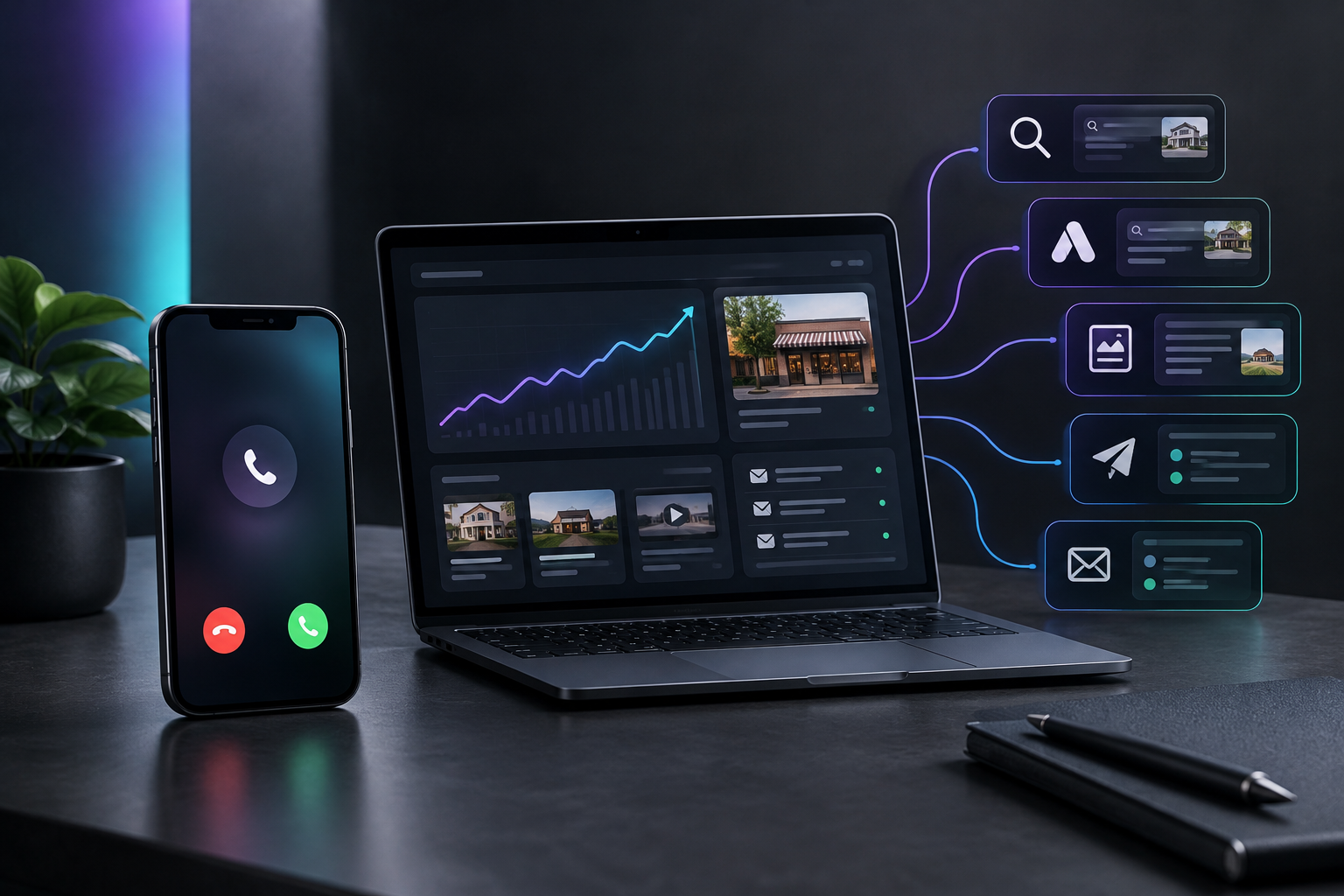

Local business social media marketing works when you post proof of real jobs in your service area, ask happy customers to share and review, and put a small, targeted ad budget behind your best posts during your busy season. Then you track which posts and ads produce calls and form leads, and cut the rest.
Most owners skip that last part, which is why social media feels like a chore with no payoff. Likes don't pay for trucks. This guide covers what makes social different for trades, home services and practices, how to build a routine you can keep, and an honest comparison of the tools and partners owners weigh. TruLata is one of those options: an AI marketing platform for local service businesses that runs search, Google and Meta ads, content, outbound and email on a schedule, and counts every lead from your own site with its source.
What makes marketing different for local service businesses?
A local service business is not selling to the whole internet. It sells to people within driving distance who usually need something fixed, cleaned, installed or treated, often on a timeline. That changes what social media is for. It is less about going viral and more about being the familiar, trusted name when a neighbor asks who to call.
Trade facts and what they mean for social
- Demand is seasonalFollow your own peak, not a generic calendar
- Home demand follows the housing marketExpect repairs, cleaning and painting after moves
- Slow seasons are for buildingBatch content and build review habits early
- Customers choose through trusted peopleEncourage shares and neighborhood tags
A few facts about the trade shape every decision that follows:
- Demand is seasonal. For many businesses, demand rushes in summer or peaks in winter, depending on the service, as Forbes Business Council notes on fluctuations in demand. Your posting and ad calendar should follow your own peak, not a generic content calendar.
- Home-related demand follows the housing market. The National Association of Realtors reports that home market activity advances in spring and summer, with seasonality varying by region. Moves and purchases trigger repairs, cleaning, painting and inspections, so many home service trades feel the same rhythm.
- Slow seasons are for building. Forbes Coaches Council recommends using an industry-specific slow season to refine systems, document processes and adopt new tools, including AI, that reduce future workload. For social, that means batching content and building your review and referral habits before the rush.
- Customers choose through people they trust. Forbes Finance Council advises asking loyal customers to spread the word on social media. For a local trade, a customer sharing your post or tagging you in a neighborhood group is worth more than any polished graphic.
What should a local service business post on social media?
Post what a nervous homeowner wants to see before inviting a stranger into their house: real work, real people, and real reasons to trust you. Before and after photos of jobs, short clips of the crew on site, a technician explaining a common problem in thirty seconds, and screenshots or quotes from reviews all outperform stock imagery because they prove you exist and do good work nearby.
- Two job postsOne before and after, one short field video
- One trust postA review, team intro, or licensing reminder
- One helpful postA seasonal tip answering a common phone question
- Reply dailyAnswer every comment and message the same business day
Mention the neighborhood or town where a job happened (never a customer's address). Local context tells both people and platforms who your post is for. If you want a deeper posting plan, our guide to a social media marketing strategy for small business walks through formats and cadence.
A simple weekly routine you can actually keep
- Two job posts: one before and after, one short video from the field.
- One trust post: a review, a team introduction, or a licensing and insurance reminder.
- One helpful post: a seasonal tip that answers a question customers ask on the phone.
- Daily: reply to every comment and message the same business day. A slow reply on social is a lost lead.
Which platforms matter most?
For most trades and home services, Facebook and Instagram (both run through Meta) carry the most local reach, and Meta's ad tools let you target by area. Nextdoor and local community groups matter for referrals. Pick one or two and do them well rather than five poorly.
Should I pay for social media ads or just post organically?
Organic posting builds trust with people who already know you. Paid ads reach people in your service area who don't know you yet. Most local service businesses need both, but the budget should flex with the season: lean in when demand rises and pull back when your schedule is full or the phone goes quiet for reasons ads can't fix.
Organic posting
- Builds trust with people who know you
- Shows your real work
Paid ads
- Reach people in your area who don't know you
- Boost your best job post to a tight radius
- Judge by calls and form leads, not likes
Start small. Boost your best-performing job post to a tight radius around your service area, run it for a week or two, and judge it by calls and form leads, not likes. Our guide to Facebook advertising for local businesses covers targeting and setup in detail.
How do I know if social media marketing is working?
Measure leads, not engagement. A post with a hundred likes and zero calls lost you an hour. A post with eight likes that produced two estimate requests won. To know which is which, every lead needs a source attached: which post, ad, page or search brought it in.
Tracking a lead to its source
- Post or ad
- Tracked link
- Caller answer to how they found you
- Know which post brought the lead
- See social alongside search, ads and email
Practically, that means sending social traffic to a page on your own website with a form, using tracked links, and asking every caller how they found you. It also means looking at social alongside search, ads and email, because a customer who sees your Facebook post often ends up searching your name on Google before calling. Tools that offer lead tracking counted from your own forms save you from stitching that together by hand.
What are the options for running local business social media marketing?
Owners usually weigh three kinds of help: field service software they already use, marketing software and CRMs, and people (an agency or themselves). Each solves a different part of the problem. The honest question is not which is best, but which gap you are trying to close: posting time, ad management, lead follow-up, or knowing what worked.
Option and what it is
- JobberOwners organizing jobs and customer records
- Housecall ProHome service teams running dispatch and billing
- ServiceTitanEstablished contractors with multiple crews
- HubSpotBroad CRM with marketing tools
- GoHighLevelOwners comfortable configuring their own funnels
- ScorpionOwners who want a done-for-you service
The descriptions below stick to categories where specifics aren't something we can verify. Check current features directly with any provider before you buy.
| Option | What it is | Best for | One honest limit |
|---|---|---|---|
| Jobber | Field service management software for scheduling, quoting and invoicing | Owners organizing jobs and customer records | Built around operations; social posting and ad management are not its core job |
| Housecall Pro | Field service management software for home service businesses | Home service teams running dispatch and billing | Operations first; a social strategy still has to come from somewhere |
| ServiceTitan | Field service software aimed at larger trade operations | Established contractors with multiple crews | Category tools of this size can take real time to set up and learn |
| HubSpot | A CRM and marketing software suite | Businesses that want a broad CRM with marketing tools | General purpose; someone must build and run the campaigns |
| GoHighLevel | A marketing and CRM platform commonly resold by agencies | Owners comfortable configuring their own funnels | Flexible tools still need someone to build and maintain them |
| Scorpion | A marketing provider serving local businesses | Owners who want a done-for-you service | As with any managed service, check how much reporting visibility you get |
| Thryv | Small business software combining marketing and management tools | Owners wanting one suite for customer communication | Suites spread across many jobs; depth in any one channel varies |
| Podium | Customer messaging and reviews software | Businesses focused on reviews and text communication | Centered on messaging and reviews rather than running full campaigns |
| A marketing agency | People you hire to plan and run your marketing | Owners who want hands-off execution | Results and reporting quality vary widely by agency |
| Doing it yourself | You or your team post, boost and track manually | Owners with time and interest | Busy season crowds it out exactly when it matters most |
| TruLata | An AI marketing platform that runs search, Google and Meta ads, content, outbound and email on a schedule | Service businesses that want marketing run and every lead counted with its source | A platform, not a field service tool; it doesn't replace your scheduling or invoicing software |
Field service software (Jobber, Housecall Pro, ServiceTitan)
These tools run the back office: scheduling, dispatch, quotes, invoices. They're valuable for keeping customers organized, and that customer list is useful for review requests and repeat business. The limit is that running social and ads is not their main purpose, so you'll still need a plan and someone to execute it.
CRMs and marketing suites (HubSpot, GoHighLevel, Thryv, Podium)
This group ranges from broad CRMs to messaging and review tools. They give you capabilities, and some are very flexible. The common limit is that a tool does not run itself: campaigns, posts and ad adjustments still need a person who knows what to do and has the time to do it.
A marketing agency or a managed provider (including Scorpion)
An agency gives you people and execution, which removes the time burden. The risk is visibility: you may get a monthly report that shows impressions rather than the calls and jobs each channel produced. Our article on choosing a social media agency for small businesses lists questions to ask before signing.
Doing it yourself
DIY costs nothing but time and gives you the most authentic content, since nobody knows your jobs better than you. It breaks down in your busy season, when posting falls behind job number one. If you go this route, batch content during slow months, as the Forbes advice above suggests.
TruLata
TruLata runs search, Google and Meta ads, content, outbound and email on a schedule, counts every lead from your own site with its source, and shows what happened and what it cost on one dashboard. Prospect emails leave from a review-first queue and every send is logged. It was built by a team that ran a marketing agency and turned that work into software. You can see how TruLata works or open your TruLata dashboard in a demo to judge it yourself.
Which one should I choose if...?
The right choice depends on what's actually stuck. Match your situation to the option below, and remember many owners combine a field service tool with a marketing option.
- Find what is stuckScheduling, reviews, campaigns, or full handoff
- Match the optionField tool, reviews tool, CRM, suite, agency, or DIY
- Combine if neededMany owners pair field service with marketing
- Apply one standardCan it show which channel produced which lead?
- If your scheduling and invoicing are a mess: fix operations first with field service software like Jobber, Housecall Pro or, for larger crews, ServiceTitan.
- If you mainly need more reviews and faster replies: a messaging and reviews tool like Podium fits that narrow job.
- If you have someone in house who enjoys building campaigns: a flexible CRM or platform like HubSpot or GoHighLevel gives them room to work.
- If you want one suite for communication and basic marketing: look at Thryv and similar all-in-one tools.
- If you want people to handle everything: a marketing agency or managed provider such as Scorpion, as long as reporting ties to leads.
- If you have time and a camera: do it yourself, and batch content in the slow season.
- If you want search, ads, social content and email run on a schedule with every lead traced to its source: TruLata.
Whatever you pick, hold it to one standard: can it tell you which channel produced which lead last month? If it can't, you're guessing.
Ready to see which posts and ads bring in your jobs?
Social media should be one channel in a system that also covers search, ads, content and email, with every lead counted from your own site and tied to its source. That's what TruLata runs for local service businesses, and you can see what happened and what it cost on one dashboard.
What TruLata brings together
- Search
- Ads
- Social content
- Leads counted from your own site
- Each lead tied to its source
- What happened and what it cost
Walk through the live demo, look at real dashboards, and decide whether it fits how you run your business. Book a TruLata demo and see your marketing, and your leads, in one place.