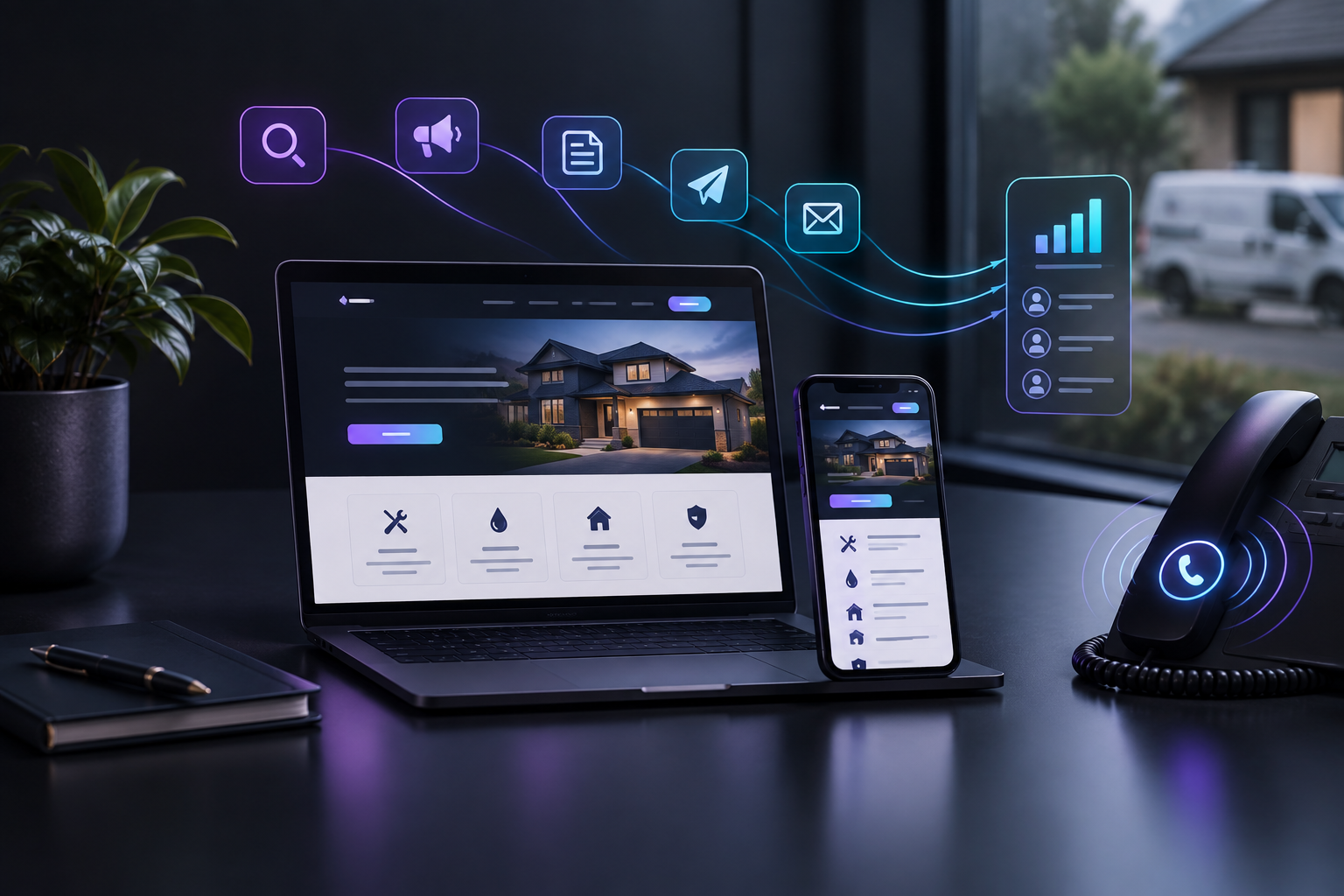



An agency alternative saves a contractor money only if four jobs keep running without the owner: ad accounts get watched, leads get counted, content goes out, and someone sees the results. Software that hands those jobs back to you adds overhead. Before switching, count the setup hours and the weekly hours the tool will actually need.
Most contractors who drop agency help want two things: a smaller monthly bill and fewer phone calls about marketing. The first is easy. The second is where many switches fail. A roofer buys a tool, spends a weekend connecting accounts, and by month three the campaigns haven't been touched, the blog is stale, and nobody can say which jobs came from which channel. The bill went down and the marketing stopped.
TruLata is an AI marketing platform for local service businesses such as contractors, HVAC companies, plumbers, roofers and landscapers. It runs search, ads, content and outbound work and shows what it did on one dashboard. This article explains what any agency alternative, TruLata included, has to do before the switch is worth it.
What does an agency actually do that a tool has to replace?
Ignore the logo on the monthly report and list the recurring work. For a typical home service business, an agency handles some version of this:
- Paid search upkeep: checking budgets, pausing waste, adjusting bids and adding negative keywords so the account doesn't spend on irrelevant searches.
- Local search presence: keeping the Google Business Profile current, responding to reviews and tracking where you rank for service and city terms.
- Content: service pages, blog posts and seasonal updates that give search engines and AI answer engines something to cite.
- Lead accounting: working out which calls and form fills came from which channel.
- Reporting: turning all of the above into something an owner can read in five minutes.
An agency alternative has to cover each of those jobs, or you have to accept that one will stop. Most failed switches drop one or two of them without anyone noticing, usually ad upkeep and lead accounting, because those are the least visible until money is gone.
Which of those jobs fail quietly?
Content gaps are easy to see because the blog stops updating. Ad accounts drift with no visible sign: a broad match keyword starts pulling junk searches, the cost per lead creeps up, and the account keeps spending. Lead accounting fails the same way. If form submissions aren't tied to a source, the business keeps paying for whatever channel sounds busiest. Any tool you consider should handle these two jobs before anything else.
Build vs. agency: what are you really choosing between?
The build vs. agency decision usually gets framed as cost. It's really a decision about who carries the operational load. There are three realistic setups:
- Agency: people do the work on their schedule and report to you.
- Self-service marketing platform: you get the tools and templates, and you or a staff member do the work.
- Software that runs the work: the platform does the recurring tasks and shows you the record, and you review and decide.
Option two is where most of the disappointment sits. A self-service marketing platform can be excellent software and still be the wrong purchase for a contractor running crews six days a week. It assumes someone has a standing block of time to build campaigns, write emails, set up automations and read reports. If that person doesn't exist, the platform becomes a login nobody uses.
Be honest about which option you are buying. Plenty of in-house marketing software is sold with language about automation when the product is really a toolkit. Check what happens on a normal Tuesday when you don't log in. If the answer is "nothing," you've bought a toolkit.
How much setup does in-house marketing software take?
Setup is the cost buyers underestimate most, because it happens once and gets done in a rush. Expect these tasks no matter which product you choose:
Account connections
Google Ads, Google Business Profile, Search Console, Analytics, your website and your email sending domain all need connecting, with the right permissions. Contractors often find that an old agency or a former office manager still owns one of these accounts. Recovering access can take days. Start there before you cancel anything.
Tracking
Your forms need to report into the system, and call tracking numbers need to be in place if you rely on phone leads. Without this, every later report is guesswork. A platform built around lead tracking counted from your own forms saves you from reconciling numbers that the ad platforms report about themselves.
Business context
Service areas, services you want more of, services you don't want (many plumbers don't want small drain calls in peak season), pricing posture, brand voice, and competitors. A tool that writes content or runs ads with no context produces generic output. Plan a few hours to write this down once.
Templates and automations
On a self-service marketing platform, this is where the bulk of the setup sits: building email sequences, landing pages, follow-up workflows and report layouts. Some contractors enjoy it. Most stall halfway. We cover the common failure points in why marketing automation setup fails.
Practical rule: ask the vendor for a written list of every setup step and who does each one. If most of the list says "you," budget your own time accordingly, or assign it to a specific person by name.
How much ongoing time does an agency alternative need each week?
There's no single honest number, because it depends entirely on which jobs the software does and which it leaves for you. Estimate your own figure by walking through each recurring job:
- Ads: Does the tool check the account every day and flag or fix waste, or does it show you a chart and leave the changes to you? Weekly manual review of a Google Ads account, done properly, is a recurring block of time.
- Content: Does it draft and publish, draft and wait for approval, or give you a blank editor? Each step down that list adds hours.
- Reviews and profile: Are review responses drafted for you? Are profile changes suggested?
- Outbound: If you prospect commercial accounts or property managers, who writes and sends the emails, and is there a record of every send?
- Reporting: Can you see results without exporting data or building a report?
Add up the "you" answers and put a realistic time next to each. Then ask whether those hours exist in your current week. If they belong to the owner, cost them at what the owner's time is worth on estimates and job sites, which is usually far more than any software line item.
What a reasonable weekly routine looks like
With software that does the running, the owner's routine should be short and consistent: open the dashboard, look at leads by source, read what changed in the ad account, approve or edit drafted content and queued outreach, and note anything that needs a decision. If the routine you're being sold has no set length and depends on "when you get time," expect it to stop by the second busy season.
What should an agency alternative show you so you can trust it?
An agency gives you a person to ask. Software gives you a record. That record has to be good enough to replace the conversation. Look for these:
- A log of actions taken. Not just results, but what the system did: which keywords were paused, which posts went out, which emails were sent.
- Current data. Monthly PDFs arrive too late to act on. You should see numbers as of when you open the screen.
- Leads tied to sources. Counted from your forms and calls, not taken from each ad platform's self-reported conversions.
- Search and AI visibility. Rankings and reviews still matter, and homeowners increasingly ask ChatGPT, Gemini, Claude or Grok who to call. You should know whether your business gets named.
This is the gap TruLata was built to close. Your TruLata dashboard shows what the platform did and what came of it, from the daily ad account watch to content published, outreach sent and leads by source. You can read the full sequence in how TruLata works.
How does TruLata handle the jobs that usually fall through?
Taking the quiet failures from earlier one at a time:
Paid search
TruLata provides Google Ads reporting with a daily account watch. The account gets checked every day for spend problems and wasted search terms, and you see what was found and what was done about it. You don't need to log into Google Ads to know whether last week went well.
Lead accounting
Leads are counted from your own forms, so the number on your screen comes from your website rather than an ad platform crediting itself. That makes it possible to compare channels fairly and cut the one that isn't producing jobs.
Content and visibility
TruLata produces service pages and posts and tracks both search rankings and AI visibility across four answer engines, so you can see whether content is moving either one.
Outbound
For contractors who sell to commercial clients, property managers or builders, TruLata runs outbound prospecting from a review-first queue. Prospect emails leave from that queue, and every send is logged, so you can see exactly what went out under your name.
How do you test an agency alternative before you cancel?
Don't run the switch as a single cutover. Run it as a test with a clear finish line:
- Secure ownership first. Confirm you own the Google Ads account, Business Profile, Analytics, Search Console and domain. Move admin access to an owner-controlled email.
- Set a baseline. Write down current monthly leads by source, ad spend and cost per lead, using your own form and call records.
- Overlap briefly. Connect the new platform while the old arrangement is still active, so tracking is in place before anything changes.
- Time your own involvement. For the first month, note every minute you spend in the tool. This is the real number to compare.
- Check the quiet jobs. At the end of each week, confirm the ad account was reviewed, leads were attributed and content went out.
- Decide on evidence. Compare leads, cost per lead and your hours against the baseline. If leads held or improved and your hours fit your week, the switch worked.
If any step fails, you've learned it cheaply and with your accounts intact.
When is a self-service tool the wrong agency alternative?
Be direct with yourself about these situations:
- You have no one with a recurring time block for marketing, and the tool expects one.
- Your lead volume depends heavily on paid search, and the tool reports on ads without watching them.
- You can't currently say where your leads come from, and the tool doesn't fix that.
- You're buying because the demo looked easy, without a written list of the work that stays with you.
In any of these cases, a cheaper subscription can cost more than the arrangement it replaces, because the work that kept the phone ringing stops.
Ready to see what the work looks like before you switch?
The right agency alternative runs the recurring work, shows you a record of it, and asks for a short, fixed slice of your week. TruLata does that for local service businesses: daily ad account watch, leads counted from your own forms, content, search and AI visibility tracking, and logged outbound, all on one dashboard. Open the live demo on our product pages, look at what the screen shows on a normal week, and measure it against the hours you have.