

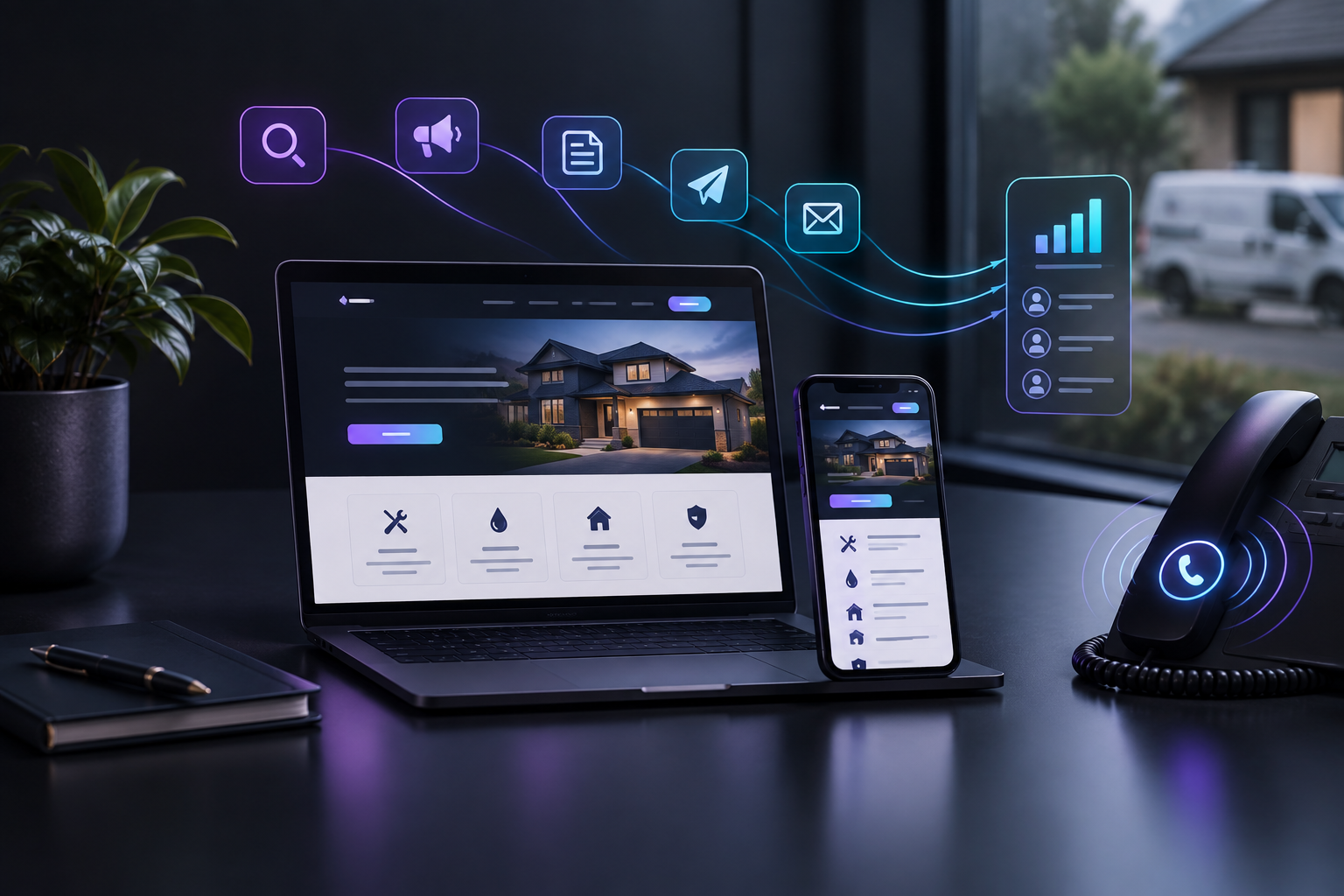

AI software that builds and manages a website for a small service business falls into four groups: AI website builders, field service platforms with web tools, all-in-one marketing platforms, and agencies. The right pick depends on whether you only need pages online or a site that brings in calls and shows where each lead came from.
Most owners shopping for this want a site that stays current, ranks in local search, feeds ads and email, and brings in calls. TruLata is one option for that second goal: an AI marketing platform for local service businesses that runs search, ads, content, outbound and email around your existing website and counts every lead it produces. Below is a comparison of the options that trades, home service companies and practices commonly weigh.
What does "builds and manages a website" actually mean for a service business?
Getting a site online is the quick part. Modern tools can produce a clean, mobile-friendly site with service pages, a contact form and a click-to-call button in an afternoon. The harder part is "managing," which for a plumber, roofer, HVAC contractor or dental practice means keeping service and location pages fresh, publishing useful content, connecting the site to Google and Meta ads, following up with leads by email, and knowing which of those efforts produced booked jobs.
Building a website
- Clean, mobile-friendly site
- Service pages and contact form
- Click-to-call button
- Quick, done in an afternoon
Managing a website
- Fresh service and location pages
- Useful content published
- Google and Meta ads connected
- Email follow-up with leads
- Knowing which efforts booked jobs
Some tools are excellent at the first job and stop there. Others ignore page building entirely and focus on running the marketing that sends people to your site. Decide whether you are hiring for building or for managing before you compare vendors. If your site already exists and works, the gap is usually management and measurement, not a new design. If you have no site at all, you need a builder first, then something to drive traffic to it.
Three questions to answer before you shop
- Do you need new pages, or more calls from the pages you have? These are different purchases.
- Who will run it week to week? Some tools hand you a toolkit; others run the work on a schedule.
- Can you see where each lead came from? If a tool cannot tell you which search, ad or email produced a call, you cannot judge whether it is working.
Which options should a local service business compare?
The options below are the ones service business owners commonly weigh. Where we describe other companies, we describe the category they sit in rather than specific features or prices, because those change often and you should confirm them directly with each vendor during a demo.
Option categories to compare
Jobber
- Field service management
- Fits owners busy running jobs
- Marketing beyond basics needs add-ons
Housecall Pro
- Field service management
- Fits small crews, office in one app
- Built around the job after the call
ServiceTitan
- Larger trade contractors
- Fits firms with office staff
- Heavy setup for a small shop
HubSpot
- CRM and marketing suite
- Fits people who enjoy configuring
- You supply strategy and content
Jobber
Jobber is field service management software: scheduling, quoting, invoicing and client management for home service crews. It fits owners whose main pain is running jobs and getting paid. Its honest limit as an answer to this question is that its core is operations, so marketing beyond the basics usually means adding other tools or help.
Housecall Pro
Housecall Pro is also field service management software aimed at home service businesses, covering dispatch, booking and payments. It fits small crews that want the office side organized in one app. Like other operations platforms, it is built around the job after the customer calls, not primarily around generating the call.
ServiceTitan
ServiceTitan is field service software built for larger residential and commercial trade contractors. It fits established companies with office staff and multiple technicians. The honest limit for a small shop is that enterprise-grade operations software typically asks for more setup and administration than a lean team can give.
HubSpot
HubSpot is a CRM and marketing software suite used across many industries. It fits businesses with someone who enjoys configuring tools and building campaigns. Its limit for a trade business is that it is general purpose: you supply the strategy, content and ongoing work.
GoHighLevel
GoHighLevel is an all-in-one marketing platform widely used by agencies to build funnels, sites and automations. It fits owners or agencies willing to build and maintain their own setup. The limit is that it is a toolkit, so results depend on who builds and runs it.
Scorpion
Scorpion is a marketing company serving home service and other local businesses, combining websites with managed marketing. It fits owners who want a done-for-you relationship with a provider. As with any managed provider, how clearly you can see what was done and what it produced depends on the reporting you are given.
Thryv
Thryv is small business software that bundles customer management and marketing tools, often alongside directory-style services. It fits owners who want one subscription for several basic needs. The limit is that bundled tools tend to cover each job lightly.
Podium
Podium is customer messaging software focused on texting, reviews and communication with local customers. It fits businesses whose biggest gap is reviews and response speed. It is not a website builder or a full marketing engine, so it usually sits alongside other tools.
A marketing agency
A local or specialist agency designs your site and runs your marketing for a retainer. It fits owners who want a person to call and are comfortable delegating. The honest limit is visibility: you often see a monthly report rather than live data, and quality varies widely from one agency to the next.
Doing it yourself
Using an AI website builder and running your own ads and posts is the lowest-commitment route. It fits new businesses and owners who like the work. The limit is time: marketing competes with jobs, and it is usually the first thing dropped in busy season.
TruLata
TruLata, the AI marketing platform, runs search, Google and Meta ads, content, outbound and email on a schedule for local service businesses. It counts every lead from your own site with its source and shows what happened and what it cost on one dashboard. It was built by a team that ran a marketing agency and turned that work into software. Its honest limit for this question: TruLata is focused on running and measuring the marketing around your website, so if you have no site at all, you will still need one in place.
| Option | What it is | Best for | One honest limit |
|---|---|---|---|
| Jobber | Field service management software | Crews focused on scheduling, quoting and invoicing | Operations first; marketing depth needs other tools |
| Housecall Pro | Field service management software for home services | Small crews organizing dispatch and payments | Built around the job after the call |
| ServiceTitan | Field service software for larger trade contractors | Established companies with office staff | More setup and admin than a lean team may want |
| HubSpot | General CRM and marketing suite | Owners with someone to configure and run it | You supply the strategy and ongoing work |
| GoHighLevel | All-in-one marketing toolkit often used by agencies | Builders who want to assemble their own system | Results depend on who builds and runs it |
| Scorpion | Marketing company for local and home service businesses | Owners who want a managed provider | Visibility depends on the reporting provided |
| Thryv | Bundled small business software | Owners wanting one subscription for basics | Breadth over depth |
| Podium | Customer messaging and reviews software | Businesses focused on reviews and response speed | Not a website or full marketing engine |
| Marketing agency | People who build your site and run campaigns | Owners who prefer to delegate fully | Often monthly reports instead of live data |
| Doing it yourself | AI site builder plus your own ads and posts | New businesses and hands-on owners | Time; it slips in busy season |
| TruLata | AI marketing platform running search, ads, content, outbound and email | Service businesses that want marketing run on a schedule and every lead counted with its source | Runs the marketing around your site; you still need a site in place |
How does TruLata manage the marketing around your website?
TruLata treats your website as the place leads land, then runs the work that sends people there. On a schedule, it handles search visibility, Google and Meta ads, new content, outbound prospecting and email. Prospect emails leave from a review-first queue and every send is logged, so you always know what went out in your name. If you want the step-by-step picture, here is how TruLata works from setup onward.
How TruLata runs the work around your site
- Search visibility
- Google and Meta ads
- New content
- Outbound prospecting
- Lead counted with its source
- Results and cost on dashboard
- Review-first send log
TruLata counts each lead from your own site's forms and records its source, then shows what happened and what it cost on your TruLata dashboard. That means you can see whether this month's calls came from search, ads or email instead of guessing. For a deeper look at that question, see our guide to tracking where every lead came from.
What makes marketing different for local service businesses
Demand for service businesses swings with the season. Summer is often the busiest season for home service businesses, as maintenance deferred over winter piles up and homeowners work through their to-do lists, according to Forbes. The same piece notes that summer storms and heat waves can double demand overnight, giving HVAC and plumbing companies sudden scheduling spikes.
The service business demand year
- Build capacityGet website content, ads and email moving early
- Pending home sales riseHousing activity picks up
- Sales peakSummer is often the busiest season
- SlowdownCold weather, travel and fewer listings
Housing activity, which drives a lot of renovation and repair work, follows a similar rhythm. The National Association of Realtors reports that pending home sales rise in March and peak in June, while November through January often brings a slowdown tied to cold weather, travel and fewer listings. For many trades, that is the window when marketing has to work hardest to keep the schedule full.
Preparation timing matters too. Writing about busy-season readiness, Forbes recommends building capacity at least two months before peak demand. Applied to marketing, that means your website content, ads and email should be in motion well before the rush, not launched in the middle of it. A system that runs on a schedule keeps that work going even when every truck is out.
Which one to choose if...
Some owners buy a new website when nobody is running the marketing, or buy marketing when the office cannot keep up with calls.
Match your situation to an option
- No website, tight budgetAI site builder, then marketing
- Bottleneck is scheduling and invoicesJobber, Housecall Pro or ServiceTitan
- Someone loves building systemsHubSpot or GoHighLevel
- Gap is reviews and fast repliesPodium
- Want one basic bundleThryv
- Want to hand it all offAgency or Scorpion
- Want scheduled marketing, visible lead costsTruLata
- You have no website yet and a tight start-up budget: do it yourself with an AI site builder, then add marketing once the site is live.
- Your bottleneck is scheduling, quotes and invoices: a field service platform like Jobber, Housecall Pro or, for larger operations, ServiceTitan.
- You have someone who loves building systems: HubSpot or GoHighLevel.
- Your biggest gap is reviews and fast replies: Podium.
- You want one basic bundle: Thryv.
- You want to hand it all to a person: an agency or a managed provider such as Scorpion, with clear reporting agreed up front.
- You have a site and want search, ads, content, outbound and email run on a schedule, with every lead and its cost visible: TruLata.
Some businesses pair a field service platform for operations with a marketing platform for lead generation. If you are weighing outside help against software, our comparison of marketing agency vs marketing software walks through the tradeoffs.
How do you get started without wasting a season?
Check that your site loads quickly on a phone, lists each service and area clearly, and has a working form and call button. Then confirm you can see where leads come from today. If you cannot, fix that first, because every later decision depends on it.
- Check your siteLoads fast on phone, clear services and areas, working form and call button
- Confirm lead sourcesMake sure you can see where leads come from today
- Pick by biggest gapChoose the option that matches your gap
- Run a full cycleDo it before the busy season starts
- Review the dashboardOpen the live demo to see TruLata yourself
Next, pick the option above that matches your biggest gap and run it for a full cycle before the busy season starts. If running the marketing and seeing every lead with its source is the gap, open the live demo and look at the TruLata dashboard yourself.