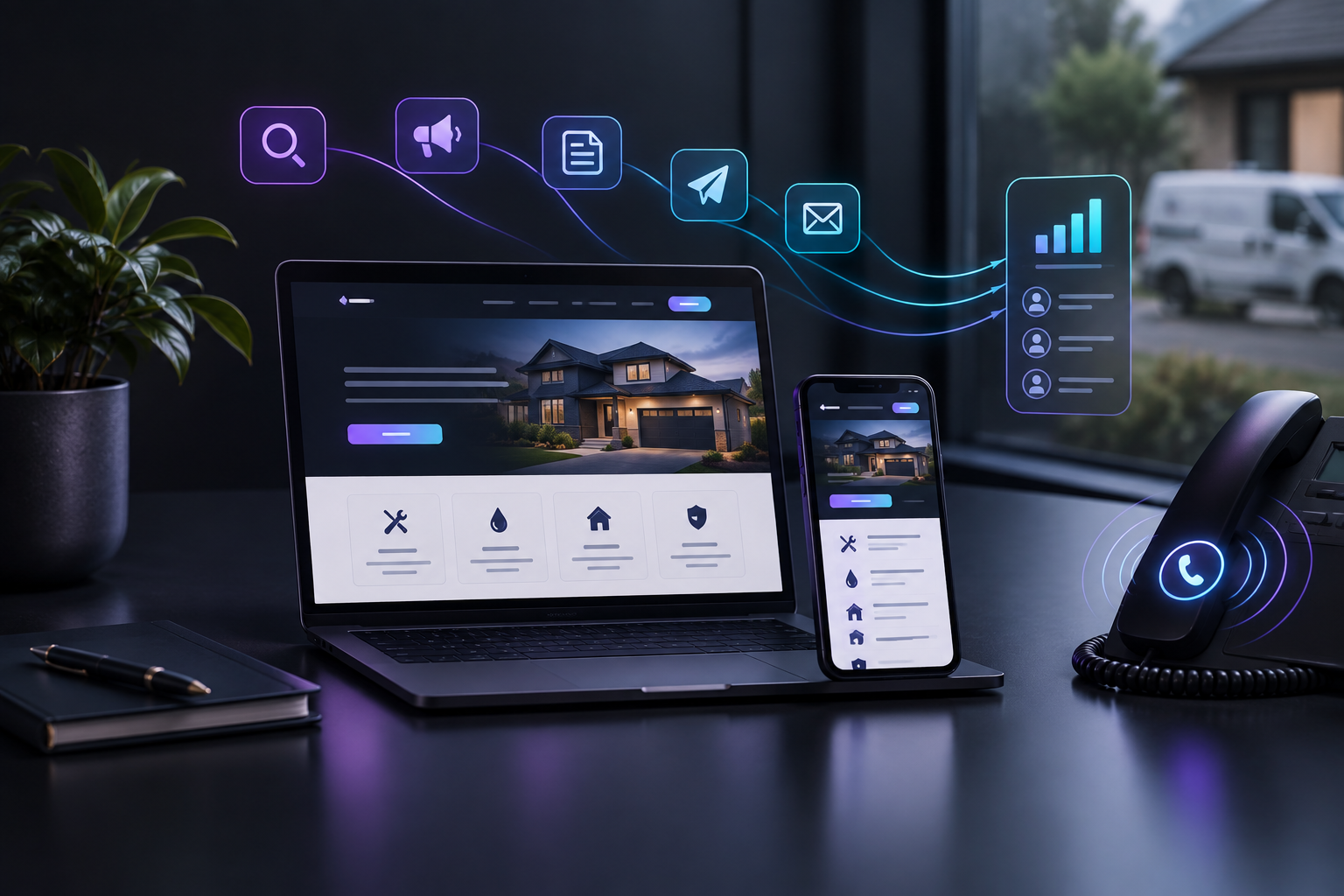



The best marketing automation platform for a small service business in 2026 depends on what you need automated. If you need help running jobs, a field service tool like Jobber or Housecall Pro is the fit. If you need the marketing itself run and every lead traced to its source, you need a platform built for that, such as TruLata.
Most owners asking this question already have a scheduling tool, a website and a Google Business Profile. What they lack is a clear view of which marketing produces calls, and the time to keep it all running. The sections below compare the real options a trades, home services or practice owner weighs, with one honest limit for each. They then match each kind of owner to the option that suits them.
What does "marketing automation" mean for a service business?
For a retailer or a software company, marketing automation usually means email sequences and lead scoring. For a plumber, roofer, dental practice or landscaper, it means something more practical. Your search listing stays current. Your ads get watched daily. Content gets published on a schedule. Past customers hear from you before the busy season. And when the phone rings, you know which channel made it ring.
What each kind of tool automates
Field service app
- Invoices
- Reminders
Email tool
- Newsletters
Builder platform
- Anything, if you build it
Service business needs
- Listing kept current
- Ads watched daily
- Content on a schedule
- Past customers contacted
- Know which channel got the call
That distinction matters because many tools sold as "automation" automate only one piece. A field service app automates invoices and reminders. An email tool automates newsletters. A builder platform gives you the parts to automate anything, if you build it. Before you compare products, write down which of those jobs you want off your plate. Our earlier piece on why marketing automation setup fails covers the most common mismatch: buying a toolkit when you wanted the work done.
What makes marketing different for local service businesses?
Local service marketing runs on a calendar that most software ignores. These facts about the trade should shape what you buy.
The local service calendar
- SlowdownPending home sales dip
- Sales risePending home sales start climbing
- PrepareLine up capacity, get campaigns and content live
- PeakHome sales peak, National Homeownership Month
- Busiest stretchDeferred maintenance drives demand
- Sudden spikesStorms and heat waves can double demand overnight
- Summer is the peak for most home services. Maintenance deferred through winter, plus National Homeownership Month in June, makes summer the busiest stretch for many home service companies, according to Forbes.
- Emergency trades get spikes they cannot schedule. The same Forbes piece notes that storms and heat waves can double demand overnight, so HVAC and plumbing firms see sudden scheduling surges.
- Housing activity follows the seasons, and home projects follow housing. The National Association of Realtors reports pending home sales rise in March and peak in June, with a slowdown from November through January. Moves drive inspections, repairs and remodels, so trades tied to home sales feel the same curve.
- Preparation has to start well before the rush. Advice in Forbes on peak-season readiness is to line up extra capacity at least two months before the busy season begins. For marketing, that means campaigns and content should be live before demand arrives, not launched once it does.
- Customers come to you, or you go to them, but it stays local. Search Engine Land points out that many services still require an in-person provider, which is why local search and reputation decide who gets the call.
The practical takeaway: a platform that runs the same activity every month regardless of season leaves calls on the table in spring and wastes effort in December. Whatever you choose, check whether it lets you plan around your own busy and slow months.
Which marketing automation platforms do service businesses actually compare?
Here are the options owners most often weigh. Where a vendor's specifics are not something we can verify from independent sources, we describe the category it belongs to rather than guess at features or prices.
Option and its honest limit
- JobberBuilt for running jobs, not marketing channels
- Housecall ProMarketing sits alongside operations
- ServiceTitanSized for bigger operations
- HubSpotLocal service setup is on you
- GoHighLevelYou assemble and maintain it
- ScorpionYou depend on the account team
- ThryvBroad focus, not a specific trade
- PodiumNo ads, content or search
| Option | What it is | Best for | One honest limit |
|---|---|---|---|
| Jobber | Field service management software | Small crews organizing quotes, scheduling and invoicing | Built around running jobs, not running your marketing channels |
| Housecall Pro | Field service management software | Home service teams wanting scheduling, dispatch and payments in one app | Marketing features sit alongside operations rather than replacing a marketing function |
| ServiceTitan | Enterprise field service platform | Larger trades companies with multiple crews and office staff | Sized and staffed for bigger operations than a small shop |
| HubSpot | General CRM and marketing automation suite | Businesses with someone to build and maintain workflows | Designed for many industries, so local service setup is on you |
| GoHighLevel | Builder platform for funnels, CRM and messaging | Owners or resellers who want to build their own system | You, or someone you hire, assemble and maintain it |
| Scorpion | Marketing agency serving home services and other local businesses | Owners who want an outside team to handle marketing | Agency model: you depend on the account team for reporting and changes |
| Thryv | Small business software for customer management and online presence | Owners wanting one general small business toolset | Broad small business focus rather than a specific trade |
| Podium | Customer messaging and reviews software | Businesses focused on texting customers and collecting reviews | Covers communication and reputation, not ads, content or search |
| A marketing agency | Outside team paid to run some or all channels | Owners who want to hand marketing off entirely | Quality varies by account manager, and data often lives in their accounts |
| Doing it yourself | Owner runs listings, ads and posts with free and native tools | Very small operations with spare hours and interest | Competes with billable work, and slips first in the busy season |
| TruLata | AI marketing platform that runs search, ads, content, outbound and email | Service businesses that want marketing run and every lead traced to its source | Not a field service tool, so it does not schedule crews or send invoices |
Jobber
Jobber is field service management software: quoting, scheduling, invoicing and client records. It fits a small crew that is still running the office from a notebook or spreadsheet. The honest limit is that its center of gravity is the job, not the lead. It will not run your Google Ads or tell you whether last month's spend paid off.
Housecall Pro
Housecall Pro sits in the same category, aimed at home service teams that want dispatch, scheduling and payments in one app. It suits owners who want the office side tidy first. Like other operations platforms, its marketing tools are an add-on to job management, so most owners still need something else to run search and ads.
ServiceTitan
ServiceTitan is an enterprise field service platform built for larger trades companies. It fits operations with multiple crews, dispatchers and a dedicated office. For a small shop, the limit is scale: it is designed for businesses with the staff to configure and use it fully.
HubSpot
HubSpot is a general CRM and marketing suite used across many industries. It fits a business with someone who enjoys building workflows and email sequences. The limit for a contractor is that nothing comes preset for local service work: map pack visibility, call tracking and seasonal campaigns are yours to set up.
GoHighLevel
GoHighLevel is a builder platform for funnels, CRM and messaging, often resold by agencies. It fits an owner who wants full control and has the time to build. If you would rather not assemble it yourself, read alternatives for contractors who do not want to build it.
Scorpion
Scorpion is a marketing agency that serves home services and other local businesses. It fits an owner who wants an outside team to own the work. The limit is shared by most agencies: you see what the account team reports, on their schedule.
Thryv
Thryv offers small business software covering customer management and online presence. It fits an owner who wants one general toolset across functions. Its breadth is also its limit for a trade: it is built for small businesses broadly, not around how home service demand moves.
Podium
Podium focuses on customer messaging and reviews. It fits a business whose main gap is replying to customers and collecting reviews. It does not run your ads, publish content or manage search rankings, so it is usually one tool among several.
A marketing agency
A local or trade-focused agency runs some or all of your channels for a monthly fee. It fits owners who want marketing completely off their plate. The limit is visibility: results depend on your account manager, and ad accounts and data sometimes sit in the agency's name rather than yours.
Doing it yourself
Plenty of owners run their Google Business Profile, boost a few posts and set up Google Ads on their own. It works when you have slack time. The catch is timing: the Forbes research above shows demand peaks in summer and spikes with weather, exactly when you have the least time to adjust campaigns.
TruLata
TruLata is an AI marketing platform for local service businesses. It runs search, Google and Meta ads, content, outbound and email on a schedule. It counts every lead from your own site's forms along with where that lead came from, and it shows what happened and what it cost on one dashboard. The team behind it ran a marketing agency and turned that work into software.
A few specifics owners ask about: prospect emails leave from a review-first queue and every send is logged; ads get a daily account watch; and visibility is tracked in Google and across four AI answer engines. You can see the screen itself on your TruLata dashboard page. The limit: TruLata does not dispatch crews or send invoices, so you keep your field service app for that.
How should I judge a marketing automation platform before buying?
Skip the feature checklist and ask five questions in the demo. First, which channels does it actually run, as opposed to report on? Second, where are leads counted: from your own website forms and calls, or from the platform's own estimate? Third, who owns the ad accounts and data if you leave? Fourth, can you see cost next to results without asking someone for a report? Fifth, how does it handle your slow months?
- ChannelsWhich does it run, not just report on?
- Lead countingFrom your own forms and calls, or its estimate?
- OwnershipWho owns ad accounts and data if you leave?
- Cost and resultsCan you see them together without asking?
- Slow monthsHow does it handle them?
The second question catches the most owners out. Many tools report "conversions" that do not match what you see in your inbox. A platform that counts leads from your own forms, with a source attached to each one, lets you check its numbers against reality. If attribution is your biggest gap, our guide to tracking where every lead came from goes deeper on what good tracking looks like.
Which one should I choose if...?
Match the tool to the problem you have today, not the one a sales rep describes.
Match the problem to the tool
- Chaotic office
- Several crews
- Builder at heart
- Review gap
- Want it handed off
- More time than budget
- Want it run and visible
- Jobber or Housecall Pro
- ServiceTitan
- HubSpot or GoHighLevel
- Podium
- Marketing agency or Scorpion
- Do it yourself
- TruLata
- ...your office is chaos and jobs slip through the cracks: start with Jobber or Housecall Pro. Fix scheduling and invoicing before spending more on leads.
- ...you run several crews and a full office staff: ServiceTitan is built for that size.
- ...you have someone who likes building systems: HubSpot or GoHighLevel give you the parts.
- ...reviews and customer texting are your main gap: Podium covers that slice.
- ...you want to hand everything to people and not look at it: a marketing agency, including trade-focused ones like Scorpion.
- ...you have more time than budget and only a few jobs a week: doing it yourself is reasonable, at least until the busy season.
- ...you want search, ads, content and email running without building it, and want to see every lead and its cost yourself: TruLata. You can walk through the live demo before talking to anyone.
Many service businesses end up with two tools: a field service app for jobs and a marketing platform for leads. That pairing is normal. What to avoid is paying for three tools that each run half a channel, with no single place showing what the phone calls cost.
What should I do next?
Pull up last year's calendar and mark your busiest and slowest months. Then count how many of last month's leads you can trace to a specific source. If that number is low, the platform you need is the one that fixes it, whatever it is called.
Check first
- Mark busiest and slowest months
- Count leads traced to a source
Then act
- Pick the platform that fixes tracing
- Go live two months before busy season
If you want to see how TruLata would run your search, ads, content and email, and show every lead with its source and cost, start with how TruLata works or book a walkthrough at trulata.com. Get it live at least two months before your busy season so the calls land when you can take them.