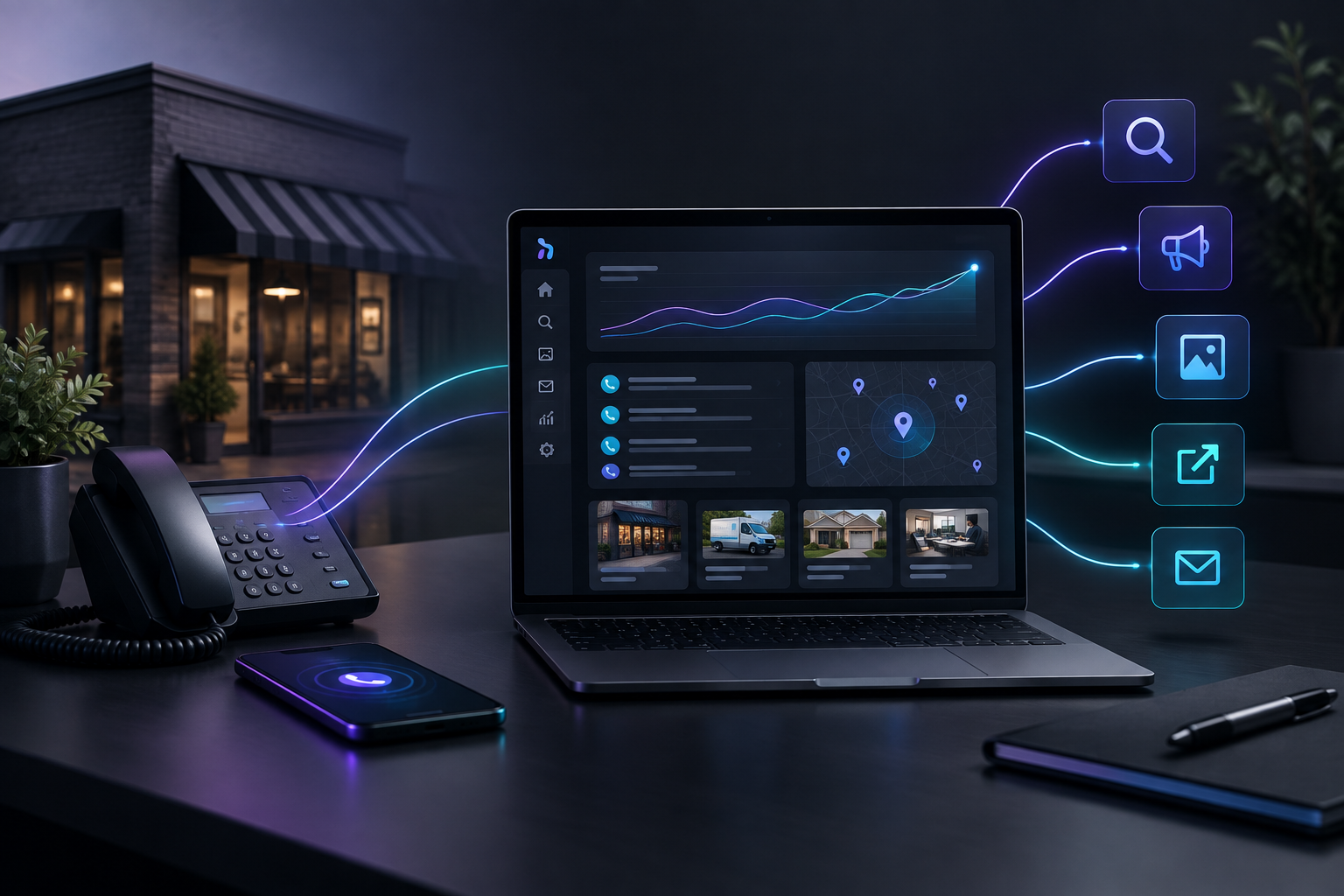



The best marketing tools for a service business doing under 5 million a year are the ones that bring in leads and show you where each lead came from. For most owners that means a field service tool for running jobs, plus one marketing system, either an agency, a platform you configure yourself, or a platform like TruLata that runs the work for you.
TruLata is an AI marketing platform for local service businesses. It runs search, Google and Meta ads, content, outbound and email on a schedule, and it counts every lead from your own site along with its source. Below, you will find the real options owners weigh, who each one fits, one honest limit for each, and a simple way to choose.
Why is choosing marketing tools so hard under 5 million a year?
At this size, you are big enough to waste real money on the wrong stack and too small to have a team that can untangle it. Most owners end up with a scheduling app, a website someone built years ago, a Google Ads account nobody checks, a review tool, and maybe an agency invoice. Each piece reports its own numbers, and none of them answers the only question that matters: which work made the phone ring?
Runs your operations
- Scheduling
- Dispatch
- Invoicing
Runs your marketing
- Getting found
- Getting chosen
- Proving it
The fix is not more tools. It is a clear split between software that runs your operations (scheduling, dispatch, invoicing) and the system that runs your marketing (getting found, getting chosen, and proving it). Keep that split in mind as you read the comparison below, because many products sit firmly on one side and lightly touch the other.
What makes marketing different for local service businesses
Local service demand moves with the calendar and the weather, which shapes when marketing should push and when it should hold. Summer is often the busiest season for home service businesses, as homeowners work through maintenance that piled up over winter, according to Forbes Business Council. The same piece notes that storms and heat waves can cause sudden spikes, with emergency trades like HVAC and plumbing seeing unpredictable surges in scheduling.
How demand moves through the year
- Pending home sales riseHousing activity starts climbing
- Home sales peakSummer is often the busiest season
- Usually slows downPlanning months for content and reviews
- New homeowners need providersBe visible when they search
Housing activity, which feeds a lot of home service work, follows a pattern too. The National Association of Realtors reports that pending home sales rise in March and peak in June, while November through January usually slows down. Moving itself is seasonal: the U.S. Census Bureau has studied the seasonality of moves specifically because businesses and service providers see their work vary by time of year.
- Peaks are predictable in general and unpredictable in detail. You know summer is coming; you do not know which week the heat wave hits.
- Slow months are planning months. The late fall and winter dip is when content, reviews and search work build the visibility you will need in spring.
- Home sales and moves create new customers. New homeowners need providers they have never used before, so being visible during spring and early summer matters.
What are the best marketing tools for a service business doing under 5 million a year?
Here are the options local service owners actually compare. Some are operations software with marketing features, some are marketing platforms, and two are ways of working rather than products. For other companies, we describe the category each sits in rather than quoting features or prices that change often.
Three kinds of options owners compare
Operations software
- Jobber
- Housecall Pro
- ServiceTitan
Marketing platforms
- HubSpot
- GoHighLevel
- Thryv
- Podium
Managed provider
- Scorpion
Read each through one lens: will this get more leads, and will it show me which source each one came from?
| Option | What it is | Best for | One honest limit |
|---|---|---|---|
| Jobber | Field service management software for scheduling, quoting and invoicing | Smaller crews organizing jobs and billing | Built to run jobs, not to run your ad and search programs |
| Housecall Pro | Field service management software for home service businesses | Owner-operators and growing crews running daily operations | Operations first, so marketing is a supporting feature |
| ServiceTitan | Field service management software aimed at larger trade contractors | Established shops with office staff to run a large system | A big system to roll out and manage at this revenue size |
| HubSpot | CRM and marketing software | Teams with someone dedicated to building workflows and campaigns | You or your staff do the setup and the ongoing work |
| GoHighLevel | All-in-one marketing and CRM platform you configure yourself | Owners or agencies who like building their own funnels | Powerful only after someone builds and maintains it |
| Scorpion | Marketing provider focused on home services | Owners who want a managed service | A managed arrangement, so you see their reporting rather than run it |
| Thryv | Small business management and marketing software | Small businesses wanting one subscription for basic tools | Broad across business types rather than deep in one channel |
| Podium | Customer messaging and reviews software | Shops focused on texting customers and collecting reviews | Covers communication and reviews, not ads, search or content |
| Marketing agency | People you hire to run your marketing | Owners who want to hand off the work entirely | Results depend on the account team, and reporting is theirs |
| Doing it yourself | You run ads, posts and your listing personally | Very early businesses with more time than budget | Your time is the cost, and it disappears in peak season |
| TruLata | AI marketing platform that runs search, Google and Meta ads, content, outbound and email on a schedule | Service businesses that want the work done and every lead counted by source | It runs marketing, not scheduling or invoicing, so you keep your field service tool |
Jobber
Jobber is field service management software: scheduling, quotes, invoices and customer records. It fits smaller crews that need their operations organized. Its honest limit for this question is that it exists to run jobs, so it will not run your search and ad programs for you.
Housecall Pro
Housecall Pro is in the same field service category, built for home service companies. It fits owner-operators and growing crews. Marketing features sit alongside operations, which is useful, but they are not a full marketing program.
ServiceTitan
ServiceTitan is field service management software geared toward larger trade contractors. It fits shops with office staff who can own a big system. Under 5 million a year, the honest question is whether you have the people to roll it out and use it fully.
HubSpot
HubSpot is CRM and marketing software used across many industries. It fits companies with someone whose time is set aside to build emails, workflows and reports. The limit: the software is a toolbox, and somebody has to do the work inside it.
GoHighLevel
GoHighLevel is an all-in-one marketing and CRM platform that you configure yourself, and many agencies build on it. It fits owners who enjoy building funnels. If you would rather not build it yourself, our piece on the best alternative to GoHighLevel for a contractor covers that path.
Scorpion
Scorpion is a marketing provider focused on home services. It fits owners who want a managed relationship. The honest limit of any managed model is that you tend to see results through the provider's reporting rather than in a system you control.
Thryv
Thryv is small business management and marketing software serving many business types. It fits owners who want one subscription for core tools. Its breadth is also its limit, since a wide toolset is rarely the deepest in any one channel.
Podium
Podium is customer messaging and reviews software. It fits shops that want to text customers and ask for reviews consistently. It covers a slice of marketing, not your ads, search rankings or content.
A marketing agency
An agency gives you people who run the work. It fits owners who want to hand everything off. The limit is variability: results ride on the account team you get, and reporting usually lives in their slides, not your system. Our comparison of marketing agency vs marketing software for a contractor goes deeper.
Doing it yourself
Running your own Google Business Profile, posts and a small ads budget costs nothing but time. It fits very early businesses. The limit shows up every summer, when jobs pile up and marketing is the first thing dropped.
TruLata
TruLata runs search, Google and Meta ads, content, outbound and email on a schedule. It counts every lead from your own site with its source, and shows what happened and what it cost on your TruLata dashboard. It is built by a team that ran a marketing agency and turned that work into software. Prospect emails leave from a review-first queue, and every send is logged. Its limit: it is not field service software, so you keep your scheduling tool for jobs.
Which one to choose if...
Most owners do not need to pick between operations software and marketing. You need one of each, and the right marketing choice depends on how you want the work done and how much you want to see.
Match your situation to a choice
- Have messy jobs and invoicesJobber, Housecall Pro or ServiceTitan
- Have a systems builderHubSpot or GoHighLevel
- Need reviews and textingPodium
- Want to hand off the workAn agency or Scorpion
- Want every lead counted with sourceTruLata
- Have more time than budgetDo it yourself
- If your jobs and invoices are a mess: start with field service software such as Jobber, Housecall Pro or, for larger shops with office staff, ServiceTitan.
- If you have a person who loves building systems: HubSpot or GoHighLevel can work, as long as that person has the hours.
- If reviews and customer texting are the main gap: a messaging and reviews tool like Podium covers that slice.
- If you want to hand off the work and trust a team: an agency or a managed provider like Scorpion fits, provided you insist on seeing lead sources.
- If you want the work run and every lead counted with its source: TruLata fits. See how TruLata works before deciding.
- If you are just starting and have more time than budget: doing it yourself is reasonable until the slow season ends.
Whatever you choose, demand one thing: lead counts from your own forms and calls, tied to a source. Without that, you cannot tell whether a slow month was the season or the marketing. Our guide to tracking where every lead came from explains what to look for.
How should you time your marketing around the seasons?
Use the slow months to build and the busy months to capture. Search visibility, reviews and content take time to compound, so the November through January lull is the right window to publish, clean up your listing and tighten your site. When spring and summer arrive, paid ads can respond quickly to demand you already see coming.
- Build in the slow monthsPublish, clean up your listing, tighten your site
- Capture in the busy monthsPaid ads respond to demand you see coming
- Watch dailyTrack your ad account and lead counts as they arrive
- Move in daysRaise or pull spend without waiting for a monthly report
Weather spikes reward businesses that can move fast. A tool that runs on a schedule, watches your ad account daily and shows lead counts as they arrive lets you raise or pull spend in days rather than waiting for a monthly report. That responsiveness matters more than the size of your budget.
Ready to see your marketing run and counted in one place?
If you are tired of stitching together tools and still guessing which one made the phone ring, TruLata runs your search, ads, content, outbound and email, and shows every lead with its source and what it cost. You keep your scheduling software; TruLata handles the marketing.
One place for your marketing
- Search
- Ads
- Content
- Outbound
- Every lead with its source
- What each lead cost
Walk through the live demo, or review the plans to see how it fits your business. Either way, you will see the real dashboard, not a pitch deck.