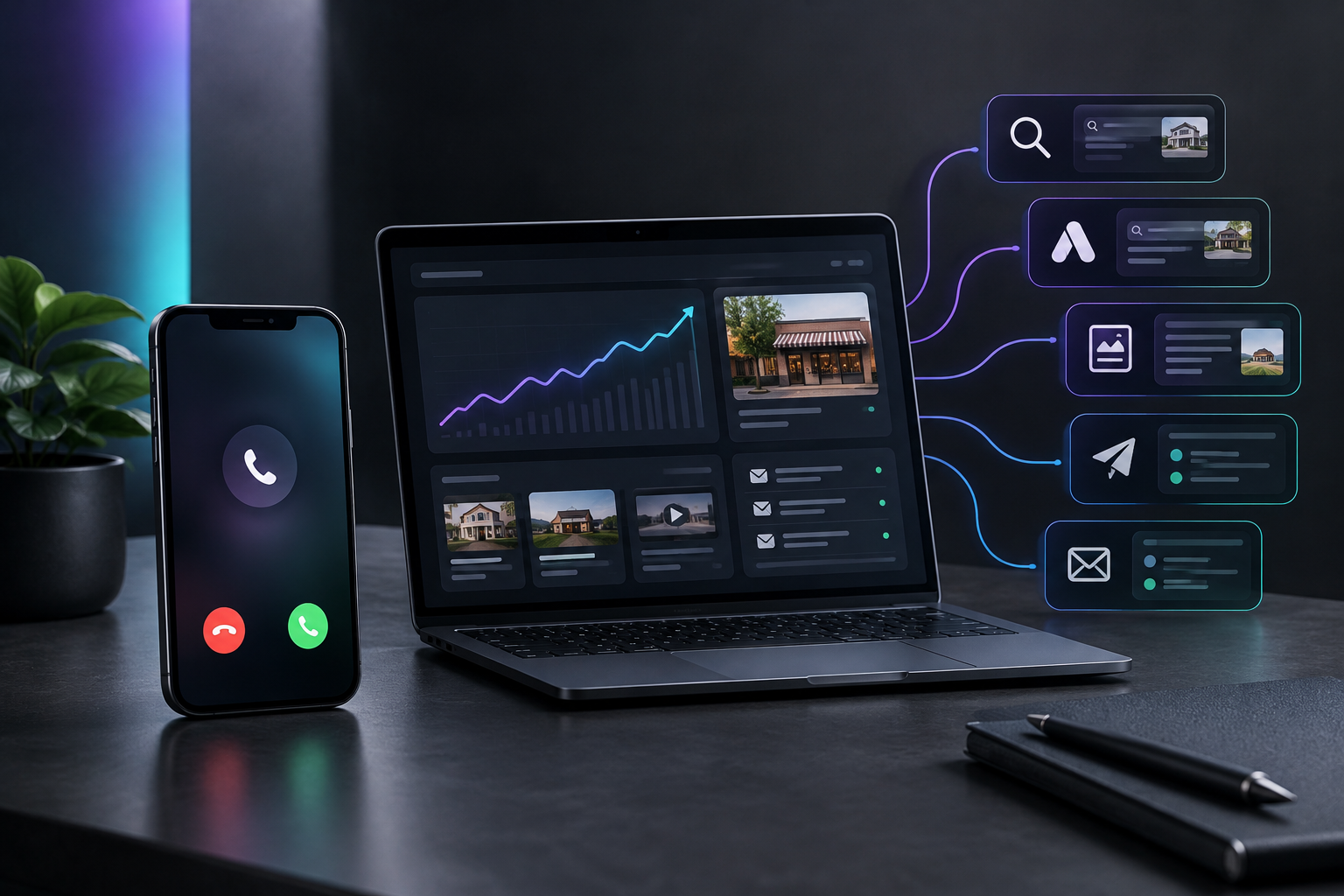

The best marketing solutions for small businesses in 2026 fall into five groups: field service software with marketing add-ons, CRM and marketing suites, messaging and review tools, marketing agencies, and AI marketing platforms such as TruLata. Pick the one that brings in leads you can count by source, at a cost you can see each month.
For a local service business, the real question is not which tool has the longest feature list. It is which option gets the phone ringing, and whether you can tell which channel made it ring. This page sets out the options a plumber, roofer, HVAC contractor, cleaner or practice owner actually weighs. It covers what each option is, who it fits, and where it falls short, so you can decide without a sales call.
What does a marketing solution need to do for a service business?
A local service business needs marketing to do three jobs. It has to put you in front of people searching for your service nearby, through Google search, maps, ads and now AI answer engines. It has to turn those searches into calls and form fills. It also has to tell you which of those calls and forms came from which channel, so you know where the next month's money should go.
- Get foundShow up in Google search, maps, ads and AI answer engines
- ConvertTurn those searches into calls and form fills
- AttributeKnow which channel produced each call and form
Most owners cover the first two jobs and skip the third. They run ads, post on social and pay for SEO, then judge results by how busy the schedule feels. Any option you consider should answer one question in plain numbers: how many leads came in this month, from where, and at what cost? If a tool or agency cannot answer that, it does not matter much what else it offers. For the channels themselves, our guide to digital marketing for local businesses goes through search, ads and reviews one at a time.
What makes marketing different for small businesses
Small service businesses compete in a crowded field. The U.S. Census Bureau counted 5.58 million U.S. firms with at least one employee but fewer than 500 employees in 2023, up from 5.53 million in 2022. In most trades, that means several capable competitors serve the same zip codes and show up for the same searches. Being good at the work is necessary, but it does not make you the business a customer finds first.
Several capable competitors often serve the same zip codes.
Demand also moves during the year, and the pattern differs by trade. HVAC peaks with heat and cold, roofing follows storms and dry weather, and pest control follows the warm months. The Census Bureau's Business Trends and Outlook Survey tracks this kind of movement, publishing data every two weeks on revenue, employment, hours worked, demand and prices from U.S. employer businesses. In practice, a marketing setup that runs the same plan all year will overspend in your busy season and go quiet when you need work most.
Customers choose locally, so your market is your service area, not the national average. The SBA's Office of Advocacy publishes small business profiles for major metropolitan areas and state-by-state snapshots of small business activity. The SBA also points owners to free federal business statistics for market research and competitive analysis. An hour with these will tell you more about how crowded your market is than any vendor deck.
Which marketing solutions do service businesses actually compare?
Below are the options that come up most often when a local service owner shops for marketing. They are not all the same kind of product. Some are operations software with marketing features attached, some are marketing suites, and some are people you hire. Grouping them this way makes the trade-offs clearer.
Three kinds of marketing option
Operations software
- Jobber
- Housecall Pro
- ServiceTitan
Marketing suites
- HubSpot
- GoHighLevel
- Thryv
People you hire
- Scorpion
- Vetted local agencies
Each entry describes the category the option belongs to and one honest limit. Where we do not have a sourced fact about a specific company, we describe the category rather than guess at features or prices. Check current details with each vendor before you sign anything.
| Option | What it is | Best for | One honest limit |
|---|---|---|---|
| Jobber | Field service management software for scheduling, quoting and invoicing | Owner-operators and small crews organizing jobs | Built for running jobs; marketing is a secondary layer |
| Housecall Pro | Field service management software for home service companies | Home service teams wanting dispatch and billing in one place | Does not replace a search, ads and content program |
| ServiceTitan | Field service management software aimed at larger trade contractors | Established contractors with dispatchers and office staff | Operations depth comes with setup and training weight |
| HubSpot | CRM and marketing software suite | Businesses with someone to build and run campaigns | A general business tool, not built around local service work |
| GoHighLevel | All-in-one marketing and CRM platform, often used by agencies | Owners or agencies willing to configure their own setup | Results depend on who builds and runs it |
| Scorpion | Marketing firm serving local service businesses | Owners who want an outside team to run marketing | Agency model: you depend on their reporting for results |
| Thryv | Small business software for customer management and marketing | Small businesses wanting one system for clients and messages | Broad small business focus rather than trade-specific |
| Podium | Customer messaging and reviews software | Businesses focused on texting customers and collecting reviews | Covers communication and reviews, not your full marketing |
| A marketing agency | An outside team that runs some or all of your marketing | Owners who want to hand the work off entirely | Quality varies widely; reporting is often on the agency's terms |
| Doing it yourself | Running your profile, ads and posts in-house | Owners with time and interest, early on | It competes with billable work for your hours |
| TruLata | AI marketing platform that runs search, ads, content, outbound and email on a schedule | Service businesses that want marketing run and every lead counted by source | A software platform, so you work through the dashboard rather than with an account manager |
Jobber
Jobber is field service management software: scheduling, quotes, invoices and client records. It fits owner-operators and small crews who need the office side organized. The honest limit is that it was built to run jobs, so its marketing features support the customers you already have rather than finding new ones.
Housecall Pro
Housecall Pro sits in the same field service category, aimed at home service companies. It fits teams that want dispatch, billing and customer records in one place. It does not stand in for search visibility, paid ads and content, so most owners still need something else for growth.
ServiceTitan
ServiceTitan is field service management software aimed at larger trade contractors. It fits established shops with dispatchers, call takers and office staff. The limit is weight: a system this deep takes real setup and training, and it is an operations platform first.
HubSpot
HubSpot is a CRM and marketing suite used across many industries. It fits businesses with someone who will build email flows, landing pages and reports. It is a general business tool, so a contractor has to adapt it to local service work.
GoHighLevel
GoHighLevel is an all-in-one marketing and CRM platform, often resold or run by agencies. It fits owners or agencies who like building their own funnels and automations. Results depend almost entirely on who sets it up and how well they maintain it.
Scorpion
Scorpion is a marketing firm that works with local service businesses. It fits owners who want an outside team to handle marketing for them. As with any agency arrangement, you rely on the provider's reporting to judge whether the work is paying off.
Thryv
Thryv is small business software that combines customer management with marketing tools. It fits small businesses that want one system for clients, messages and online presence. Its focus is small business broadly, not trades specifically.
Podium
Podium is customer messaging and reviews software. It fits businesses that want to text customers and collect more reviews. Reviews matter for local search, but they are one piece of marketing, not the whole program.
A marketing agency
A local or specialist agency runs your marketing for you, from SEO to ads. It fits owners who want to hand the work off completely. Quality varies a great deal between agencies, and many report results in their own format. Our guide to the best digital marketing agencies for small business covers what to ask before signing.
Doing it yourself
Plenty of owners start by managing their Google Business Profile, boosting a few posts and running a small ads campaign. It fits early-stage businesses with time to learn. The limit is your hours: marketing competes with quoting, crews and billable work, and it is usually the first thing dropped in busy season.
TruLata
TruLata is an AI marketing platform for local service businesses. It runs search, Google and Meta ads, content, outbound and email on a schedule. It counts every lead from your own site with its source, and shows what happened and what it cost on one dashboard. It was built by a team that ran a marketing agency and turned that work into software. Prospect emails leave from a review-first queue, and every send is logged. The honest limit is that you work through the platform rather than through an account manager. You can see how TruLata works step by step before deciding.
How do you tell whether a marketing solution is working?
Start with leads, not traffic or impressions. A lead is a call or form from someone who wants a quote or an appointment. Count them every week, by source: Google search, maps, ads, Meta, referrals, email. If your current setup cannot split leads by source, fix that before you change anything else, because otherwise every decision is a guess.
Checking a solution, week by week
- Count leadsCalls and forms from people wanting a quote
- Split by sourceSearch, maps, ads, Meta, referrals, email
- Add costAd spend, tool fees and retainers beside lead counts
- Run the checklistSource, cost, seasonal control, ownership, time
Then put cost next to each source. When ad spend, tool fees and agency retainers all sit beside lead counts, the weak channels show up quickly. TruLata handles this with lead tracking counted from your own forms, so the numbers come from your website rather than from an ad platform grading itself. The totals sit on your TruLata dashboard next to what each channel cost.
Use this short checklist when you evaluate any option:
- Source tracking: Can it show leads by channel from your own site and phone?
- Cost visibility: Can you see total monthly cost per channel in one place?
- Seasonal control: Can you shift budget up or down as demand moves?
- Ownership: Do you keep your ad accounts, site and data if you leave?
- Time required: How many of your hours does it need each week?
Which one to choose if...
No single option fits every owner. The right choice depends on what is broken today: the office side, the marketing side, or your ability to see results. Match your situation to the line that sounds most like you.
If the problem is operations or a gap
- Messy scheduling: Jobber or Housecall Pro
- Larger contractor: ServiceTitan
- Reviews and texting: Podium or Thryv
If the problem is marketing or visibility
- Campaign builder: HubSpot or GoHighLevel
- Hand it off: Scorpion or local agency
- Scheduled channels with counted leads: TruLata
- If scheduling and invoicing are a mess, start with field service software such as Jobber or Housecall Pro, then add marketing on top.
- If you run a larger contractor with office staff, ServiceTitan's operations depth may be worth the setup work.
- If you have someone who likes building campaigns, a suite such as HubSpot or a configurable platform such as GoHighLevel can work.
- If reviews and customer texting are your main gap, Podium or Thryv addresses that piece directly.
- If you want to hand off the work and trust a partner, a specialist agency such as Scorpion or a vetted local agency fits, as long as you insist on lead counts by source.
- If you are early and have more time than budget, doing it yourself is a reasonable start.
- If you want search, ads, content, outbound and email run on a schedule, with every lead counted by source and cost shown in one place, TruLata fits. That includes outbound prospecting from a review-first queue for businesses that sell to commercial accounts.
Many owners combine options. A common, sensible setup is field service software for operations plus one marketing solution for growth. Avoid stacking three marketing tools and an agency, because overlapping reports make it harder, not easier, to see what is working.
Ready to see where your leads come from?
If you cannot say how many leads came in last month and which channel produced each one, that is the first thing to fix. TruLata runs your search, ads, content, outbound and email, counts every lead from your own site with its source, and shows the results and cost on one dashboard.
What TruLata runs and shows
- Search
- Ads
- Content
- Outbound
- One dashboard
- Results and cost together
Open the live demo on trulata.com to see the dashboard with real-looking data, or review the product pages to see how each channel is run. Then compare it honestly against the other options above.