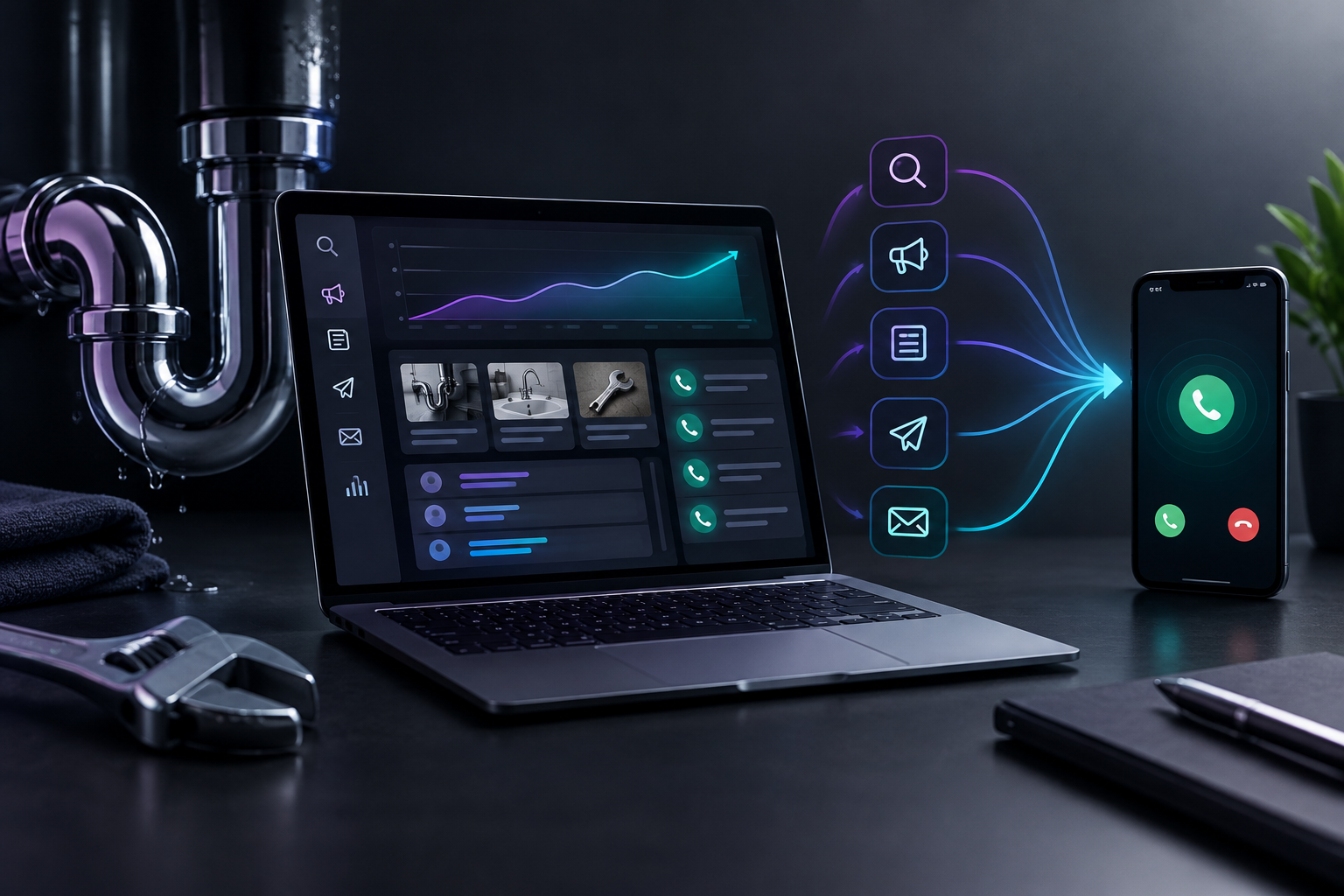

The online marketing plumbers need comes down to five things: a complete Google Business Profile with steady reviews, a fast website that makes calling easy, search ads for urgent jobs, content that answers homeowner questions, and a record of which of these produced each call. After that, you decide who runs it.
We build TruLata, an AI marketing platform for service businesses, so we see this from the operating side. Below are the channels, the way plumbing demand moves through the year, the realistic options for running the work (ours included), and a short way to track what pays.
Which online marketing channels bring plumbers calls?
Homeowners search for a plumber in one of two moods. Something just broke and they need someone today, or they are planning a water heater replacement or a bathroom upgrade. Some channels serve the first mood better and some the second, so weight your mix toward the work you want more of.
- Profile and reviewsFill every field, add real photos, ask for and answer reviews.
- Website built for callsTappable number, short form, a page per service and town.
- Search adsAdd once the site can take a call, only when someone answers.
- Content and emailLayer these on after the basics are working.
You do not need every channel on day one. Start with the profile and the website, add ads once the site can take a call, and add content and email after that.
Google Business Profile and reviews
Your profile is often the first thing a homeowner sees for a search like "plumber near me." Fill in every field: service area, hours, emergency availability, the services you actually offer, and real photos of your trucks and crew. Ask for a review after every completed job and reply to each one, including the bad ones. A profile last updated two years ago looks like a company that may not pick up.
A website built for the phone call
Put the phone number at the top of every page and make it tappable on a phone. Keep the request form short: name, number, address and what is wrong. Build one page per service (drain cleaning, water heaters, leak repair, sewer lines) and one per town you serve, so each problem and each place has a page that matches the search.
Search ads for urgent work
Google search ads put you at the top for searches you choose, such as "burst pipe repair" or "emergency plumber," in the towns you choose. Run them only during hours someone will answer. Add negative keywords for jobs you do not take and for people looking for plumbing jobs rather than a plumber. Meta ads on Facebook and Instagram suit planned work like upgrades and remodels better than a 2 a.m. emergency.
Content that answers what homeowners search
Short articles on real questions ("why does my water heater make a popping noise," "what to do before the plumber arrives for a leak") catch searches your service pages miss. Write about the problems your techs see most in your area, and link each article to the service page it relates to.
Showing up in AI answers
Homeowners now ask ChatGPT, Google AI Overviews, Perplexity and other assistants to recommend a plumber. Those tools draw on reviews, your own site and mentions elsewhere. Clear service pages, matching business details across listings and a steady stream of reviews all help you get named.
Email to past customers
Past customers already know you. A reminder about freeze prevention before winter, or a note about drain care before the holidays, reaches people who will need a plumber again.
What makes marketing different for plumbing companies
Plumbing demand follows the weather and the calendar, and jobs range from a clogged sink to a failed system. That affects when you spend, what you say and how you staff the phone. Four points from trade reporting:
Plumbing demand through the year
- BacklogPostponed winter issues drive a call spike while teams are still organizing.
- Home improvement seasonUpgrades and remodels, often started by homeowners on their own.
- Peak daySalt Lake City saw a 23% increase in plumbing searches the year before.
- Arrives on scheduleStock trucks and prepare call takers, dispatchers and technicians ahead.
- Spring brings a backlog. As temperatures rise, homeowners start on issues they postponed over the winter, from frozen pipes and system failures to routine repairs and upgrades, and call volumes spike while plumbing businesses are still organizing teams and schedules, according to Plumbing & Mechanical's report on the cost of missed calls. The same report says unanswered phones during that surge turn into lost work.
- Summer is home improvement season. Homeowners take on plumbing upgrades, HVAC maintenance and remodeling, often starting with their own plans before realizing the job might be over their heads, as Plumbing & Mechanical noted on contractor visibility. The same column observes that being featured in a story about summer plumbing maintenance or water conservation helps homeowners see a company as knowledgeable and trustworthy.
- The day after Thanksgiving is a peak. One Dallas plumbing company founder told the publication that the day after Thanksgiving is always the company's busiest day of the year, and Salt Lake City saw a 23% overall increase in plumbing-related searches for clogged sinks, broken garbage disposals and leaky toilets during that period the year before, per Plumbing & Mechanical's coverage of holiday plumbing demand.
- Cold weather arrives on schedule. The cold-season rush comes every year at the same time, which lets a company stock trucks and prepare call takers, dispatchers and technicians ahead of it, as a long-running Plumbing & Mechanical column on busy-season planning argues.
Three practical moves follow. Plan ad budgets and content around the predictable peaks (late fall, the holiday week, early spring) instead of one flat monthly level. Publish seasonal content a few weeks before each peak so it has time to be found. And confirm someone answers the phone before you raise spend, since extra searches only help if the calls get picked up.
The job mix matters too. A leaky toilet arrives as an urgent search, while an upgrade gets planned and compared. Search ads and your Google profile carry the urgent work. Content, Meta ads and email carry the planned work.
What are your options for running online marketing as a plumber?
Owners usually weigh the same handful of options. Some are software that runs operations with marketing attached, some are toolkits someone has to operate, and some are people you hire. These are categories, since products inside each differ, so check any specific product against your own needs before you sign.
Each option and where it stops
- Field service management softwareMarketing mostly works on existing customers
- CRM and marketing automation suiteNothing runs until a person builds it
- All-in-one funnel and texting platformResults depend on whoever configured it
- Review and customer messaging toolCovers reputation and chats, not ads or content
- Small business software suiteBuilt for the basics from one vendor
Field service management software
Scheduling, dispatch, quoting, invoicing and payments built for trades, often with add-ons like review requests and email to past customers. It fits any plumbing company with trucks on the road, because it is where the jobs live. The limit: the marketing features mostly work on customers you already have, not on search rankings, ad accounts or new content.
CRM and marketing automation suite
A contact database with pipelines, email, automation and optional modules for landing pages, ads and reporting. It fits a company with someone whose time can go into building campaigns and workflows. The limit: it is a set of tools, and nothing runs until a person builds and maintains it.
All-in-one funnel and texting platform
Landing pages, text messaging, pipelines and booking widgets, frequently resold under a consultant's or agency's brand. It fits owners already working with someone who sets it up. The limit: results depend on whoever configured it.
Review and customer messaging tool
Software that requests reviews and pulls web chat and texts into one inbox. It fits companies whose main gap is reviews and reply speed. The limit: it covers reputation and conversations, not ads, rankings or content.
Small business software suite
One subscription bundling listings, a basic website, scheduling, payments and simple marketing. It fits small shops that want one vendor for the basics. The limit: each piece is lighter than a dedicated tool.
Buying leads from a marketplace
You pay for shared enquiries that go to you and to other contractors. It fits a company that needs jobs this week and has nothing else running. The limit: the marketplace keeps the record of the lead, so you build no history of your own. We lay out the difference on our page comparing TruLata with buying leads from a marketplace.
A marketing agency
A firm, generalist or focused on home services, that runs your SEO, ads and website for a retainer. It fits owners who want the work off their plate entirely. The limit: you see results through the agency's reports, on the agency's schedule. TruLata grew out of an agency, and our agency comparison covers what changes when the engagement runs on a live screen instead.
Doing it yourself
You or someone in the office handles the profile, reviews, ads and posts. It fits a one or two truck shop with an owner who likes the work. The limit: it slips during busy seasons, which are the weeks it matters most. See TruLata vs doing it yourself for how we think about replacing five separate consoles with one screen.
TruLata
TruLata puts search, ads, content, outbound and email on one screen. It refreshes when a person opens it, counts leads from your own forms with their source, and holds every outbound send in a review-first queue. It fits service businesses that want the work running and visible in one place. The limit: it is not dispatch or invoicing software, so your jobs stay in your booking platform, which TruLata reads.
| Option | What it is | Best for | One honest limit |
|---|---|---|---|
| Field service management software | Scheduling, dispatch, invoicing and payments, with marketing add-ons | Any plumbing company running trucks | Marketing features mostly reach existing customers, not search or ads |
| CRM and marketing automation suite | Contacts, pipelines, email and automation tools | Teams with time to build campaigns | Nothing runs until someone builds and maintains it |
| All-in-one funnel and texting platform | Landing pages, texting, pipelines and booking widgets, often resold | Owners working with a consultant who sets it up | Results depend on whoever configured it |
| Review and messaging tool | Review requests plus a shared inbox for chat and texts | Companies short on reviews or slow to reply | Does not cover ads, rankings or content |
| Small business software suite | Listings, basic site, scheduling, payments and simple marketing | Small shops wanting one vendor | Each piece is lighter than a dedicated tool |
| Marketplace leads | Shared enquiries you pay for | Companies that need jobs this week | The marketplace keeps the lead record |
| Marketing agency | A firm running SEO, ads and site on retainer | Owners who want to hand it off | You see results through its reports, on its schedule |
| Doing it yourself | Owner or office staff handle it | One or two truck shops | Slips during busy seasons |
| TruLata | One screen running search, ads, content, outbound and email | Service businesses wanting every form lead, its source and its outcome in one place | Not dispatch or invoicing software; jobs stay in your booking platform |
Which one to choose if...
Most plumbing companies end up with two tools: one to run the jobs and one to run the marketing. Which marketing option fits depends on how your company works today.
Which option fits how you work
Fix the basics
- Whiteboard scheduling: field service software
- Review gaps: review and messaging tool
- Small shop: small business suite
Build in house
- Systems-minded office manager: CRM suite
- One truck and slow months: do it yourself
Work with someone
- Consultant set it up: keep the all-in-one, hold the login
- Hand off everything: agency, with ownership in writing
Need reach now
- Jobs this week: marketplace leads, track cost per booked job
- Everything on one screen: TruLata
- If you still schedule from a whiteboard or a group text: start with field service management software. Fix the schedule before you send more calls into it.
- If you have an office manager or marketer who enjoys building systems: a CRM and marketing automation suite gives that person room to work.
- If a consultant already set up your funnels and texting: keep the all-in-one platform, as long as you hold the login.
- If your main gap is reviews and slow replies: a review and messaging tool fixes that specific problem.
- If you want one vendor for the basics and run a small shop: a small business software suite keeps it simple.
- If you need jobs this week and have no other channel running: marketplace leads can fill the gap, but track what each one costs you per booked job.
- If you want to hand off everything and trust a team's reporting: hire an agency, and get in writing who owns the ad accounts, the website and the lead data.
- If you run one truck and have slow months: do it yourself, and use the slow season to build service pages and collect reviews.
- If you want search, ads, content, outbound and email running on a schedule, with your leads and their outcomes on one screen: TruLata.
Whichever you pick, keep ownership of your Google Business Profile, your ad accounts, your domain and your lead records. That is what lets you change direction later without starting over.
How do you tell which marketing produced a job?
Without a source on each lead, every channel looks equally good and budget decisions turn into guesses. Fixing that takes a few habits, not a big system.
- Record a sourceForms capture it and the phone answerer asks and logs it.
- Tag your linksLabel ad links and the Google Business Profile website link.
- Mark the outcomeBooked, quoted, lost or spam.
- Review monthlyCompare spend to booked jobs before each peak.
- Record a source on every lead. Forms should capture where the visitor came from, and whoever answers the phone should ask and log it.
- Tag your links. Add tracking parameters to ad links and to the website link on your Google Business Profile so visits from each are labeled.
- Mark the outcome. Booked, quoted, lost or spam. A channel that brings many calls but few booked jobs is not your best channel.
- Review monthly, and before each peak. Compare spend against booked jobs by channel, then decide what to raise or cut ahead of the next busy stretch.
For a step-by-step version written for this trade, see our guide on which marketing brought in new jobs for a plumbing company.
What does TruLata run for a plumbing company?
You ask Addy, the orchestrator inside TruLata, for work in plain English. Addy starts a team of AI agents on it, checks what they bring back and waits for your OK on anything public. The dashboard refreshes when you open it, so what you see was pulled when you looked.
Flat monthly, month to month, no setup fee.
The work covers search visibility (rankings, queries and reviews), ads with a daily watch on spend and cost per lead, a content engine that publishes blogs, lifecycle email, and AI visibility, which tracks whether ChatGPT, Gemini, Claude, Grok, Manus, Google AI Overviews, Perplexity, Meta AI and DeepSeek cite you. TruLata counts leads from your own forms with their source, and your team sets each outcome. It also reads your job pipeline from your booking platform. Prospect emails leave from a review-first queue.
Pricing is flat monthly and month to month, with no setup fee: Starter is $400 a month, Launch is $650 and Growth is $1,200. Command is scoped per engagement. Anyone can sign up, or you can open the live demo first to see the real dashboard. For the trade-specific version, see our plumber marketing page.