

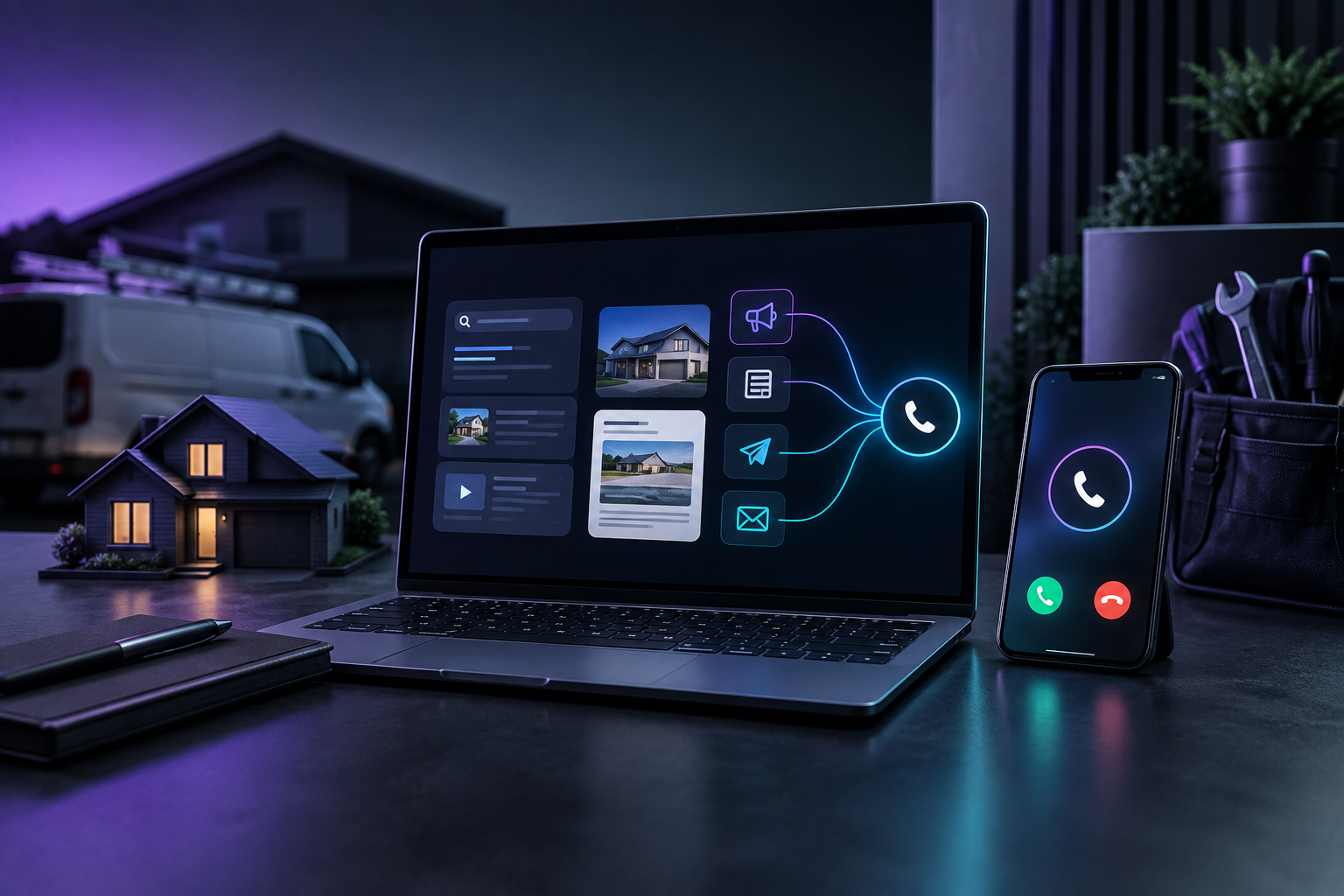

The best AI marketing platform for a home service business is the one that runs the marketing work itself and shows you which leads it produced. Job software, CRMs and agencies each solve part of that. TruLata runs search, ads, content, outbound and email on a schedule and counts every lead with its source on one dashboard.
Most owners asking this already have something: a scheduling app, a CRM trial, an agency invoice, or a nephew who "does the Facebook." The question underneath is usually why the phone still isn't ringing predictably. That depends less on how many features a tool has and more on what kind of tool it is.
TruLata is an AI marketing platform for home service businesses (trades such as HVAC, plumbing, roofing, electrical, cleaning and landscaping, plus local practices). It was built by a team that ran a marketing agency and turned that work into software.
What makes marketing different for home service businesses?
Home services don't sell on a steady curve. Demand moves with weather, the housing market and emergencies, and the customer usually needs someone soon and nearby. A platform built for a software company or an online store will not plan around that.
The home service demand calendar
- Pending home sales riseNAR reports sales climb and peak in June
- Busiest stretchWinter maintenance gets tackled; June is Homeownership Month
- Emergency spikesStorms and heat waves can double demand overnight
- Line up capacityForbes advises extra service partners ahead of the rush
- Sales slowPending home sales fall off
Here are the facts that shape how marketing has to work in this trade:
- Summer is usually the busiest stretch. Maintenance that piles up over winter gets tackled in summer, and June is National Homeownership Month, according to Forbes on home service peak seasons.
- Emergency trades get sudden spikes. The same Forbes piece notes that storms and heat waves can double demand overnight, so HVAC and plumbing companies see scheduling jumps they cannot plan for in advance.
- Housing activity has a clear calendar. The National Association of Realtors reports that pending home sales rise in March and peak in June, then slow from November through January. Moves, sales and renovations drive a large share of home service work.
- Quotes often surprise homeowners. A price a homeowner finds online may reflect little more than equipment or materials, while a professional service call includes expertise and labor, according to Plumbing & Mechanical. Your marketing has to set expectations before the estimate does.
- Capacity has to be planned ahead of the rush. Forbes advises lining up extra service partners at least two months before the busy season starts. Marketing should follow the same calendar: spend more before demand rises, not after it peaks.
The practical point is that a home service marketing tool has to be turned up and down with the seasons, and you have to see where each call came from. Otherwise you can't tell whether a busy July came from your ads or from a heat wave.
What are the real options, and where does each fall short?
The tools owners compare fall into five groups: field service software, CRMs and marketing suites, agency-style platforms, single-channel tools, and people (an agency or yourself). Each is listed below with what it is, who it fits, and one honest limit.
Five groups of tools and their limits
Field service software
- Jobber, Housecall Pro, ServiceTitan
- Runs jobs, relies on outside demand
CRMs and marketing suites
- HubSpot, GoHighLevel
- Needs a person to build and operate
Agency-style and single-channel
- Scorpion, Thryv, Podium
- Visibility or depth depends on the tool
People
- Marketing agency or yourself
- Retainer or your own time
The descriptions are about the category each product belongs to. Check current features with each vendor before you buy.
| Option | What it is | Best for | One honest limit |
|---|---|---|---|
| Jobber | Field service management software | Scheduling, quoting, invoicing for smaller crews | Built to run jobs, not to generate demand |
| Housecall Pro | Field service management software | Owner-operators and small teams running dispatch | Marketing features sit beside operations rather than at the center |
| ServiceTitan | Field service management software for larger contractors | Multi-truck companies with office staff | Heavier setup, and it still relies on outside channels for new demand |
| HubSpot | CRM and marketing software suite | Businesses with someone to build and run campaigns | The tools sit idle until a person configures and operates them |
| GoHighLevel | All-in-one marketing and CRM platform | Agencies and technically comfortable owners | You or a reseller have to build the setup |
| Scorpion | Marketing services and platform for local businesses | Owners who want the work done for them | Agency-style service, so visibility depends on the reporting provided |
| Thryv | Small business management software | Owners who want basic marketing and admin in one place | Broad coverage, less depth in any single channel |
| Podium | Customer messaging and reviews platform | Businesses focused on reviews and text conversations | Covers communication, not search, ads or content |
| Marketing agency | People who run your channels for a retainer | Owners who want to hand marketing off entirely | Results and reporting quality vary by account manager |
| Doing it yourself | Owner or staff running channels directly | Very early businesses with time and some skill | Marketing stops whenever the field gets busy |
| TruLata | AI marketing platform that runs search, Google and Meta ads, content, outbound and email | Service businesses that want the work done and every lead traced to its source | Focused on marketing, so job scheduling and invoicing stay in your field service software |
Jobber
Jobber is field service management software for scheduling, quoting, invoicing and client records. It fits smaller crews that need the office side organized. Its limit as a marketing answer is that it manages work once a customer exists. Getting that customer to call is mostly someone else's job.
Housecall Pro
Housecall Pro is also field service management software, popular with owner-operators and small teams. It fits companies whose main pain is dispatch and payment. Marketing features in this category sit next to operations, so they rarely replace a full search and ads program.
ServiceTitan
ServiceTitan is field service software aimed at larger contractors with office staff and several trucks. It fits established companies that need deep operational reporting. Setup takes real effort, and like the rest of the category it depends on outside channels to create demand.
HubSpot
HubSpot is a CRM and marketing suite. It fits a business with someone whose job includes building email sequences, landing pages and reports. The limit is simple: the software waits for an operator. Without one, much of what you pay for goes unused.
GoHighLevel
GoHighLevel is an all-in-one marketing and CRM platform that agencies often use for their clients. It fits technical owners or agencies that like building their own funnels. The limit is that you, or whoever resells it to you, has to assemble and maintain everything.
Scorpion
Scorpion offers marketing services and technology for local businesses. It fits owners who want a provider to handle the work. As with most agency-style arrangements, what you can see depends on the reports they give you.
Thryv
Thryv is small business software that combines admin and marketing tools. It fits owners who want one login for many basic tasks. Breadth comes at the cost of depth in any single channel.
Podium
Podium focuses on customer messaging and reviews. It fits businesses where speed of reply and review volume are the main gap. It doesn't run search, ads or content, so it works as one part of a stack rather than the whole marketing program.
A marketing agency
An agency runs your channels on a retainer. It fits owners who want marketing off their plate completely. The limit is variance: a good account manager makes it work, a stretched one leaves you with monthly PDFs and no clear line from spend to booked jobs. Our guide to choosing a home service marketing agency covers what to ask.
Doing it yourself
Running your own Google Business Profile, ads and posts costs time instead of fees. It fits brand new businesses with slow weeks. It breaks down in exactly the months that matter: when the summer rush hits, the owner is on jobs and the marketing stops.
TruLata
TruLata is an AI marketing platform for service businesses that runs search, Google and Meta ads, content, outbound and email on a schedule. It counts every lead from your own site's forms and calls along with its source, and your TruLata dashboard shows what happened and what it cost. Prospect emails leave from a review-first queue, and every send is logged.
Its limit is scope. TruLata is a marketing platform, not job software, so dispatch, quoting and invoicing stay in Jobber, Housecall Pro, ServiceTitan or whatever you already use. See TruLata integrations for how data connects.
Which one to choose if...
The right pick depends on what's actually broken. Map your situation to one of these:
Fix what is broken first
- Messy schedule: field service software
- Review gap: Podium
- Hands-off: agency or Scorpion
- Staff marketer: HubSpot or GoHighLevel
Run demand with visible leads
- TruLata runs search, ads, content, outbound, email
- Each lead shown with its source
- Pair with job software
- Avoid three tools claiming one call
- Your schedule and invoices are a mess: start with field service software (Jobber, Housecall Pro, or ServiceTitan if you have office staff and several trucks). Fix operations before you buy more leads.
- You have a marketer on staff who likes building campaigns: HubSpot or GoHighLevel give that person a workbench.
- Reviews and text replies are the main gap: a messaging and reviews tool such as Podium covers that piece.
- You want to hand marketing off and trust a person to run it: an agency or an agency-style provider such as Scorpion. Insist on lead-level reporting.
- You're brand new and have slow weeks: do it yourself for now, starting with your Google Business Profile.
- You want search, ads, content, outbound and email running every week, and you want to see each lead and its source: TruLata. The lead tracking counted from your own forms is what separates it from tools that report clicks.
Many home service companies end up with two pieces: field service software for jobs and one marketing system for demand. The mistake is buying three marketing tools that each claim credit for the same call. Trade-specific breakdowns are in our pages on the best AI marketing platform for an HVAC company and similar guides for other trades.
How should you test a platform before committing?
Ask any vendor or agency three questions. First: can you show me a single lead, with the date, the channel it came from and what that channel cost that month? Second: what runs without me logging in this week? Third: how do I turn spend up before my busy season and down in the slow months?
- Ask for one leadDate, channel and that channel's cost that month
- Ask what runs unattendedWhat happens this week without you logging in
- Ask about spend controlUp before busy season, down in slow months
- Time the testStart in late winter, not during a July rush
Then time the test to your calendar. Given the March through June ramp NAR describes and the November through January slowdown, starting a new platform in late winter gives it time to settle before demand climbs. Starting in July means judging it during a rush when almost anything looks like it works.
Ready to see where your leads actually come from?
If you want your marketing running every week and every lead traced to its source, look at how TruLata works or open the live demo to see the dashboard with real data shapes. TruLata runs the search, ads, content, outbound and email, and shows you what each one produced.
From your marketing to a traced call
- Search
- Ads
- Content
- Outbound
- Each lead traced to its source
- Cost of each call
- Job software stays in place
Keep the job software you have. Add the part that makes the phone ring, and see the cost of each call.