

Know before you buy whether TruLata was built for your business.
TruLata was built for a business that sells a service, usually inside a territory. The owner carrying marketing on the side and a marketer on staff read the same screen. Pick the situation that matches yours, or read what each part of that fit decides in the product.

Which situation is yours, and what does the product do about it?
Each page below takes one way a service business shows up and answers the same questions: what runs on a schedule, what you see on the screen, and what a person still decides.
Is TruLata built for my business?
Yes. It was built for a business that sells a service. A territory is typical, a county, a metro, a set of towns, and a multi-location or national business fits the same way. The marketing may fall to you, to the office between calls or to a marketer on staff, and the product serves each of those seats. It is not a list of industries: the same trade shows up differently from one town to the next, and the screen reads whatever each one connects.
We ran our own client list against that fit. It picks out the businesses TruLata was built around without being tuned to them: the ones where the owner did the marketing after hours, and the ones where a manager with another title carried it on the side. What changes for that owner is the point of the product: the evening work goes away, the vendors stop being a mystery, and the next customer keeps coming.
Whoever runs the marketing
- The owner, after hours
- The office, between calls
- A marketer on staff
- A business that sells a service
- A territory: a county, a metro, a set of towns
- Multi-location or national, read the same way
Will I see whether people in my territory are finding me?
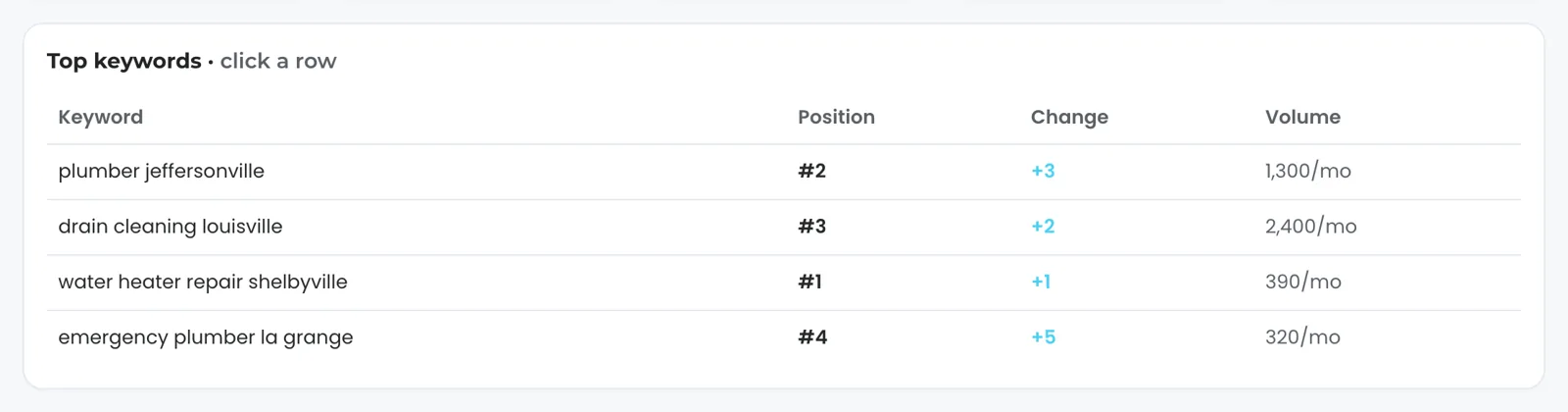
Yes. Every source the product reads for search and listings belongs to a place. Your Google Business Profile is a listing with an address, and the product reads its reviews, rating and listing performance. Search Console shows the queries you appeared for and the pages that earned the clicks; for a territory business those are the town and the trade. Google Ads campaigns for a service business are drawn around a service area, and the ads view reports their spend, conversions and cost per conversion.
A territory also makes the answer-engine question concrete. When someone asks ChatGPT, Gemini, Claude, Grok, Manus, Google AI Overviews, Perplexity, Meta AI or DeepSeek who to call, the useful answer covers their address, and the AI visibility program scores whether that answer is you, at baseline and again as the work moves. A multi-location or national service business is read the same way, place by place, because its listings and its campaigns are still drawn around places.
Will it pay off for a business my size?
It pays off when you can see what each lead cost and what it became, and the screen shows you that at any size. The product counts leads one at a time from your own site: where your site's forms feed the lead sheet, each submission is written to it server-side as it arrives, and the Leads view reads that sheet newest first. It reads volume from the sources you already run: sessions, sources and key events from GA4, and jobs and pipeline stages from your CRM or booking platform where the business runs on one. Where the daily lead watch is set up, it compares the sheet at 7:20am Eastern against what Google Ads and GA4 counted, so a dead tag that reports zero while real leads keep landing is flagged the next morning. Five checks run in all, so a blind ad account, an ad campaign that has gone dark and a form that has gone quiet are named the same way. Every lead is counted the day it lands, and a count that goes wrong is on the screen the next morning instead of at the end of the quarter.
The same count runs through the outbound engine, on Command. Prospects are sourced weekly to a target profile. Prospect emails leave from a review-first queue; a person releases them, or the queue releases on the schedule set for the engagement, and every send is logged. Measure the published tiers against the leads and jobs the screen counts for you each month: Starter is $400 a month, Launch $650, Growth $1,200, and Command is scoped per engagement.
- A form is submittedWritten to your sheet server-side as it arrives
- The Leads view reads itNewest first, counted the day it lands
- Volume is read beside itGA4 sessions and key events, your CRM's pipeline
- The lead watch comparesAt 7:20am ET where it is set up; a dead tag is named the next morning

Every lead is counted the day it lands.
Will the work get done if nobody here runs marketing full time?
Yes. The product is built for the person who will open it: you, or whoever answers the phone, not a marketing manager with every console already open. The work splits in two. Scheduled work runs whether anyone is at a desk: the page pulls live numbers when you open it, prospects are sourced weekly on Command, content is researched and drafted on your cadence on Launch, Growth and Command, and the change history of your ads account is read every morning at 7:05 Eastern. Judged work stays with a person: prospect emails leave from a review-first queue; a person releases them, or the queue releases on the schedule set for the engagement, and every send is logged. Where we manage your ads, budget and bid changes move within the limits set for your engagement, and the change history the watch reads records each one.
Open one screen with a view for each connected source. It refreshes because you opened it, and the header stamp says how old the data is; every press of Refresh ends in a reloaded page. Ask for the next thing from the screen: a website change, or a content, keyword or targeting change, goes to the team and is logged. Set a lead outcome and it is written to the lead record. A request from the screen goes to your team as a logged ticket; the engine's writes to your ad accounts and your site go through their APIs and land in each account's own change history. A department wants the consoles. An owner wants the answer and a way to ask for the next thing.
A department wants
- The consoles
- Every one of them already open
An owner wants
- The answer, on one screen
- A way to ask for the next thing
What if my business does not match the fit?
Then read what the screen would show you before deciding, because the fit above is a description, not a gate in front of TruLata. A business with a marketing department gets the same schedule and one screen with every source on it and the record of every change. A business that counts customers in volume gets the same screen: the product counts leads one at a time from your forms, and from your calls where your CRM records them, and it reads volume from GA4 and your CRM beside those counts. A business that sells nationally is read place by place, wherever its listings and campaigns are drawn.
TruLata also does the work as a service, on the software or beside it: managed marketing for service businesses, search work, search ads with a daily account watch and website builds. If you want a strategist as well as the engines, add a managed retainer on any tier. Not sure it fits? Open the industries list, which shows the screen from each trade's seat, or open the demo: it runs the same engine code every client runs, on a fictional company, so you see the screen before you decide.

What each part of the fit decides in the product.
| Part of the fit | What in the product depends on it | Read more |
|---|---|---|
| You sell a service, usually inside a territory | Business Profile reviews and listing performance; Search Console queries and pages; a service-area campaign in Google Ads; answer-engine scoring | Your listing, read as a place |
| Customers of any size | Each form submission written to your sheet where your forms feed it; the daily lead watch where it is set up; volume from GA4 and your CRM; the review-first outbound queue on Command | How a submission becomes a counted lead |
| Whoever runs marketing | One screen refreshed when you open it; a header stamp that says how old the data is; requests to the team from the screen, logged | The screen you open |
| All of it together | The five use cases and the industries list | The trades it is built around |
Run against our own client list, the fit picks out the businesses the product was built around without being tuned to them: service businesses where the owner, or a manager with another title, carried the marketing on the side. Where a business sits outside it, the service pages carry the work and the demo shows the screen first.
Questions, answered.
What counts as a geographic service area?
A territory you drive to or that drives to you: a county, a metro, a set of towns. A multi-location or national service business fits the same way, read place by place, because its listings and its campaigns are still drawn around places.
Does the size of my jobs change what I get?
You get the same screen either way. Leads are counted one at a time from your own forms, and volume is read from GA4 and your CRM, so a business that wins a few large jobs a month and one that wins many small ones both read what ran, what each lead cost and what it became.
One person here does some marketing between jobs. Does the product fit?
Yes. An owner or office manager fitting it in between jobs is one of the seats the product was built for, and the page for that situation is the one where you are the marketing department. A business with a marketer on staff fits too.
Which industries is it built for?
The ones on the industries page, each with the screen shown from that trade's seat. The list comes from that fit rather than from a hand-picked set, and a trade that is not on it yet connects the same sources and reads the same screen.
Does TruLata work with businesses outside that fit?
Yes. TruLata is built around service businesses, and it is not limited to them; the demo shows you the screen before you decide. TruLata also does the work as a service through the service pages, on TruLata or beside it, and we tell you which fits rather than sell you the wrong thing.
Can I see the product before deciding?
Yes. Open the demo: it runs the same engine code every client runs, on a fictional company with illustrative numbers, and it needs your name and email.
See how it would run
for your business.
15 minutes with TruLata. We show you what your marketing brings in, what each lead costs, and what we would change first.
Book a demo or start a 7-day free trial
No card. It ends on its own after 7 days unless you add one. See pricing.
New here? See what TruLata is. Prefer to write? Send us the one thing you want to know.
Start here: AI marketing platform · AI marketing software · all-in-one marketing platform · marketing automation software · marketing software for small business.
- Refreshed when you open itLive data on page load, never a monthly PDF
- Counted from your own formsLeads recorded server-side, compared daily with Ads and GA4
- Seen in AI answersHow often ChatGPT, Gemini, Claude, Grok, Manus, Google AI Overviews, Perplexity, Meta AI and DeepSeek name you, measured
- Every send loggedProspect emails leave from a review-first queue, and every send is logged.