


AI Powered Marketing Tools for Contractors: Skip the Features Nobody Uses
Contractors should choose ai powered marketing tools by the handful of capabilities that actually produce booked jobs: lead capture and tracking, fast follow-up, review generation, ad monitoring, search and AI visibility, content production, and one reporting view. Everything past that list is usually vendor bloat you will pay for and never open.
Walk into most service businesses and you will find a platform with a feature menu three screens long. The owner or the person running marketing uses the contact list, the email sender, and maybe a dashboard they half trust. The other 90-odd features sit there, quietly justifying the invoice. The problem is not that the software is bad. The problem is that nobody chose it against a list of what a contractor actually does on a Tuesday.
Who is TruLata and who are these tools for?
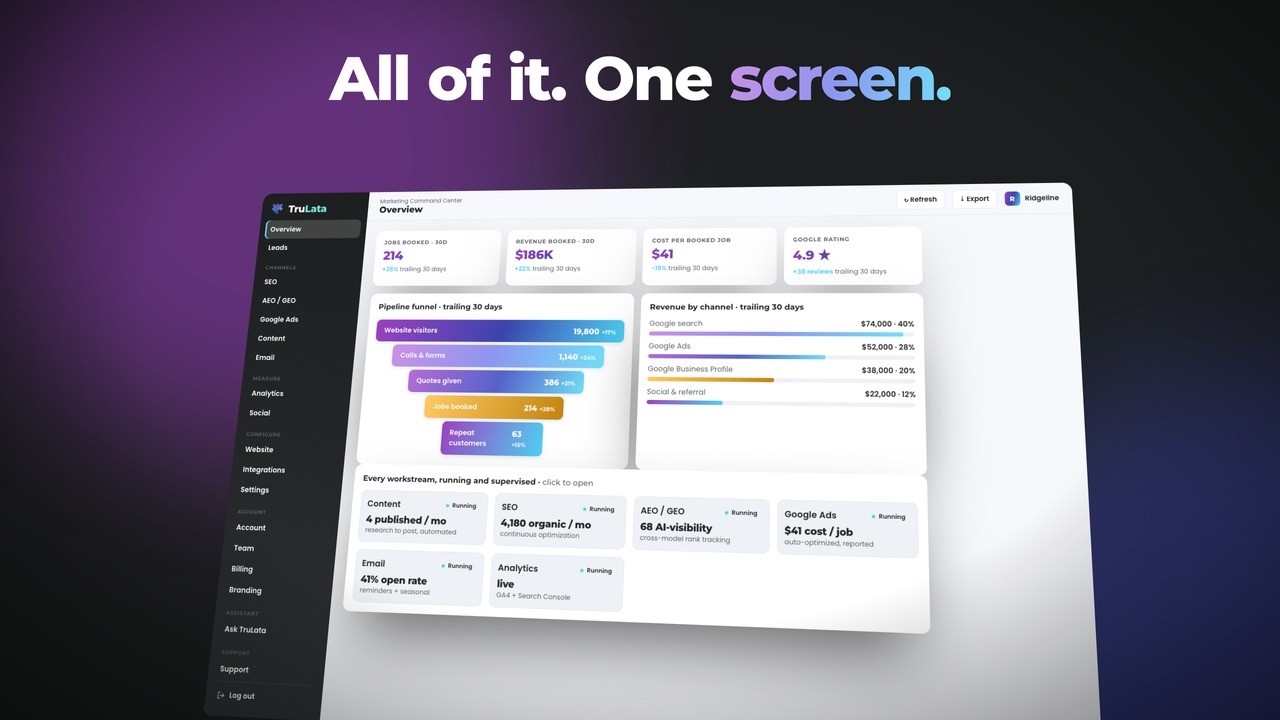
TruLata is an AI marketing platform built for local service businesses across the United States: contractors, plumbers, electricians, HVAC companies, roofers, law firms, and the trades around them. It runs marketing work and then shows what it did in a single dashboard, so whoever runs marketing at the company can see the actions taken and the results, not just a settings panel. That distinction matters more than feature count.
The people buying contractor marketing tools are rarely full-time marketers. They are owners, office managers, or a single marketing hire wearing four hats. A platform that requires a certification course to configure is a platform that will be configured once, badly, and never revisited. That is the real cost of bloat: not the subscription, the abandonment.
Why do contractors use so few of the features they buy?
Three reasons, and they compound.
The demo shows the ceiling, not the floor
Sales demos present the fully configured version: every integration mapped, every workflow branching, sample data flowing. Your account on day one is empty. The distance between the demo and your real Tuesday is the distance most implementations never travel.
Generic platforms carry ecommerce DNA
Many of the biggest marketing automation software products were designed for online retailers and SaaS companies. Guidance on choosing an email platform, including EmailToolTester's buyer guidance, notes that ecommerce buyers should prioritize deep Shopify or WooCommerce integrations while small businesses should weight ease of use instead. Cart abandonment sequences and product recommendation blocks are dead weight when your conversion event is a phone call about a leaking water heater.
Nobody budgets the setup hours
Integration work is where contractor implementations stall. Industry comparisons of contractor platforms point out that QuickBooks, which most contractors run, needs a third-party connector or Zapier on some major platforms and has no first-party integration on others, per Contractor ToolStack's 2026 comparison. Every connector you have to broker yourself is a place your data quietly stops syncing. We covered the downstream damage in fixing data sync issues that kill your lead pipeline.
Which features actually move the needle for a service business?
Here is the short list. If a platform does these seven things well, the rest is negotiable.
1. Lead capture counted from your own forms
Not estimated, not modeled, not "conversions" as a platform defines them. You need a count of humans who filled out your form or called, with source attached. This is the number every other decision hangs on, which is why lead tracking counted from your own forms should be a floor requirement, not an upgrade tier.
2. Follow-up that fires without anyone remembering
Speed matters more than polish. A lead that gets a reply in minutes converts at a materially higher rate than one that waits until the end of the day. You need triggered sequences for new leads, open quotes, and jobs that went quiet. Three sequences, built well, beat thirty templates nobody finished.
3. Review requests tied to job completion
Review generation is one of the highest-return automations a contractor can run because it compounds into both map pack ranking and close rate. HVAC-focused coverage from pulseM describes connecting CRM data with email, SMS, and review platforms so requests go out after every completed job without manual effort. The trigger should be job completion, not a calendar date.
4. Ad spend monitoring with a daily check
Google Ads accounts break silently: a disapproved ad, a budget cap hit, a conversion action stopped reporting. Weekly reviews find these five days late. Google Ads reporting with a daily account watch catches them in one. If a platform sells ad management but only refreshes reporting weekly, that is a reporting product, not a management product.
5. Search and AI visibility in the same place
Buyers now ask ChatGPT and Gemini for contractor recommendations the way they used to ask Google. That means two visibility questions, not one: do you rank, and do you get named. AI visibility tracking across four answer engines answers the second, and it is a capability most legacy marketing automation software has no concept of.
6. Content production you do not have to schedule around
Service pages, location pages, and blog posts are how you become the entity an answer engine cites. The bottleneck is never strategy, it is production. A content engine that ships consistently is worth more than an AI writing assistant that requires you to sit down and prompt it.
7. One reporting view you actually trust
If your marketing numbers live in five tabs, you will reconcile them never. Live marketing data, refreshed when you open it removes the weekly export ritual. Company 119's guidance on evaluating contractor automation makes the same point: research the reporting and analytics options before you buy, because tracking the metrics that matter is the whole point of marketing automation for contractors.
What features are usually bloat for contractors?
Not useless in every context. Useless in yours.
- Multi-stage lead scoring. Scoring models earn their keep when you have thousands of leads a month and a sales team to route them to. With a few dozen, the owner already knows which ones are real.
- Ecommerce and cart workflows. Abandoned cart, product feeds, upsell blocks. You do not sell a cart.
- Elaborate branching workflow builders. Impressive in a demo, abandoned in month two. Most contractors need linear sequences with a stop condition.
- Social scheduling across eight networks. Two channels done consistently outperform eight done once.
- Custom object modeling and sandbox environments. Enterprise features priced into small business plans.
- Chatbots that only deflect. If it does not capture a name and number and hand it off, it is a cost center.
McKinsey research cited in Keen's 2026 marketing planning software comparison found 47% of martech decision-makers report losing value from their stack, which is exactly what buying the ceiling and using the floor looks like on a spreadsheet.
How do you evaluate a platform without sitting through six demos?
Run the Tuesday test
Write down the five marketing tasks that actually happen in your business in a normal week. Responding to new leads. Asking for reviews. Checking ad spend. Posting something. Pulling a number for the owner. Now ask the vendor to show you those five, in that order, in your account with your data. Anything they show you outside that list is a nice-to-have.
Count the connectors
Every integration that requires a middleware tool is a future failure point. Ask which connections are native. Reviewing TruLata integrations before you commit tells you more than a feature matrix will, because the question is not whether it connects but whether you have to maintain the connection.
Ask what it does versus what it lets you do
This is the sharpest question in the whole evaluation. Most marketing automation software lets you do things: it hands you a builder and waits. An ai marketing platform should do the work and then report it. How TruLata works is built on that second model, including outbound prospecting where emails leave from a review-first queue and every send is logged.
Check the exit before the entrance
Can you export your contacts, your lead history, and your reporting? Month-to-month or annual commitment? A platform confident in retention does not need a twelve-month lock.
What does a lean contractor stack actually look like?
A working setup for a 3 to 25 person service business usually comes down to four layers: a place leads land and get counted, a follow-up layer that fires automatically, a visibility layer covering search and answer engines, and one dashboard that shows all of it. Field service software handles scheduling and invoicing. Marketing software handles demand. Confusing the two is how contractors end up with two half-used platforms instead of one used fully.
If you already have tools that work, the question is consolidation timing, which we broke down in when to consolidate versus keep your stack. Consolidate when reconciliation eats more time than the tools save. Not before.
See what the dashboard actually shows
The fastest way to tell bloat from value is to look at the screen you would open every morning. Book the live demo and see the lead counts, ad watch, visibility tracking, and content output in one place, with the work already done rather than waiting for you to configure it. Bring your five Tuesday tasks and check them off.