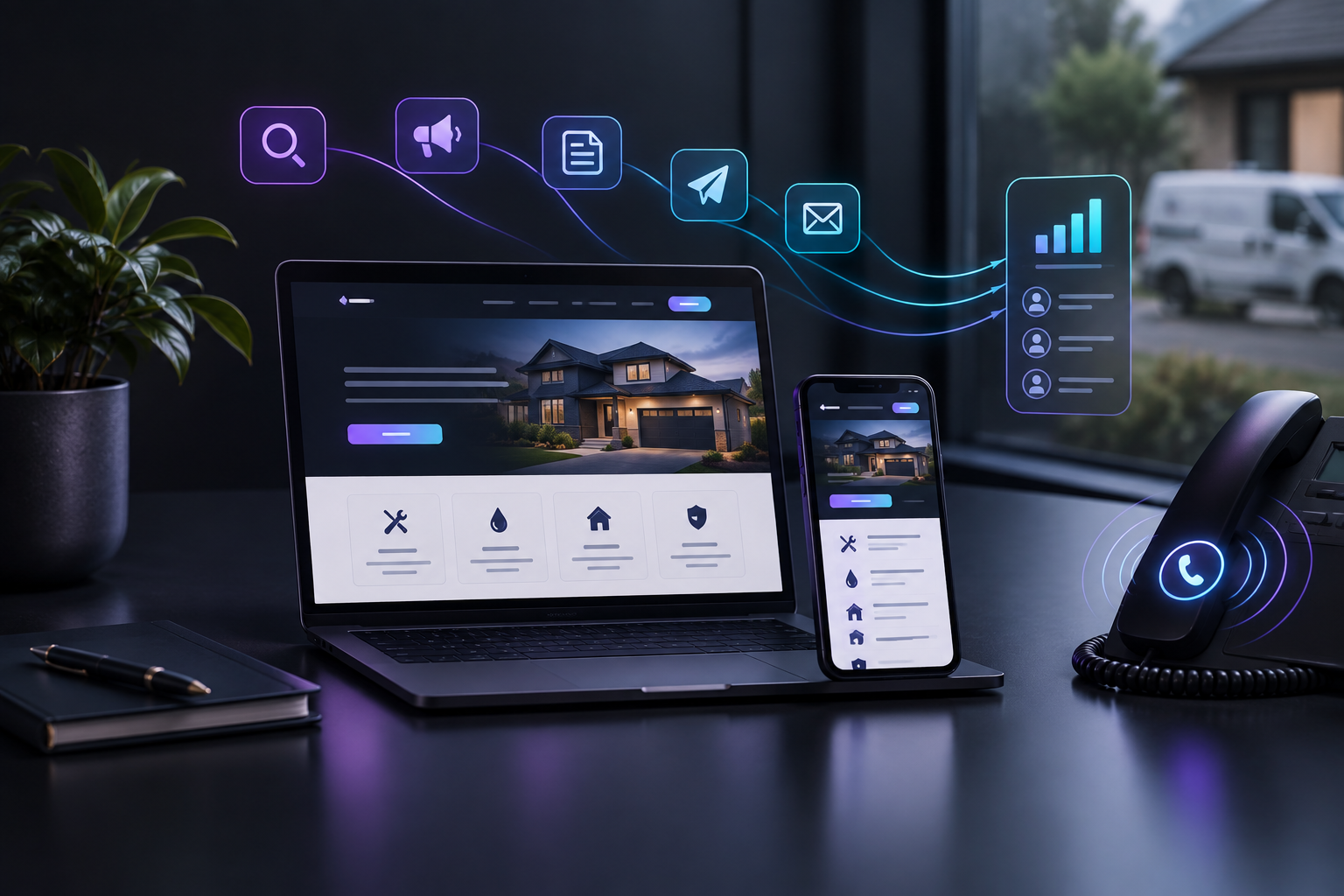



The best AI marketing platform for local service businesses is one that runs the marketing itself and proves which leads it produced. That means search, ads, content and follow-up running on a schedule, and every lead counted with its source. Field service software, agencies and DIY toolkits each cover part of that job. Few tools cover search, ads, content and follow-up together.
Most owners asking this question already pay for something: a job management app, a website from a marketing company, or a Google Ads account someone set up years ago. The real question is which option closes the gap between "we do some marketing" and "we know which marketing booked jobs." This page compares the real options side by side, with one honest limit for each.
What should an AI marketing platform actually do for a service business?
A plumber, roofer, HVAC shop or dental practice needs five things handled every week: showing up in local search, running Google and Meta ads without wasting spend, publishing useful content, following up with past customers by email, and reaching new commercial accounts. Then it needs one thing on top of all of that: a count of the calls and form fills each channel produced, and what each one cost.
Five weekly jobs plus one count
Local search
- Showing up in local search
Ads
- Google and Meta ads
- No wasted spend
Content and email
- Useful content published
- Past customers followed up
Outreach and counting
- New commercial accounts reached
- Calls and form fills counted, with cost
Sometimes "AI" means a writing assistant inside a CRM. Sometimes it means software that actually executes the work on a schedule. When you evaluate options, ask two questions. First, does it do the work or help you do the work? Second, does it count leads from your own website and phone, or does it report platform metrics like clicks and impressions? The answers show which kind of product you are looking at.
What makes marketing different for local service businesses?
Demand in the trades follows the calendar and the weather, and marketing has to move with it. Summer is often the busiest stretch for home service businesses, because maintenance that piled up over winter gets tackled when the weather turns, according to a 2026 Forbes Business Council piece on peak seasons. The same piece notes that storms and heat waves can double demand overnight for emergency trades like HVAC and plumbing. A platform that only changes your ads when someone remembers to log in will miss those spikes.
Why timing matters in the trades
- Usually slowerHousing activity usually slows down
- Build capacityContent, reviews and ad structure go in place
- Home sales risePending sales rise in March and peak in June
- Often busiestWinter maintenance gets tackled; storms can double demand
The housing market drives a lot of this work, too. The National Association of Realtors reports that pending home sales rise in March and peak in June, while November through January usually slows down. Moves, inspections and renovations follow that curve, so remodelers, painters, movers and landscapers feel it directly.
Preparation also has a lead time. Forbes contributors writing on preparing for the busiest time of year recommend building capacity at least two months before the peak starts. For a service business, that means the content, reviews and ad structure that will carry the busy season need to be in place during the slow one. Content and ads started after the busy season begins will not have time to pay off.
Which AI marketing platforms do local service businesses compare?
Here are the options owners usually weigh. Where we have no sourced specifics about a company, we describe the category it belongs to instead of guessing at features or prices.
Run operations
- Jobber
- Housecall Pro
- ServiceTitan
- Scheduling, dispatch, payments
Run marketing
- HubSpot and GoHighLevel: you configure
- Scorpion and agencies: outside team
- Thryv: broad scope
- Podium: texting and reviews
| Option | What it is | Best for | One honest limit |
|---|---|---|---|
| Jobber | Field service management software | Scheduling, quoting and invoicing for smaller crews | Built around running jobs, not running ad and search campaigns |
| Housecall Pro | Field service management software | Home service teams managing dispatch and payments | Marketing tools sit beside operations rather than at the center |
| ServiceTitan | Field service management software for larger contractors | Multi-truck shops with office staff | A large operations system; marketing execution is still someone's job |
| HubSpot | General CRM and marketing software | Businesses with someone ready to configure and run it | Built for many industries, so local service setup is on you |
| GoHighLevel | Configurable marketing and CRM toolkit | Owners or agencies who want to build their own system | You assemble and maintain the workflows yourself |
| Scorpion | Marketing company focused on home services | Owners who want an outside team to handle marketing | Service model, so day-to-day visibility depends on the reporting you get |
| Thryv | Small business management and marketing software | Owners wanting one tool for many small business tasks | Broad scope means less depth on any one channel |
| Podium | Customer messaging and reviews software | Shops focused on texting customers and collecting reviews | Covers communication, not ads, search content or outbound |
| Marketing agency | People you hire to run your marketing | Owners who want hands-off service | Results arrive as monthly reports, and switching is slow |
| Doing it yourself | Owner runs ads, posts and email directly | Very small shops with time in the slow season | Stops when the busy season starts |
| TruLata | AI marketing platform that runs search, ads, content, outbound and email | Service businesses that want the work done and every lead counted | It runs marketing, not dispatch, invoicing or scheduling |
Jobber, Housecall Pro and ServiceTitan
These are field service management tools. Their core job is the work after the phone rings: scheduling, dispatch, quotes, invoices and payments. Many add marketing features such as review requests or customer email. If your biggest problem is a messy schedule, start here.
The limit is that none of them were built primarily to run your Google Ads, publish content or prospect for commercial work. Most owners who use one still need something else for getting the phone to ring.
HubSpot and GoHighLevel
Both are flexible toolkits. HubSpot is a general CRM and marketing suite used across many industries. GoHighLevel is a configurable marketing and CRM system that owners or agencies build out themselves.
Both depend on having the right person running them. Someone has to design the pipelines, write the emails, connect the ad accounts and keep it all running. If that person exists in your business, these can work well. If not, they sit unused.
Scorpion and marketing agencies
Scorpion is a marketing company focused on home services, and it sits in the same decision as hiring any agency: you pay people to run the marketing for you. You do not have to spend your own time on the work.
The limit is visibility. You see what the monthly report shows, and you rarely see the leads themselves in real time. We wrote more about this tradeoff in marketing agency vs marketing software for a contractor.
Thryv and Podium
Thryv is small business software that bundles management and marketing tools for many kinds of local businesses. Podium centers on customer messaging and reviews.
Neither is designed to run your search content, ad campaigns and outbound prospecting together. You may still need another tool or person for the channels that bring in new customers who have never heard of you.
Doing it yourself
Many owners run their own Google Business Profile, boost a few posts and send an occasional email. It costs time, not a subscription, and you know your customers better than anyone.
The limit is the calendar from earlier. DIY marketing happens in slow months and disappears in busy ones, which is exactly when the groundwork for next season should be laid.
TruLata
TruLata is an AI marketing platform for local service businesses. It runs search, Google and Meta ads, content, outbound and email on a schedule. It counts every lead from your own site with its source, and shows what happened and what it cost on your TruLata dashboard. The team behind it ran a marketing agency and turned that work into software.
Instead of trusting platform-reported conversions, TruLata uses lead tracking counted from your own forms, so a form fill shows the channel it came from. For commercial work, prospect emails leave from a review-first queue and every send is logged, through outbound prospecting from a review-first queue. The limit: TruLata does not schedule crews or send invoices, so you would keep your field service software alongside it.
Which one should you choose?
Match yourself to the closest description below.
Match your situation to a choice
- Schedule and invoicing are the messField service software
- Someone enjoys building systemsHubSpot or GoHighLevel
- Want people to handle everythingAn agency such as Scorpion
- Reviews and texting are the gapPodium
- Want one broad toolThryv
- Very small, slow-season timeDo it yourself
- Want work run and leads countedTruLata
- If your schedule and invoicing are the mess: start with field service software like Jobber, Housecall Pro or ServiceTitan, sized to your crew count.
- If you have someone who enjoys building systems: HubSpot or GoHighLevel gives that person room to build exactly what they want.
- If you want people to handle everything and you are comfortable with monthly reporting: an agency, including home service specialists like Scorpion.
- If reviews and customer texting are the main gap: a messaging and reviews tool like Podium.
- If you want one broad tool for many small business tasks: Thryv fits that category.
- If you are very small and have slow-season time: do it yourself, and build next season's content now.
- If you want search, ads, content, outbound and email run for you, with every lead counted from your own site: TruLata, alongside the field service software you already use.
Before you sign with any of them, ask whether you can open it on a Tuesday and see how many leads came in last week, from which channel, at what cost. If the answer requires waiting for a report or exporting a spreadsheet, you will not see your numbers when you need them.
How do you get started with TruLata?
TruLata's dashboard shows leads by source, ad spend, search rankings and what went out this week, all in one place.
What the TruLata dashboard brings together
- Leads by source
- Ad spend
- Search rankings
- What went out this week
- Walkthrough for your shop
- See what it would track
If you want to see whether it fits your shop before the next busy season, see how TruLata works and book a walkthrough. Bring your current lead count and your current marketing spend, and we will show you what the dashboard would track for your business.