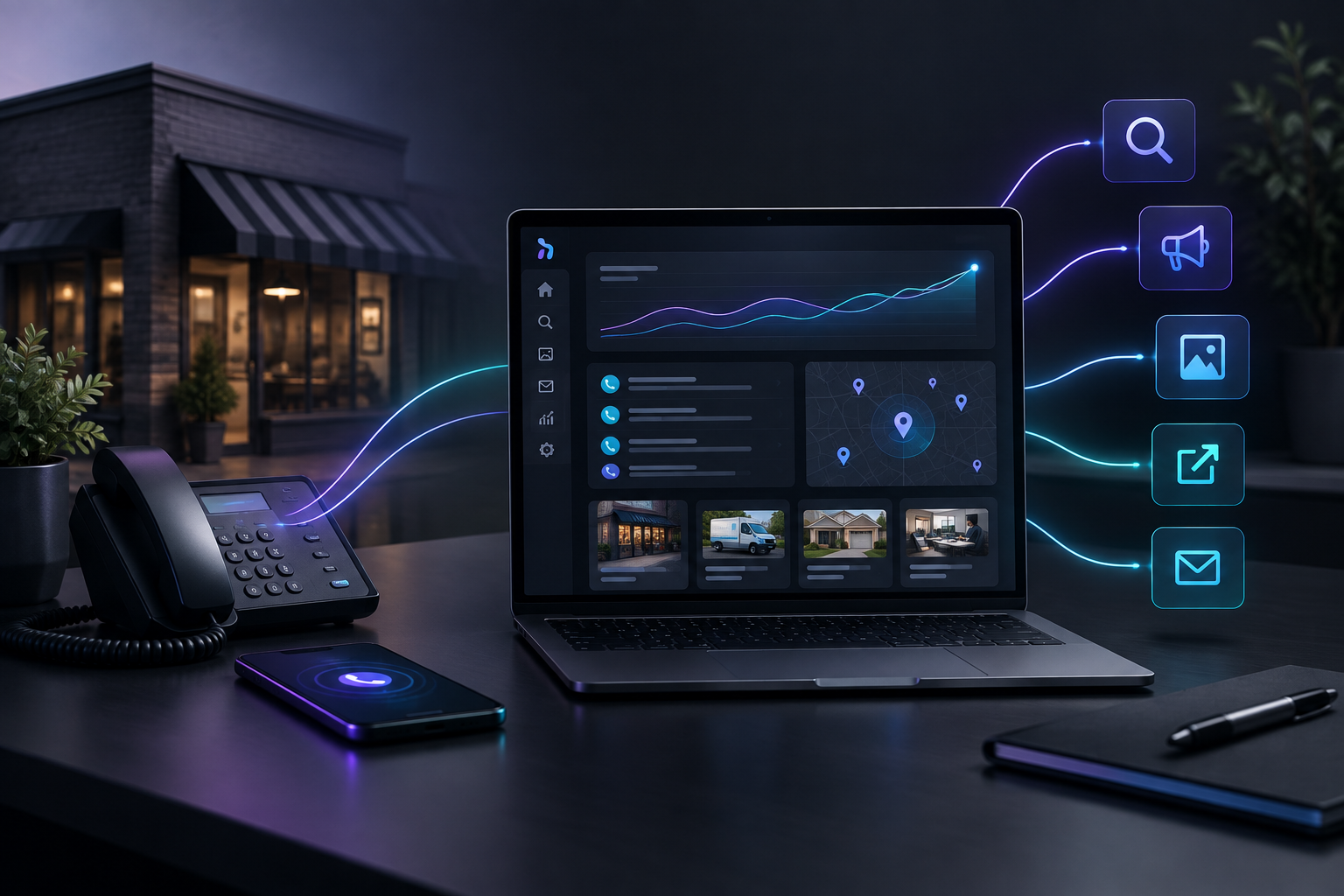



The best software for a contractor to see all their marketing in one place is one that both runs the marketing and counts the leads it produces, so the numbers come from one source instead of five logins. Field service tools track jobs, CRMs track contacts, and agencies send reports. A platform like TruLata runs the channels and shows results and cost on one dashboard.
Most contractors already have the pieces. There's a Google Ads account, a Business Profile, a website form, maybe a Facebook page and an email list in the field service app. What they don't have is one screen that answers a simple Monday question: how many leads came in last week, from where, and what did it cost? This page compares the options owners actually weigh, says plainly what each one is good at, and names one real limit for each.
Why is it so hard to see all your marketing in one place?
Each channel reports on itself. Google Ads counts conversions its own way. Meta counts them another way. Your SEO person sends a rankings PDF. Your answering service logs calls. None of these reports agree, and none of them know about the others, so the same homeowner can show up as a "conversion" in two ad platforms and as nothing in your job software.
Count leads where they land
- Google Ads
- Meta
- SEO
- Answering service
- Cost per channel is simple arithmetic
- One count of each homeowner
The fix isn't another report stapled on top. It's counting leads where they actually land, on your own website and phone line, and tagging each one with the channel that sent it. Once that's in place, cost per channel is simple arithmetic. Without it, every dashboard is a guess.
What makes marketing different for contractors
Contractor marketing runs on the calendar and the weather. That changes what you need to see and when you need to see it.
A contractor's year of demand
- Summer rush beginsBusy months leave no time to plan
- Tune-up seasonPeaks expose missed calls
- Furnace callsOctober and November capacity filled in advance
- Spring tune-up pushBefore the next summer peak
- Demand moves in seasons, not straight lines. One HVAC owner writing in ACHR News describes a summer rush starting around Memorial Day, a tune-up season from August, furnace calls after the first snowfall, and a push for spring tune-ups in March and April before the next summer peak.
- Busy months leave no time to plan. Contractors interviewed by ACHR News describe filling October and November call capacity months in advance, and admit it is hard to do while everyone is buried in summer demand. A trade brokerage owner told Contracting Business that in summer, contractors are "slammed."
- Peaks expose missed calls. Plumbing & Mechanical reports that seasonal spikes catch small service businesses off guard, and recommends reviewing missed call logs, testing the booking process and measuring after-hours volume before demand peaks.
- Big repairs land on tight household budgets. The ACCA notes that about 75% of homeowners live paycheck to paycheck, so a failed system is a financial strain, and buyers compare carefully before choosing who to call.
Put together, a contractor needs to see marketing by week and by channel, spot a slow month coming, and know whether leads are being answered. A monthly PDF that arrives after the season has turned doesn't do that.
What are the real options, and what does each one actually do?
Owners usually weigh four kinds of tools: field service software, CRMs and marketing suites, all-in-one marketing vendors, and people (an agency or doing it yourself). They solve different problems, which is why so many contractors end up paying for two or three of them and still can't see the whole picture.
Four kinds of tools
Field service software
- Jobber
- Housecall Pro
- ServiceTitan
CRMs and suites
- HubSpot
- GoHighLevel
All-in-one vendors
- Scorpion
- Thryv
- Podium
People
- An agency
- Doing it yourself
The table below sums up each option. Details follow it.
| Option | What it is | Best for | One honest limit |
|---|---|---|---|
| Jobber | Field service management software | Scheduling, quoting and invoicing for smaller crews | Built around jobs, not around running ad, search or content channels |
| Housecall Pro | Field service management software | Home service teams that want dispatch and payments in one app | Marketing data from outside channels still lives in those channels |
| ServiceTitan | Field service platform aimed at larger operations | Multi-truck companies with office staff to run it | A heavy system to adopt if your main gap is marketing visibility |
| HubSpot | CRM and marketing software suite | Businesses with someone to configure and maintain it | Shows what you set it up to show; it does not run your channels for you |
| GoHighLevel | Marketing and CRM toolkit often resold by agencies | Owners or agencies willing to build their own funnels and automations | You or your agency do the building and upkeep |
| Scorpion | Marketing services company for local businesses | Owners who want an outside provider handling their marketing | Reporting comes through the provider's view of the work |
| Thryv | Small business software with marketing features | Owners wanting business tools and some marketing in one account | A general small business tool, not built around contractor lead tracking |
| Podium | Customer messaging and reviews software | Businesses focused on texting customers and collecting reviews | Covers communication, not ads, search or content results |
| Marketing agency | People who run your campaigns for a retainer | Owners who want to hand the work to a person | You see what their report shows, on their schedule |
| Doing it yourself | Native tools: Google Ads, Business Profile, Meta, a spreadsheet | Very small operations with time to log in weekly | The owner becomes the integration, and it slips when the season hits |
| TruLata | AI marketing platform that runs channels and counts leads | Service businesses that want marketing run and measured in one place | It runs and reports on marketing; it is not job scheduling or invoicing software |
Field service software: Jobber, Housecall Pro, ServiceTitan
These are the systems that run the job side of a contracting business: booking, dispatch, estimates, invoices, payments. Many include customer reminders and follow-up messages. If your question is "what happened after the customer booked," this is where the answer lives.
The gap is upstream. They aren't built to run your Google Ads, publish content or work your search rankings, so the "where did this lead come from and what did it cost" question still depends on data held elsewhere. ServiceTitan suits larger shops with office staff; Jobber and Housecall Pro tend to suit smaller teams.
CRMs and toolkits: HubSpot, GoHighLevel
These give you contact records, pipelines, email tools and reporting you can configure. In capable hands they can pull a lot into one view. The catch is the phrase "in capable hands." Someone has to connect sources, build the reports and keep them accurate when tracking breaks.
GoHighLevel in particular is a toolkit many agencies build on. If you'd rather not build it yourself, see our piece on the alternative to GoHighLevel for a contractor.
All-in-one vendors and point tools: Scorpion, Thryv, Podium
Scorpion is a marketing services provider, so you're buying work done plus its reporting. Thryv bundles general small business software with marketing features. Podium centers on messaging and reviews. Each covers a real need. None of them, by category, is the same as counting every lead from your own site across every channel you run.
Before signing, ask any vendor one question: "Where is a lead counted, and can I see the source of each one?" The answer tells you whether you're getting measurement or a summary.
A marketing agency, or doing it yourself
An agency brings people and judgment. What you see depends on what they choose to report and how often. That isn't bad faith; it's the structure. Our comparison of marketing agency vs marketing software for a contractor goes deeper.
Doing it yourself is the cheapest in cash and the most expensive in attention. It works in February. By July, when every truck is out, the spreadsheet stops getting updated, which is exactly when you most need to know which channel is producing calls.
TruLata
TruLata is an AI marketing platform for local service businesses such as trades, home services and practices. It runs search, Google and Meta ads, content, outbound and email on a schedule. It counts every lead from your own site with its source, and shows what happened and what it cost on your TruLata dashboard. Prospect emails leave from a review-first queue, and every send is logged.
The team behind it ran a marketing agency and turned that work into software, so the platform does the recurring work an agency would do and shows the results directly instead of through a monthly report. You can read how TruLata works step by step, or look at the lead tracking counted from your own forms. It does not replace your scheduling or invoicing software; it sits beside it.
Which one to choose if...
The right answer depends on where your blind spot is. Match the problem you have now, not the one a sales demo describes.
Match your problem to a tool
- Scheduling and billingJobber or Housecall Pro
- Many trucks, office staffServiceTitan
- Someone who enjoys building systemsHubSpot or GoHighLevel
- Want a person to own itAn agency or Scorpion
- Reviews and customer textingPodium
- Every lead counted with source and costTruLata
- Your problem is scheduling and billing, not marketing: start with Jobber or Housecall Pro, or ServiceTitan if you run many trucks and have office staff.
- You have someone who enjoys building systems: HubSpot or GoHighLevel can be shaped into a custom view, if that person stays.
- You want a person to own it and you trust their reports: a marketing agency, or a provider like Scorpion.
- Your main gap is reviews and customer texting: Podium fits that specific job.
- You want marketing run on a schedule and every lead counted with its source and cost on one screen: TruLata.
- You're a one-truck operation with slow winters and time to spare: the native tools and a weekly spreadsheet can carry you for now.
Many contractors end up with two: field service software for the job, and one marketing system for everything before the job. That's a reasonable setup. What causes trouble is three or four overlapping marketing tools, each claiming the same lead.
How do you check whether a tool really shows everything?
Run a short test before you commit. Submit a form on your own site, call your tracked number, and click one of your own ads. Then see whether each shows up, tagged with the right source, within a day. If any of them are missing, the dashboard is incomplete no matter how good it looks.
- Submit a formUse your own site
- Call your tracked numberSee if the call appears
- Click one of your adsCheck the source tag within a day
- Check timingCan you see last week, with spend beside leads?
- Check after-hours leadsPeak demand often goes unanswered here
Then check timing against your season. Ask whether you can see last week, not just last month, and whether ad spend and lead count sit next to each other. Following the Plumbing & Mechanical advice, also check after-hours leads, since that's where peak-season demand often goes unanswered.
Ready to see your marketing on one screen?
If you're tired of piecing together ad accounts, ranking reports and form emails to figure out what's working, TruLata puts the running of your marketing and the counting of your leads in the same place.
Piecing it together
- Ad accounts
- Ranking reports
- Form emails
TruLata
- Running your marketing
- Counting your leads
- One place, live demo
Open the live demo on the TruLata site to see the dashboard with real data, then decide whether it fits before your next busy season starts.