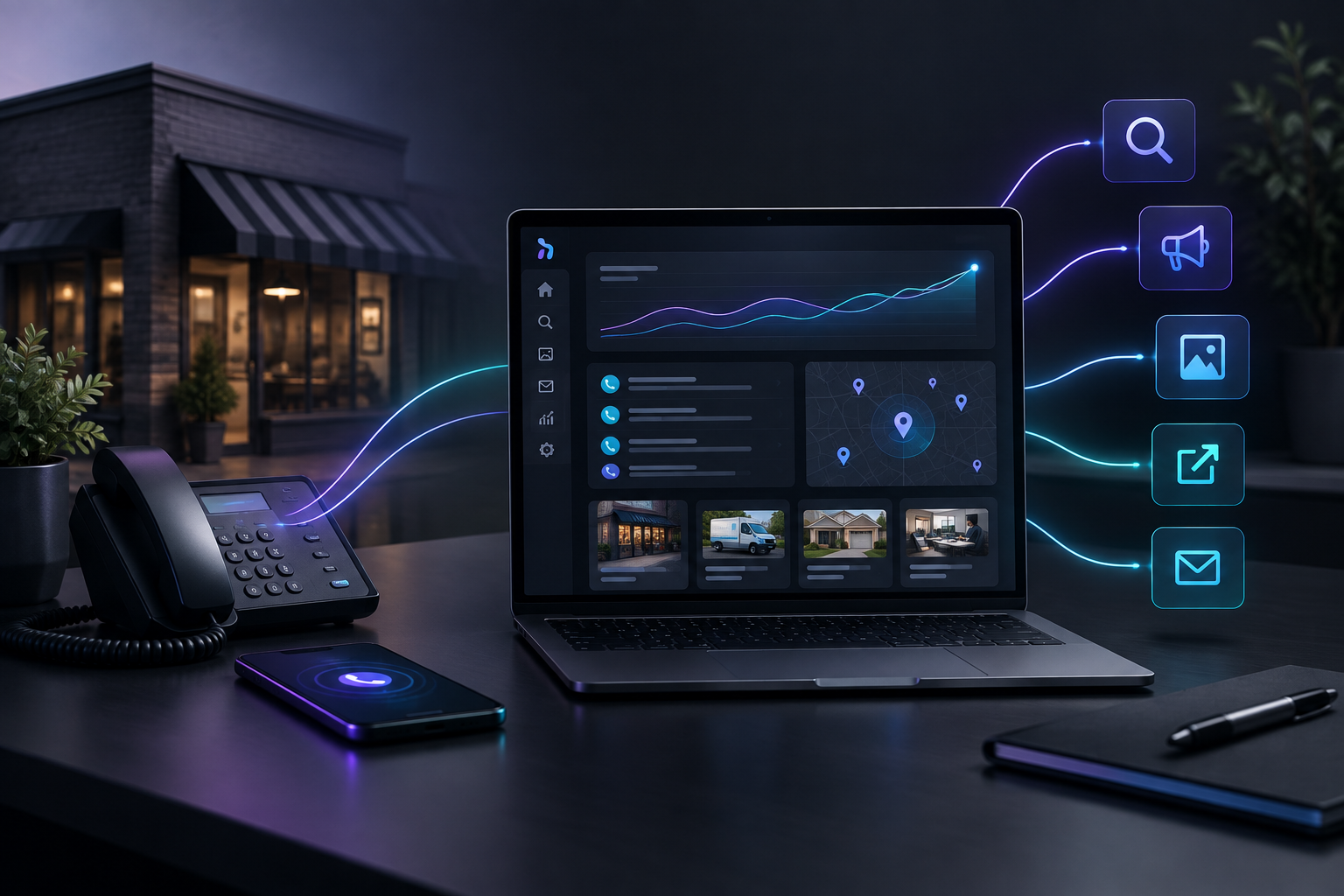



Yes. Some software now runs the marketing work itself instead of just storing your customer list. Most tools marketed to service businesses are scheduling, invoicing or CRM systems with marketing features attached, so you still do the work or pay someone to do it. A small number of platforms, TruLata among them, run search, ads, content, outbound and email on a schedule.
TruLata is an AI marketing platform for local service businesses such as trades, home services and practices. It was built by a team that ran a marketing agency and turned that agency's work into software. This page compares it with the other options owners usually weigh: field service software, CRMs, all-in-one builders, done-for-you marketing companies, an agency, and doing it yourself. Each option gets an honest limit.
What does "software that runs my marketing" actually mean?
An agency does three jobs. It does the work: ad changes, blog posts, review responses, email campaigns, outreach. It does that work on a schedule, every week, without you asking. And it reports back on what happened. Software only replaces an agency if it covers all three. Most products cover one. A CRM stores leads. A scheduling app books jobs. A dashboard shows numbers someone else produced.
- Does the workAd changes, posts, review replies, email, outreach
- Runs on a scheduleEvery week, without you asking
- Reports backTells you what happened
- Ask per channelWho does this every week?
When you evaluate a tool, ask one question about each channel: who does this every week? If the honest answer is "you," the tool is a workspace, not a replacement. That isn't a criticism, and plenty of owners want exactly that. It just means the agency's labor is still missing.
What are the real options, and what does each one do?
Here is how the common choices line up. The descriptions of other companies are kept at the category level. Check current features directly with any vendor before you buy.
Where each option fits
- Field service software
- CRM and marketing tools
- Messaging and reviews tools
- Agency or done-for-you provider
- Doing it yourself
- Jobs, scheduling, invoicing
- Tools someone must work in
- Texting and reviews
- Hands-off service relationship
- Your own time and effort
| Option | What it is | Best for | One honest limit |
|---|---|---|---|
| Jobber | Field service management software | Scheduling, quoting and invoicing for smaller crews | Built around running jobs, not running marketing channels |
| Housecall Pro | Field service management software | Home service operations and customer communication | Marketing features support the operation; you still drive campaigns |
| ServiceTitan | Field service management software for larger trade companies | Multi-truck operations with office staff | An operations system that expects a team to run it |
| HubSpot | CRM and marketing software | Businesses with someone whose job includes marketing | Provides tools; someone has to do the work in them |
| GoHighLevel | All-in-one marketing platform you configure yourself | Owners or agencies who like building their own setup | You build and maintain the funnels and automations |
| Scorpion | Marketing company serving home services | Owners who want a provider to handle marketing for them | A service relationship more than software you control |
| Thryv | Small business software with marketing features | General small businesses wanting one login for basics | Broad coverage, not built around trade lead sources |
| Podium | Customer messaging and reviews software | Businesses focused on texting customers and collecting reviews | Covers communication and reviews, not ads, SEO or outbound |
| A marketing agency | People who run your marketing for a retainer | Owners who want a hands-off relationship | Reporting often comes on the agency's schedule, in its own format |
| Doing it yourself | You run ads, posts and email directly | Owners with time and interest in marketing | The work stops when the season gets busy |
| TruLata | AI marketing platform that runs the channels on a schedule | Service businesses that want the work done and every lead counted | Runs the marketing; it does not schedule crews or invoice jobs |
Jobber, Housecall Pro and ServiceTitan
These are field service management systems. They handle booking, dispatch, quotes and invoices, and that is where they earn their place. Marketing features usually sit next to that core, such as review requests or follow-up messages to existing customers. Keep one if you already use it. It does not replace the person who runs your Google Ads or writes your service pages.
HubSpot
HubSpot is CRM and marketing software with a large toolset. It suits a business that has someone assigned to marketing who will build emails, landing pages and workflows. The limit is the same as with any toolset: the tools sit idle until someone uses them.
GoHighLevel
GoHighLevel is an all-in-one platform that many agencies use to build client setups. An owner can use it directly, but you are the one assembling the funnels, automations and pipelines. If you enjoy that, it's flexible. If you don't, it becomes another project. We cover this in more detail in a contractor who does not want to build it.
Scorpion and Thryv
Scorpion is a marketing company that works with home service businesses, so it sits closer to the agency model than the software model. Thryv is small business software with marketing features across many business types. Both fit some owners. Ask either one how much of the work is done for you, how much is left to you, and how leads are attributed to their source.
Podium
Podium focuses on customer messaging and reviews. Reviews matter a great deal for local trades, so this is a real need. It is one channel, though, not the whole marketing job.
A marketing agency
A good agency does the work and takes it off your plate. The common complaints are a slow feedback loop and reports you can't check against your own numbers. If you are comparing the two models directly, read marketing agency vs marketing software for a contractor.
Doing it yourself
Doing it yourself is cheap in cash and expensive in attention. Most owners can keep it going in a slow month. Very few can in a peak month, which is exactly when steady visibility pays off.
TruLata
TruLata runs search, Google and Meta ads, content, outbound and email on a schedule. It counts every lead that comes in through your own website along with its source, and it shows what happened and what it cost on one dashboard. Prospect emails leave from a review-first queue, and every send is logged. You can see the screen itself on your TruLata dashboard page, and the weekly cycle is laid out in how TruLata works. The limit is that TruLata is not field service software. If you need dispatch and invoicing, keep your operations tool and run marketing alongside it.
What makes marketing different for local service businesses
Marketing software built for e-commerce or SaaS assumes steady demand and buyers who browse for weeks. Trade demand works differently, and that changes what "running your marketing" requires.
The local service calendar
- Pending home sales riseHousing activity builds toward the peak
- Home sales peakNational Homeownership Month, summer is busiest
- Demand can spike overnightStorms and heat waves hit HVAC and plumbing
- Usually slowsHousing activity cools down
- Summer is the busiest season for many home service businesses. Maintenance put off over winter piles up, and June is National Homeownership Month, so homeowners work through their to-do lists then, according to Forbes.
- Demand can spike overnight. The same Forbes piece notes that summer storms and heat waves can double demand overnight, and emergency trades like HVAC and plumbing see unpredictable scheduling spikes.
- Housing activity follows the calendar. The National Association of Realtors reports that pending home sales rise in March and peak in June, while November through January usually slows. Move-ins and sales drive a lot of repair, inspection and upgrade work.
- Local services still mean a local provider. Search Engine Land points out that even in an on-demand economy, many services still depend on a nearby provider. That is why local search, reviews and nearby visibility carry so much weight in the trades.
In practice, the software has to keep working when you are too busy to look at it, and it has to shift effort as the season turns. An agency handles this with people. Software can only handle it if the work runs on a schedule rather than waiting for you to log in.
How do I check whether a tool really replaces an agency?
Before you sign up for anything, run these five checks:
- Weekly workList each channel and who performs it
- Lead countingOwn website forms with source attached
- Cost next to resultsSpend and leads on the same screen
- Outbound controlsEmails queued, reviewed and every send logged
- ExitKeep ad accounts, content and lead history
- Weekly work: List each channel (ads, search, content, email, outreach) and ask who performs the work each week.
- Lead counting: Ask whether leads are counted from your own website forms with their source attached, or reported back from the ad platform's view. See lead tracking counted from your own forms for what source-level counting looks like.
- Cost next to results: Ask whether spend and leads appear on the same screen, so you don't have to rebuild the math in a spreadsheet.
- Outbound controls: Ask how prospect emails get queued and reviewed, and whether every send is logged.
- Exit: Ask what you keep if you leave, including your ad accounts, content and lead history.
A tool that passes all five is doing an agency's job. A tool that passes one or two is a useful part of a stack that someone still has to run.
Which one to choose if...
The right answer depends on where your time goes and what you already own. Here is a plain mapping.
Pick by your biggest need
- Scheduling and invoicing is the problemJobber, Housecall Pro or ServiceTitan
- You have a marketer on staffHubSpot or a similar CRM
- You like building systems yourselfGoHighLevel
- Reviews and texting are the gapPodium
- You want a provider to handle itAn agency or Scorpion
- You want scheduled channels and sourced leadsTruLata alongside your operations software
- Money is tight, slow months freeDo it yourself
- If your biggest problem is scheduling and invoicing, start with field service software such as Jobber, Housecall Pro or ServiceTitan, sized to your crew count.
- If you have a marketer on staff who wants a toolset, HubSpot or a similar CRM gives that person room to build.
- If you like building systems yourself, GoHighLevel gives you the parts.
- If reviews and customer texting are the gap, a messaging and reviews tool like Podium targets that specific need.
- If you want a provider to handle it and don't need to see the work, an agency or a done-for-you company like Scorpion fits that model.
- If you want the channels run on a schedule and every lead counted with its source on one dashboard, TruLata is built for that. Pair it with your existing operations software.
- If money is tight and you have time in the slow months, do it yourself, and plan for what happens to the work in June.
Plenty of owners end up with two tools: one that runs the jobs and one that runs the marketing. That combination usually replaces an agency more cleanly than any single all-in-one product.
What should I do next?
Write down what your marketing does each week today and who does it. Then compare that list against the options above. If the gap is the work itself, meaning ads that need adjusting, pages that need writing, outreach that needs sending, and leads you can't trace to a source, that is the gap TruLata was built to close.
From your weekly list to one screen
- What your marketing does weekly
- Who does each task today
- Ads adjusted and pages written
- Outreach sent
- Leads traced with their cost
See TruLata running on real marketing data in the live demo, or review plans before you talk to anyone. You'll see the channels it runs, the leads it counts and what each one cost, all on one screen.