

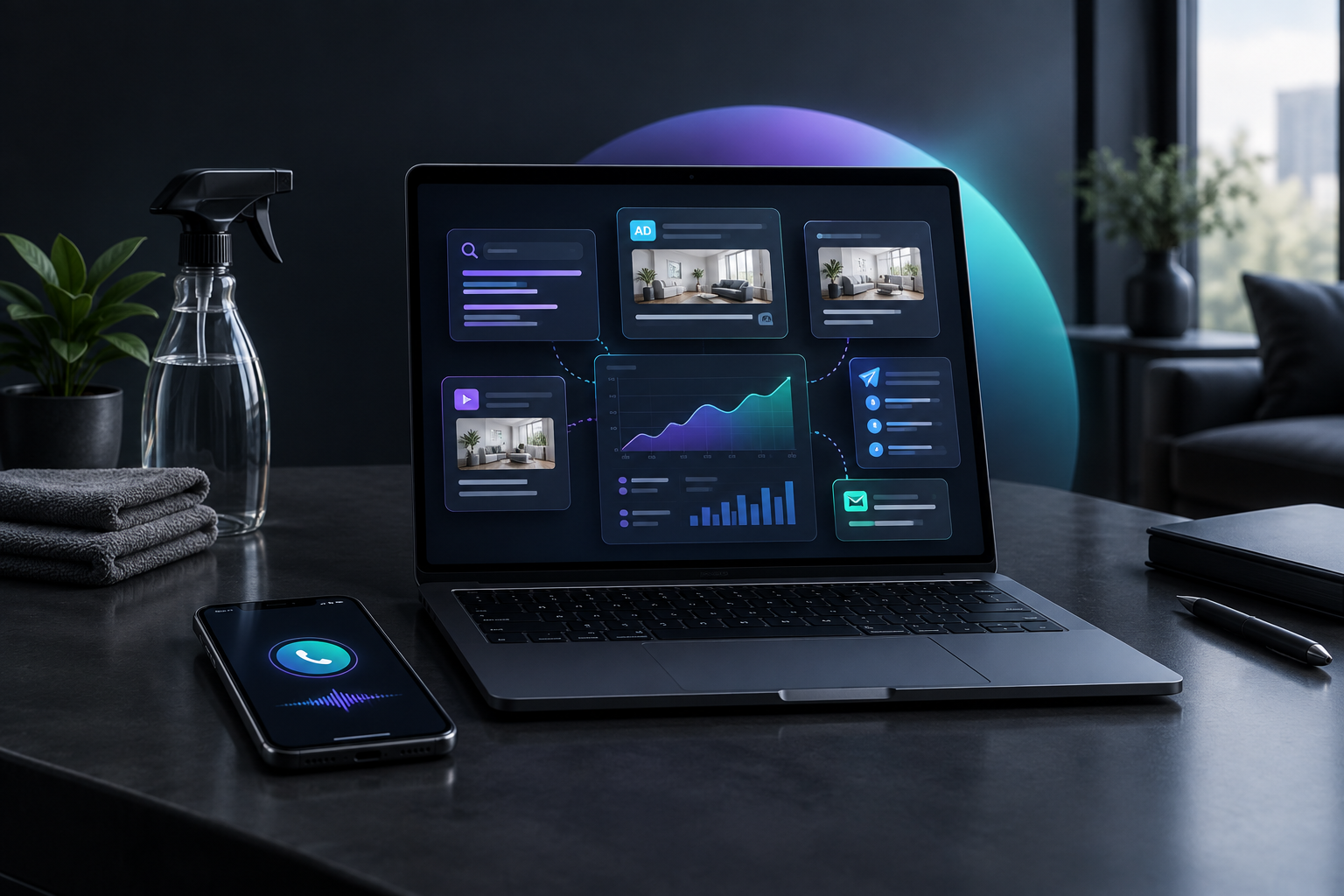

The best marketing software for a house cleaning business is the one that brings in new recurring clients and shows you which channel each one came from. Scheduling tools like Jobber or Housecall Pro run the jobs you already have. TruLata runs the marketing that wins new ones: search, ads, content, outbound and email, with every lead counted by source.
Most cleaning owners already have software. It books visits, sends invoices and reminds clients the crew is coming Thursday. What it usually doesn't do is decide where next month's new clients come from, or tell you whether the Google Ads spend produced three bookings or none.
What problem is marketing software supposed to solve for a cleaning company?
A house cleaning business runs on two engines. The first is operations: scheduling, routing, payments, client notes. The second is demand: being found when someone searches for a cleaner, getting picked over the other options on the page, and following up before the lead books someone else. Most "marketing software" lists blur these two together, which is why owners end up paying for features they never use.
Match the weak engine to the fix
- Unanswered quotes
- Holes in the calendar
- Spend with no clear results
- Follow-up and a CRM
- Marketing that runs every week
- Source-level lead tracking
Before you compare tools, write down which engine is weak. If clients slip through because quotes go unanswered, you need follow-up and a CRM. If the calendar has holes because not enough people find you, you need marketing that actually runs every week. If you're spending money and can't tell what works, you need source-level lead tracking. The options below each cover a different one of these.
What makes marketing different for house cleaning businesses
Cleaning is a mature, steady trade. The U.S. Bureau of Labor Statistics projects employment in building and grounds cleaning and maintenance occupations to grow 2% from 2024 to 2034, against 3% for all occupations. With growth that slow, a cleaning company mostly grows by taking clients from competitors in its own area. That puts the weight on being visible in local search and being the obvious choice when a homeowner compares options.
Slow growth means most gains come from taking clients from local competitors.
Trust decides the shortlist. Your crew is inside someone's home, often while they're out. The Better Business Bureau's seasonal home maintenance checklist tells homeowners to look for signs of trust and transparency when choosing a home service company. For a cleaner, that translates into reviews, clear service descriptions, proof of insurance and fast, professional replies. Software that can't help you show reviews, clear service details, insurance and quick replies won't help you get shortlisted.
Homeowner attention also moves with the seasons. The same BBB checklist organizes home care by spring, summer, fall and winter, and homeowners tend to think about deep cleans, move-outs and pre-holiday prep in those cycles. Your content and ad schedule should follow that calendar rather than running the same message all year.
Recurring service businesses use the quiet months to protect revenue. The National Association of Landscape Professionals describes members using the off-season for contract renewals and client communications. Cleaning companies with weekly and biweekly clients can apply the same logic: slower weeks are when email to past and current clients does its best work.
How do the main marketing software options compare?
These are the options a cleaning owner realistically weighs. The descriptions stick to what each type of tool is and who it fits. Where we don't have a sourced fact about a specific product, we describe its category instead.
- Pick the categoryField service, CRM, messaging, or agency
- Check who it fitsOwner-operator, larger team, or hands-off owner
- Read the honest limitEach option has one trade-off
- Plan the workA tool is only as good as the work inside it
One rule holds across all of them: a tool is only as good as the work someone does inside it.
| Option | What it is | Best for | One honest limit |
|---|---|---|---|
| Jobber | Field service management software | Scheduling, quoting and invoicing recurring cleans | Built to run jobs, not to generate new demand |
| Housecall Pro | Field service management software | Owner-operators who want booking and payments in one app | Marketing features sit beside operations, not at the center |
| ServiceTitan | Field service platform for trade contractors | Larger operations with office staff and complex dispatch | Category generally built around larger trades, heavy for a small cleaning team |
| HubSpot | CRM and marketing platform | Owners who want a full CRM and will build workflows | Someone has to set up and run the campaigns |
| GoHighLevel | All-in-one marketing and CRM toolkit | Owners or agencies comfortable building funnels themselves | A toolkit, so results depend on who builds it |
| Scorpion | Marketing services and technology for local businesses | Owners who want an outside team handling marketing | Agency-style model, less hands-on visibility into the work |
| Thryv | Small business management and marketing software | Owners who want basic tools under one login | General small business focus, not specific to cleaning |
| Podium | Customer messaging and reviews software | Collecting reviews and replying to leads by text | Covers communication, not search, ads or content |
| A marketing agency | Outside team you hire for ads, SEO or content | Owners who want to hand the work off entirely | Reporting quality varies, and you depend on their account |
| Doing it yourself | Your own Google profile, posts and ad account | Very early businesses with time and no budget | It stops the moment the schedule fills up |
| TruLata | AI marketing platform that runs search, ads, content, outbound and email | Cleaning companies that want marketing running weekly with every lead tied to its source | Not scheduling or invoicing software, so it sits alongside your job management tool |
Jobber
Jobber is field service management software: quotes, scheduling, invoicing and client records. It fits cleaning companies with recurring routes who need the back office organized. Its limit for this question is that running jobs well isn't the same as finding new clients.
Housecall Pro
Housecall Pro is in the same field service category, popular with owner-operators who want booking and payments from a phone. Like Jobber, it is strongest after a client has already found you.
ServiceTitan
ServiceTitan is a field service platform aimed at trade contractors with dispatch teams and office staff. For a small residential cleaning company, platforms in this tier are usually more system than the business needs.
HubSpot
HubSpot is a CRM with marketing tools on top. It suits owners who like building pipelines and email sequences. The honest limit: it provides the tools, not the weekly labor of writing, posting and adjusting ads.
GoHighLevel
GoHighLevel is an all-in-one marketing and CRM toolkit, often used by agencies to serve their own clients. It can do a lot, but what you get depends entirely on who builds and maintains it.
Scorpion and other marketing agencies
Scorpion offers marketing services and technology for local businesses, and works much like an agency. Agencies in general fit owners who want to hand marketing off. The tradeoff is visibility: you often see a monthly report rather than the work and its results as they happen.
Thryv
Thryv is small business software that bundles management and marketing tools. It fits owners who want one login for basics. It is built for small businesses broadly, so nothing in it is shaped around how cleaning clients choose a provider.
Podium
Podium focuses on customer messaging and reviews. Because clients let a crew into their homes, reviews carry weight in who gets hired. But it covers one slice of marketing, not search, ads or content.
Doing it yourself
A Google Business Profile, a few posts and a small ad budget can carry a new cleaning business. The limit is time: DIY marketing tends to stop exactly when the business gets busy, which is how slow months get created.
TruLata
TruLata is an AI marketing platform for local service businesses, including cleaning business marketing. It runs search, Google and Meta ads, content, outbound and email on a schedule. It counts every lead from your own site's forms with the source it came from, and shows what happened and what it cost on your TruLata dashboard. The team behind it ran a marketing agency and turned that work into software. It doesn't schedule crews or send invoices, so you keep your job management tool.
Why does lead source tracking matter so much for cleaning companies?
Cleaning leads arrive through many doors at once: a Google search, a Facebook ad, a neighbor's referral, a form on your site at 10pm. If all of them land in one inbox with no source, you can't tell which spend to keep. Owners then cut the wrong channel in a slow month or keep paying for one that produces nothing.
Tag every lead with its source
- Google search
- Facebook ad
- Neighbor referral
- Site form at 10pm
- Know which spend to keep
- Avoid cutting the wrong channel
- Faster quote follow-up
The fix is counting leads where they actually happen, on your own forms, and tagging each one with where it came from. TruLata's lead tracking counted from your own forms does this instead of relying only on what an ad platform reports about itself. Pair it with fast follow-up: a quote answered in minutes beats one answered tomorrow, a point we cover in why quote follow-up speed matters.
How should outbound and email work for a cleaning business?
Residential cleaning grows mostly through search, reviews and referrals, but outbound still has a place. Property managers, realtors who need move-out cleans, and small offices are all reachable directly. Email to past clients does steady work too, especially in the quieter stretches when recurring clients pause.
How a review-first send works
- Prospect queueProperty managers, realtors, small offices
- ReviewCheck the email before it goes out
- SendProspect emails leave from the queue
- LogEvery send is recorded with what and when
The risk with automated outreach is sending something careless under your name. TruLata handles this with outbound prospecting from a review-first queue: prospect emails leave from that queue, and every send is logged so you can see exactly what went out and when.
Which one to choose if...
Match your situation to the option below, starting from what's broken today.
Your situation and where to start
- Losing track of jobs and invoicesJobber or Housecall Pro
- Large multi-crew operationServiceTitan
- Enjoy building workflowsHubSpot or GoHighLevel
- Reviews and text replies are the problemPodium
- Want to hand it all offAn agency, including Scorpion
- Uneven client flow, unclear what worksTruLata alongside your job tool
- You're losing track of jobs, invoices and schedules: start with field service software like Jobber or Housecall Pro.
- You run a large, multi-crew operation with office staff: look at heavier field service platforms such as ServiceTitan.
- You enjoy building workflows and have time to run campaigns: HubSpot or GoHighLevel.
- Your main problem is reviews and replying to texts: a messaging and reviews tool like Podium.
- You want to hand everything off and accept less visibility: an agency, including Scorpion.
- You're just starting and have more time than budget: do it yourself until the schedule fills.
- Your operations are fine, but new client flow is uneven and you can't tell which marketing works: TruLata, alongside the job management tool you already use.
Pairing one tool that runs the jobs with one that runs the marketing is usually cleaner than forcing a scheduling app to act as a marketing department, or the reverse.
What should you do next?
Pull the last 90 days of new clients and write down where each one came from. If you can't answer that for most of them, tracking is your first fix, before any new spend. If you can, look at which channel brought the recurring clients, not just the one-time cleans, and put more behind it.
- Pull 90 days of new clientsWrite down where each one came from
- Check your answersIf you can't, fix tracking before new spend
- Look at recurring clientsSee which channel brought them, not just one-time cleans
- Book a walkthroughSee the TruLata dashboard with live data
If you want to see marketing running weekly with every lead tied to its source, book a walkthrough of TruLata. We'll show you the dashboard with live data and how search, ads, content, outbound and email run for a cleaning company.