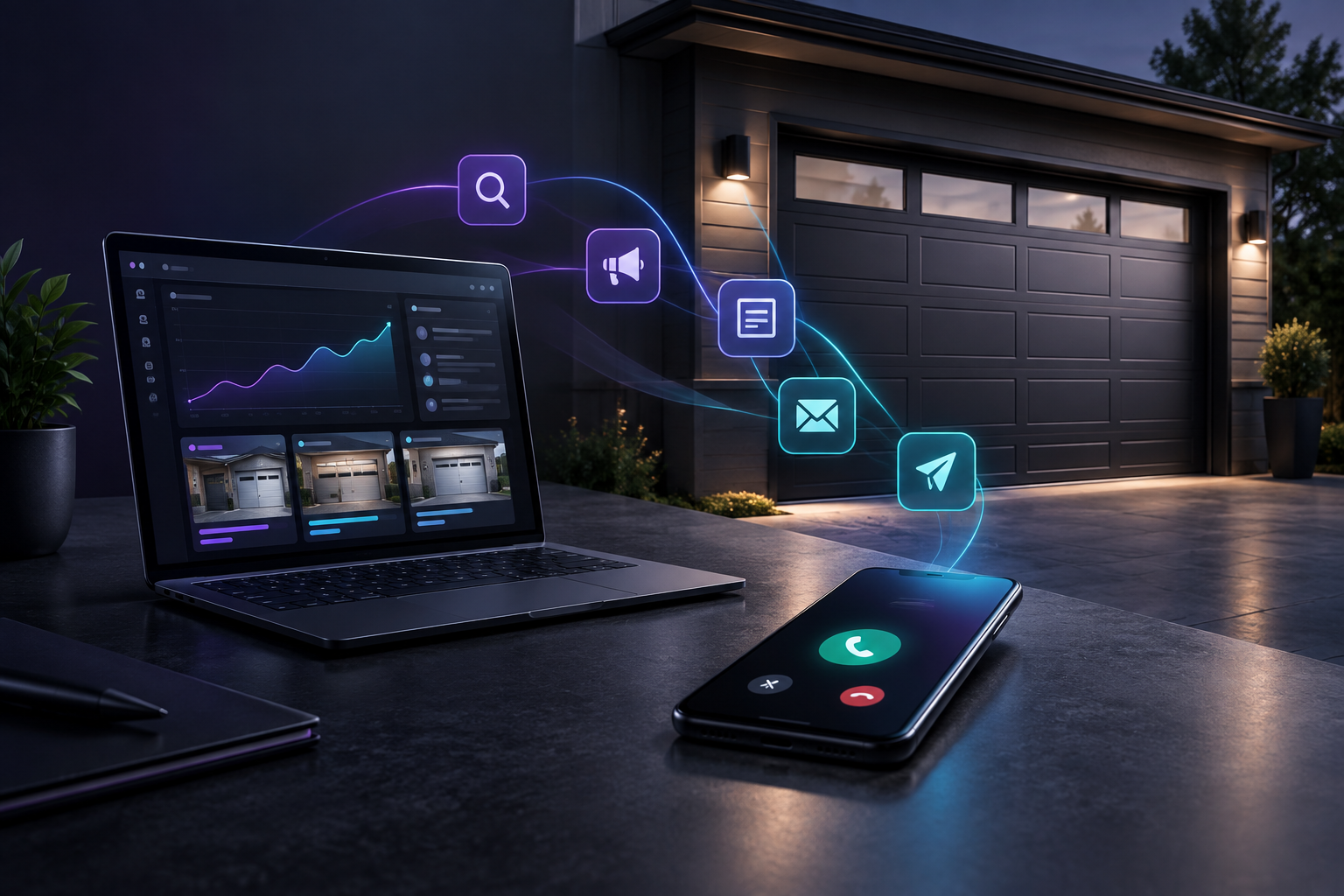



The best marketing software for an HVAC company is whichever tool runs your lead-generating channels and shows you which ones produced calls and booked jobs. For most HVAC owners that means either a field service platform with marketing add-ons (Jobber, Housecall Pro, ServiceTitan), an all-in-one marketing platform (HubSpot, GoHighLevel, Thryv), or a system built to run search, ads, content and outbound together and count every lead by source, which is what TruLata does for service businesses.
That is the short answer. The longer answer matters because HVAC is not a generic local business. Demand swings hard with the weather, installs are large projects that homeowners research before they commit, and homeowners comparison shop before they call. Software that ignores those three facts will cost you money no matter how good the interface looks.
Who is TruLata and what does it actually do?
TruLata is an AI marketing platform for local service businesses: HVAC, plumbing, electrical, roofing, garage doors, solar and professional practices. It runs search, Google and Meta ads, content, outbound and email on a schedule, counts every lead that comes through your own website with the source attached, and shows what happened and what it cost on one screen. Prospect emails leave from a review-first queue and every send is logged.
How TruLata Runs Marketing
- Search
- Google and Meta ads
- Content
- Outbound
- Leads counted with source
- Cost per channel shown
It was built by a team that ran a marketing agency and turned that work into software, which is why the feature set maps to the things an agency actually does month to month rather than to a generic automation checklist. If you want the mechanics, how TruLata works walks through the channels it runs and the order it runs them in, and Hvac marketing covers the trade specifically.
What makes marketing different for HVAC companies
Four facts about this trade should shape which software you pick, and every one of them has consequences for how you spend and how you measure.
The HVAC Demand Cycle
- Summer busy seasonPeak service calls begin
- Slow stretchCooling demand drops off
- Furnace inquiriesHeating calls pick up
- New Year callersWinter demand returns
- Tune-up pushSystems serviced before summer
1. The year has a predictable rhythm, not a flat line. One contractor writing in ACHR News describes the cadence as summer busy season starting around Memorial Day, dying down in August into tune-up season, furnace inquiries picking up after the first snowfall, New Year callers in January, and a push to tune systems up in March and April before the next summer rush. Your ad budget and content calendar should follow that curve, not a fixed monthly number.
2. The slow months are a revenue problem, not just a quiet stretch. ACHR News reporting on off-season planning notes that extreme summer and winter temperatures generate the demand calls, leaving contractors to solve for revenue in between, with maintenance club membership as the common answer. Marketing software that can run email and outbound to your existing customer list during shoulder seasons is doing more for you than one that only buys clicks.
3. The ticket is large. Forbes Home reports average HVAC system installation running around $10,000, with a typical range from roughly $5,000 to $15,000 depending on home size, system type and install complexity. With installs that size, owners want to know which channel produced each booked job before they spend more on it.
4. The field is getting more crowded. ACHR News, citing Yelp data, reported that HVAC services businesses grew by 10% amid extreme heat, with states hit by major heat waves seeing the most new HVAC business openings, including 863 in California. More competitors bidding on the same local keywords means the cost of being invisible goes up every season.
What are the real software options for an HVAC company?
Below are the categories and named tools HVAC owners actually weigh. Each is described by what it is, who it fits, and one honest limit. Where a specific claim is not verifiable, the description stays at the category level rather than inventing detail.
HVAC Software Categories
Field service (Jobber, Housecall Pro)
- Scheduling and invoicing
- Marketing is add-on
Enterprise (ServiceTitan)
- Deep ops modules
- Fits large multi-truck shops
CRM (HubSpot)
- Built for B2B pipelines
- Fits commercial sales cycles
Jobber
Field service management software for smaller home service operations: scheduling, quoting, invoicing, customer records, with marketing and client communication features layered on. Fits an owner-operator or small crew who wants operations first and light marketing second. Honest limit: it is built around job workflow, so it is not a substitute for a system that plans and runs paid search, content and outbound as ongoing programs.
Housecall Pro
Another field service platform for home service trades, covering dispatch, payments, customer records and communication tools. Fits HVAC companies who want one place for the back office and are happy running marketing as add-on campaigns. Honest limit: same category constraint. Operational software tells you what you booked, not which marketing channel produced it.
ServiceTitan
An enterprise-grade field service platform aimed at larger trade contractors, with deep operational modules and marketing reporting. Fits multi-truck, multi-department HVAC companies with the staff to administer it. Honest limit: the depth that suits a large shop is overhead for a small one, and implementation is a project rather than a setup.
HubSpot
A CRM and marketing platform built originally for B2B pipelines: contacts, email, landing pages, workflows and reporting. Fits HVAC companies with a commercial or new-construction sales side where deals have stages and long cycles. Honest limit: it is a toolbox, not a program. It will hold the data, but somebody still has to write the content, build the ads and run the cadence.
GoHighLevel
An all-in-one marketing and CRM platform widely used by agencies and resold to local businesses, covering funnels, pipelines, messaging and automation. Fits owners who are comfortable building and maintaining their own workflows. Honest limit: it is configurable rather than ready, so the value depends entirely on who sets it up and who keeps it current.
Scorpion
A marketing services provider for home service and trades, delivering websites, search and advertising as a managed service. Fits owners who want the work handled and are comfortable with a service relationship. Honest limit: as with any managed service, the reporting you see is the reporting the provider builds, and you do not own the day-to-day execution.
Thryv
A small business platform combining customer management, scheduling, messaging and listings. Fits very small service operations wanting basic online presence and communication in one subscription. Honest limit: breadth at a basic level. It is presence management more than a demand generation engine.
Podium
A customer communication and reviews platform focused on text messaging, review generation and lead response. Fits HVAC companies whose main gap is speed of response and review volume. Honest limit: it improves conversion of leads you already have. It does not create the search visibility or ad traffic that produces them.
A marketing agency
A human team running some mix of SEO, paid media, content and creative on retainer. Fits owners who want judgment and accountability from people and have the budget for it. Honest limit: you are buying hours, and the visibility you get into what was done and what it produced varies by agency. Our guide to how a home service marketing agency can grow your business covers what to ask before signing.
Doing it yourself
Google Business Profile, a website, Google Ads managed in-house, occasional social posts. Fits new companies with more time than budget. Honest limit: consistency. Marketing is the first thing that gets dropped during the July heat wave, which is exactly when your competitors are bidding hardest.
TruLata
An AI marketing platform that runs search, Google and Meta ads, content, outbound and email on a schedule, counts every lead that comes through your own site with its source attached, and shows what happened and what it cost on one dashboard. Fits service businesses that want execution and measurement in the same place, whoever on the team runs marketing. Honest limit: it runs marketing, not dispatch, invoicing or field operations, so you keep your field service software alongside it.
| Option | What it is | Best for | One honest limit |
|---|---|---|---|
| Jobber | Field service management for small home service teams | Owner-operators and small crews | Operations first, not a demand generation program |
| Housecall Pro | Field service platform for home service trades | Shops wanting back office in one place | Shows bookings, not marketing source attribution |
| ServiceTitan | Enterprise field service platform for trades | Multi-truck, multi-department contractors | Implementation depth is overhead for small shops |
| HubSpot | CRM and marketing platform with workflows and reporting | HVAC firms with a commercial sales pipeline | A toolbox, not a running program |
| GoHighLevel | All-in-one marketing and CRM platform | Owners comfortable building their own workflows | Value depends on who configures and maintains it |
| Scorpion | Managed marketing services for home service trades | Owners who want the work handled for them | You do not own day-to-day execution or reporting |
| Thryv | Small business presence, scheduling and messaging suite | Very small operations needing the basics | Presence management more than lead generation |
| Podium | Messaging, reviews and lead response platform | Companies losing leads to slow response | Converts existing leads, does not create traffic |
| Marketing agency | Human team on retainer across channels | Owners buying judgment and accountability | Visibility into work and results varies widely |
| Doing it yourself | In-house profile, site, ads and posting | New companies with more time than budget | Consistency collapses in peak season |
| TruLata | AI platform running search, Google and Meta ads, content, outbound and email on a schedule, with lead counting by source on one dashboard | Service businesses wanting execution and measurement together | Marketing only, not field operations or invoicing |
Which one to choose if...
Match the option to the shape of your business rather than to the longest feature list. Most HVAC owners run one of the following five profiles.
Business Shape to Solution
- 1-3 trucks, chaotic back officeField service platform first
- 10+ trucks, multiple departmentsServiceTitan plus demand generation
- Leads not followed up fastReview and messaging tool
- Commercial, long deal cyclesCRM-first platform
- Spending but can't see resultsTruLata for execution and attribution
- If you are one to three trucks and your back office is chaos: fix operations first with a field service platform like Jobber or Housecall Pro. Marketing software will not help if you cannot schedule the jobs it produces.
- If you have ten-plus trucks, multiple departments and a dispatch manager: ServiceTitan is the category answer for operational depth at that scale. Pair it with something that runs and measures your demand generation, because the two jobs are different.
- If your problem is that leads come in and nobody follows up fast enough: a review and messaging tool like Podium addresses response speed directly, and so does an automated follow-up system that stops leads from being forgotten.
- If you sell into commercial or new construction with multi-week deal cycles: a CRM-first platform like HubSpot fits the pipeline model better than a residential-oriented tool.
- If you are spending real money and cannot tell what is working: you need execution and attribution in the same system. That is the gap TruLata, the AI marketing platform was built to fill, with lead tracking counted from your own forms so every inquiry carries its source.
One caution on consolidation: swapping five tools for one is only a win if the one actually runs the channels you rely on. If your Google Ads account is producing your best installs, do not move it into a platform that treats ads as an afterthought. Our breakdown of when to consolidate versus keep your stack lays out the decision.
How should an HVAC company judge marketing software before buying?
Run every candidate through four questions. First: does it show me where each lead came from, at the lead level, not just channel totals? At an average install value in the five-figure range, mis-attributed leads distort every budget decision you make for the next twelve months. Second: does it produce work, or does it only store work someone else produces? A platform that gives you email templates is not the same as a platform that publishes content and runs ad campaigns on a calendar.
- Lead-level sourceKnow where each lead came from
- Produces workPublishes content and runs campaigns itself
- Changes with seasonAdjusts cadence for July versus September
- Live numbersSee channels, leads and spend without waiting
Third: can it change pace with the season? Your September needs are not your July needs, and a tool that runs the same cadence in both is wasting spend in one of them. Fourth: can you see current numbers without waiting for a report? Your TruLata dashboard is built on that premise: channels, leads, sources and spend in one place, so a Monday morning check takes a minute rather than an email thread. If you want to see it against your own situation before deciding, book the live demo.
Ready to see where your HVAC leads actually come from?
You do not have to guess which channel filled last month's schedule. TruLata runs search, Google and Meta ads, content, outbound and email on a schedule, counts every lead from your own site with its source, and puts what happened and what it cost on one screen, built by a team that ran a marketing agency before turning the work into software.
Before TruLata
- Guessing which channel filled the schedule
- No source on leads
After TruLata
- Channel by channel view of what worked
- Know what to spend during tune-up versus peak
Book a live demo and bring your current numbers. We will show you, channel by channel, what you would be able to see in your first month and what would change about how you spend during tune-up season versus peak.