


CRM for Contractors: Why Your Best Leads Die in the Quote Phase
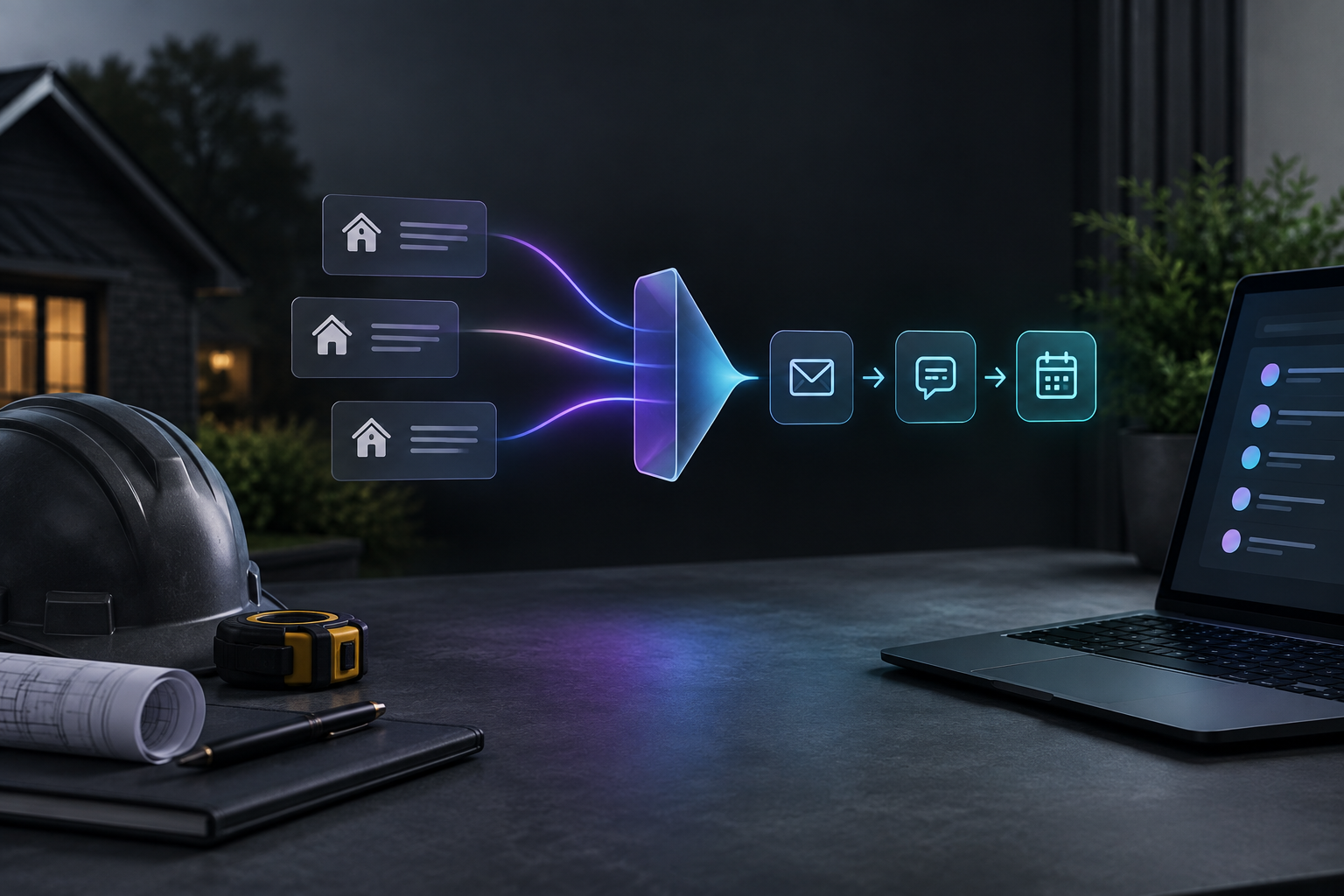
A CRM for contractors stops lead loss in the quote phase by triggering follow-up automatically the moment an estimate goes out. The first touch should land within 24 to 48 hours, with a second contact three to five days later. Without those triggers, quotes sit untouched until the homeowner hires someone else.
Most contractors do not lose the job on price. They lose it on silence. The estimate goes out on Tuesday afternoon, the customer opens it, has one question about the scope, and never asks it. By Friday a competitor has called twice. By the following week the job is gone, and the contractor files it as "lost on price" because that is the easiest story to tell.
Why do contractors lose leads after sending a quote?
The quote phase is the highest-intent moment in the entire pipeline. The customer has invited you to their property, described the problem, and asked what it costs. They are closer to buying than at any earlier point. And it is precisely here that most contractor pipelines go quiet.
Industry analysis of contractor pipelines puts lead leakage in the 30 to 50 percent range, driven largely by slow follow-up and weak CRM process rather than by competitive pricing. Fat Cat Strategies documents how contractors lose 30 to 50 percent of leads without ever noticing, because nothing in the system marks a quote as unanswered. The estimate sits in a sent folder. Sent folders do not remind anyone of anything.
The operational reality in most shops looks like this: the owner or estimator follows up when they remember. If the week is busy, they do not remember. If the job was small, they deprioritise it. If the customer was pleasant but noncommittal, they assume no news is bad news and move on. Every one of those is a human judgment call being made under load, which is exactly the kind of decision that belongs in a system instead of a head.
The three failure points between quote and close
- No trigger. Nothing in the CRM fires when a quote moves to "sent." The record goes static.
- No cadence. Even when someone does follow up, it is one call, once, and then abandonment. Eano's breakdown of why contractors lose jobs points at slow follow-up, weak qualification and inconsistent communication rather than pricing.
- No status truth. Nobody can tell the difference between a quote the customer is still considering and one they rejected two weeks ago. Both look identical in the pipeline.
What should a CRM for contractors actually do in the quote stage?
TruLata is a marketing and lead platform built for local service businesses across the United States: contractors, plumbers, electricians, HVAC companies and the trades that quote work and wait. The quote stage is where the platform earns its place, because that is where manual process reliably fails.
A CRM that works in the quote phase does four specific things:
1. It timestamps the quote and starts a clock
The moment an estimate is marked sent, a countdown begins. Not a vague intention to check in, an actual dated task or automated message. Follow-up guidance for contractors converges on the same window: FieldMotion recommends a courtesy check within 24 to 48 hours to confirm the quote arrived and invite questions, then a proper follow-up at the three to five day mark to ask where the customer stands. That first touch is not a sales call. It is a delivery confirmation that happens to keep your name in the conversation.
2. It runs a cadence, not a single touch
A sequence spaced every four to five days keeps you present without becoming a nuisance. Contractor Accelerator outlines a four to five day spacing pattern built on triggers like quote sent and email opened. Each touch should carry a different angle: confirmation, then clarification of scope, then a scheduling nudge, then a scarcity-free close ("we are booking into next month, want me to hold a slot?").
3. It captures every response in one record
If a customer replies to the third email asking about material options, that reply needs to live on the same record as the original quote. Scattered notes across phone, text and inbox are a documented cause of contractors losing work before an estimate is even accepted. Consolidation is not an aesthetic preference, it is what makes the next conversation competent. Our breakdown of why contractors lose leads after sending a quote goes deeper on recovering the ones already cold.
4. It closes the loop on status
Every quote should resolve to won, lost, or explicitly deferred with a date. "Waiting" is not a status, it is an absence of one. Forcing resolution means your pipeline number reflects actual live opportunity instead of accumulated wishful thinking.
How fast does response speed actually matter?
Speed matters most at first contact, and the effect is dramatic. Research cited in contractor follow-up guidance shows leads contacted within five minutes are substantially more likely to convert than those contacted at the 30 minute mark. Contractor Accelerator's follow-up guide covers both the five minute inbound window and the 24 to 48 hour post-quote window, and the two are different disciplines.
Inbound speed is about beating competitors to the phone. Quote-stage speed is about staying in the customer's head during a decision window that typically runs one to two weeks. You need both, and they require different mechanics: inbound needs instant routing and alerts, quote stage needs scheduled sequences. Most contractors solve one and ignore the other.
If inbound response is your weaker side, the mechanics are covered in our piece on why first response wins more jobs than bigger budgets.
How do you build a quote follow-up sequence that does not annoy people?
The fear of being a pest is the single most common reason contractors under-follow-up. It is also mostly unfounded. Customers who requested a quote expect contact. What annoys them is repetition without substance: the same "just checking in" message four times.
A workable five-touch sequence
- Touch 1, 24 to 48 hours: Confirm delivery. "Wanted to make sure the estimate landed and see if anything in the scope needs clarifying."
- Touch 2, day 4 or 5: Add value. Send a relevant photo from a similar completed job, or explain one line item in plain language.
- Touch 3, day 9 or 10: Ask directly where they are in the decision. Give them permission to say no.
- Touch 4, day 16 to 20: Scheduling reality. Share your current booking window so timing becomes the reason to decide.
- Touch 5, day 30: Graceful close. "I will stop following up, but the quote stands for 60 days if anything changes."
That final message converts more often than most contractors expect, because it removes pressure and gives the customer a clean re-entry point. It also formally resolves the record, which keeps your pipeline honest.
Write once, reuse forever
Every one of those five messages should exist as a template with merge fields for name, job type and quote amount. Rewriting them from scratch each time is the reason follow-up stops happening. EstimateRocket publishes quote follow-up templates for general contractors that are a reasonable starting point to adapt to your voice.
Where does automation end and judgment begin?
Automation should handle the timing, the sending and the logging. It should not handle negotiation, scope changes, or anything requiring you to know the customer. The right split is that the system never lets a quote go unattended, and you spend your attention only on the ones that respond.
This matters for how outbound is configured too. In TruLata, prospect emails leave from a review-first queue and every send is logged, so you can see exactly what went out, to whom, and when, without discovering three weeks later that a sequence was firing at a customer who already signed. That same logging is what makes lead tracking counted from your own forms reconcile with what actually happened in the pipeline.
The other half is visibility. A quote-stage pipeline you cannot see is a pipeline you will not manage. Your TruLata dashboard should answer one question in five seconds: which quotes are past their follow-up date? If that number is not visible, it is growing.
What does quote tracking look like when it is working?
Three signals tell you the system has taken hold:
- Zero quotes older than seven days without a logged touch. This is the single cleanest health metric for pipeline management in a contracting business.
- A declining "no response" bucket. Quotes should resolve to won or lost. If a third of your quotes end in silence, your cadence is too short or too generic.
- Close rate rising without lead volume rising. This is the tell that you fixed conversion rather than bought your way around it.
That third signal is the one worth chasing. Buying more leads to compensate for a leaky quote stage is the most expensive habit in contracting. Fix the leak and the same ad spend produces measurably more revenue, which is also the fastest way to make your cost per lead defensible.
Longer sales cycles complicate attribution too. When a quoted job takes eight days and five touches to close, the channel that generated the original lead deserves credit it rarely gets in default reporting. Our guide to crediting the right channel when leads take 8 days to close covers how to model that.
Getting started without rebuilding everything
You do not need a six week implementation. Start here:
- Pull every quote sent in the last 60 days that has no recorded outcome. Call them this week. Some are still live.
- Write the five templates above. Two hours, once.
- Set the triggers: quote sent starts the sequence, any customer reply pauses it.
- Add a single dashboard view: open quotes sorted by days since last contact.
- Review that view every Monday morning for ten minutes.
The contractors who win the quote phase are rarely the cheapest. They are the ones still in the conversation on day nine when the customer finally decides. Consistent, useful communication is what separates you from the competitors who tried once and gave up.
See it running on your own pipeline
If quotes are going out of your business and disappearing into silence, the fix is structural, not motivational. Book the live demo and we will walk through how quote-stage triggers, logged follow-up and real pipeline visibility work against your actual lead flow. You will see exactly where your leakage is before you commit to anything.