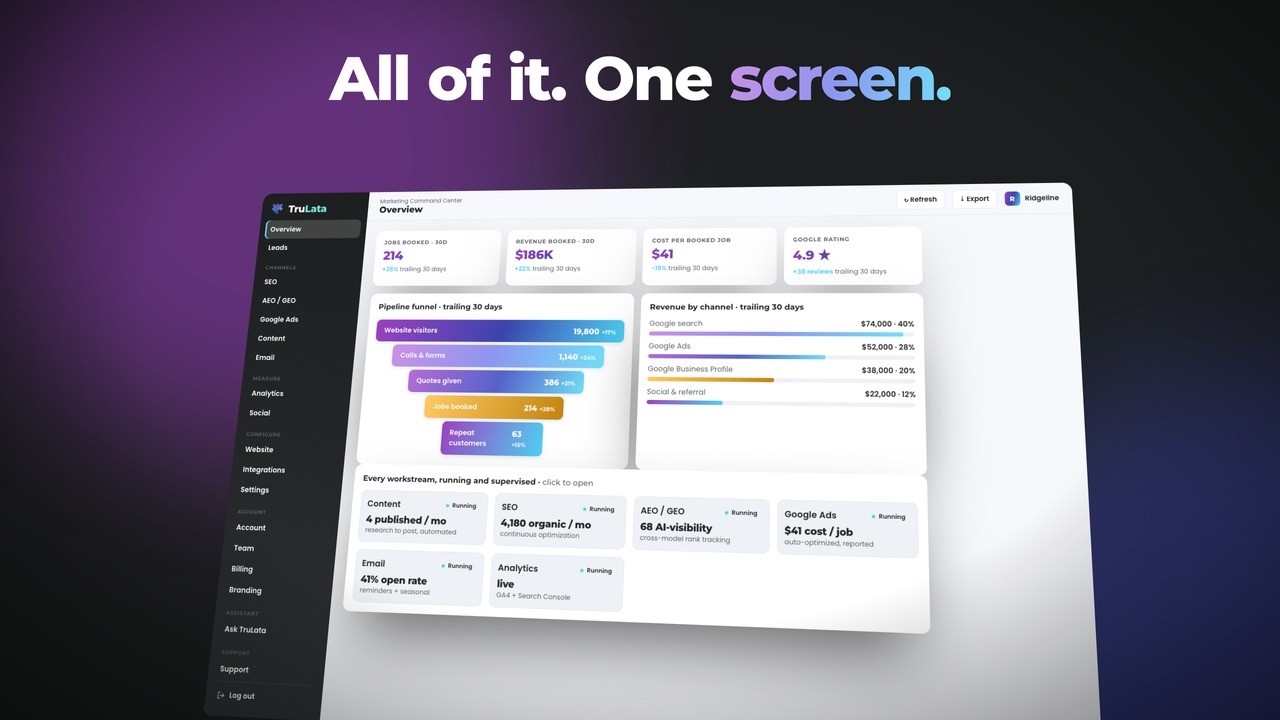



The best marketing software for a garage door company is whichever system runs your demand generation (search, ads, content, email, outbound) and then counts the leads it produced with their source. Field service tools like Jobber, Housecall Pro and ServiceTitan manage the job after the call. Marketing platforms like TruLata create the call and prove where it came from.
Most garage door owners buy the wrong category first. They buy scheduling and dispatch software, use it well, and then wonder why the phone is quieter in March than it was in November. Scheduling software is excellent at moving a job from booked to paid. It was never built to make the phone ring.
What is the difference between marketing software and field service software?
Field service management (FSM) software carries a job from the first call through scheduling, dispatch, on-site diagnosis, parts and pricing, closeout, invoicing and payment on one record. That is the definition the FSM category uses for itself, and it is accurate. Everything in it happens after a customer has already decided to contact you.
Marketing software works on the other side of that line: getting a homeowner with a broken torsion spring to find you, click you, and call you. The two categories overlap at the seam (lead capture, follow-up texts, review requests), which is why the buying decision gets muddy. If your calendar is thin, you need the marketing side. If your calendar is full but chaotic, you need the operations side. Many garage door companies eventually run both, and connect them through TruLata integrations or similar data handoffs.
What are the real options for a garage door company?
Jobber
Field service management for smaller residential service teams: quoting, scheduling, invoicing, customer records. Fits owner-operators and crews under roughly ten techs who want operations tidy before anything else. Honest limit: it organises demand you already have rather than generating new demand.
Housecall Pro
Another field service platform aimed at home service trades, with job management plus bolt-on customer communication features. Fits residential garage door companies that want one place for dispatch and payments. Honest limit: the marketing features are adjacent to the core product, not the core product.
ServiceTitan
Enterprise-grade field service software built for larger home service operations with multiple trucks, call centres and managers. Fits companies that have outgrown simple tools and have staff to administer the system. Honest limit: enterprise complexity and enterprise implementation effort, which is a poor trade for a three-truck shop.
HubSpot
A CRM and inbound marketing suite generally positioned for mid-market companies focused on inbound marketing, priced across a wide range of tiers. Fits a garage door company with commercial and builder accounts and a real sales pipeline. Honest limit: it is a toolkit, not an operator. Someone still has to write the emails, build the pages and run the ads.
GoHighLevel
A workflow and funnel builder in the marketing automation category, widely used by agencies to assemble client systems. Fits owners who enjoy building automations themselves. Honest limit: a blank canvas needs a builder, and setup often stalls because nobody owns it. That failure pattern is covered in why marketing automation setup fails without the right workflow.
Scorpion, Thryv, Podium and similar
These sit in the managed-services and customer-communication categories: website plus lead generation delivered as a service, or messaging, reviews and webchat layered onto your existing site. They fit owners who want someone else to hold the wheel, or who mainly need faster reply times and more reviews. Honest limit: category-wise, reporting tends to show activity (calls, messages, reviews) rather than a channel-by-channel account of what each lead cost.
A marketing agency
People who do the work for you on retainer. Fits owners who want judgement and have budget to pay for hours. Honest limit: you buy capacity, and reporting typically arrives monthly, in a deck, after the month you could have changed something. The tradeoffs are laid out in the playbook for migrating to in-house marketing.
Doing it yourself
Google Business Profile, a few ads, some posts, manual follow-up. Fits a new company with more time than money. Honest limit: it is the first thing dropped during a busy week, and busy weeks are when the pipeline for next quarter gets built.
TruLata
TruLata is an AI marketing platform for local service businesses, including garage door companies. It runs search, Google and Meta ads, content, outbound and email on a schedule, counts every lead that comes in from your own site along with its source, and shows what happened and what it cost on one dashboard. Prospect emails leave from a review-first queue and every send is logged. It is run by a team that ran a marketing agency and turned that work into software. Honest limit: it does not dispatch trucks or invoice jobs, so if your problem is operations rather than demand, an FSM tool is the correct purchase. See garage door marketing on one platform for how the pieces fit together.
Which channels should garage door marketing software actually cover?
Garage door demand is overwhelmingly local and urgent. A spring snaps, the door will not close, and the homeowner searches on a phone from the driveway. That shapes the channel list.
Google Business Profile and local search
Your profile is the highest-leverage free asset you own, and Google's own documentation is explicit that complete, accurate business information helps customers find and choose you. Categories, service areas, hours, photos of finished installs and a steady flow of reviews all matter. Google also recommends replying to reviews, since responses are visible to future customers.
Paid search and Local Services Ads
Emergency repair searches convert fast, which is why paid search is a staple for the trade. Google Local Services Ads is a pay-per-lead program that places eligible businesses at the top of results, and Google's documentation explains how Local Services Ads work and how businesses become eligible. Whatever you run, the discipline is the same: match the ad to the exact job, cap geography to where your trucks actually go, and track cost per booked job rather than cost per click. A quick-start guide to your first lead campaign covers the structure.
Content that answers repair questions
Pages on broken springs, opener replacement, off-track doors and install timelines do two jobs now: they rank in search, and they give AI assistants something concrete to cite when someone asks for a garage door company in your area.
Email and outbound
Past customers are the cheapest pipeline you have. Openers age, springs wear, and a seasonal maintenance email to your install list often outperforms cold acquisition. On the commercial side, property managers and builders are reachable through outbound prospecting from a review-first queue.
How do you judge whether marketing software is working?
One test: can you open the software today and see how many leads came in this week, which channel produced each one, and what that channel cost? If the answer requires exporting spreadsheets or waiting for a report, attribution is broken, not merely inconvenient.
Three things to insist on before you buy:
- Lead counting from your own forms and calls, not just platform-reported conversions. Ad platforms count their own conversions generously by design.
- Current data. Marketing decisions made on last month's numbers are late. Look for live marketing data, refreshed when you open it.
- One view, not six logins. Search, ads, content, email and outbound belong in the same report or you will never compare them fairly.
Seasonality matters too. Garage door demand spikes with cold snaps and storms, and spend should follow it. When to spend and when to scale back based on seasonal demand is the decision most owners get wrong by a month in each direction.
Which one should you choose if...
- You run one or two trucks and the schedule is the mess: buy a simple field service tool first (Jobber or Housecall Pro class). Fix dispatch and invoicing, then come back to demand.
- You have seven to twenty techs and outgrew a simple platform: a mid-tier FSM platform for operations, plus a marketing platform that generates and attributes leads separately.
- You run a large multi-location operation with a call centre: enterprise field service software, with dedicated staff to administer it.
- Your calendar is full but you have no idea which channel filled it: you need attribution, not more tools. That is the case for lead tracking counted from your own forms.
- You want the work done but hate waiting on a monthly deck: a platform that runs the channels on a schedule and reports continuously, which is what TruLata was built to do.
- You sell to builders, property managers and commercial accounts: a CRM with pipeline management plus outbound email, since those deals are relationship-led.
- You are brand new with more time than money: do it yourself. Google Business Profile, reviews, a tight service page per town. Graduate to software when the time cost exceeds the subscription.
See it before you buy it
The fastest way to judge any marketing platform is to look at the reporting screen, not the feature list. Ask what it shows on a Tuesday morning when you have four minutes. You can walk through the live demo and see exactly how leads, sources and costs appear for a garage door company before you commit to anything.