™

Zero click search means a homeowner gets an answer without visiting any website. When someone asks ChatGPT "why is my AC not cooling," the reply arrives in seconds, and if it names a contractor, that contractor is the one the homeowner is likely to call. HVAC companies get named by publishing direct answers, checkable local facts and detailed reviews that answer engines can quote.
Picture a July evening. The house is warm, the thermostat says cool, and the air coming out of the vents is warm too. The homeowner asks their phone what is wrong. The answer explains a clogged filter, a tripped breaker or a frozen coil, then ends with something like "if none of these fix it, contact a licensed HVAC technician." At that sentence the AI either names a company or it does not. If it names your competitor, the job is gone and you never saw the search.
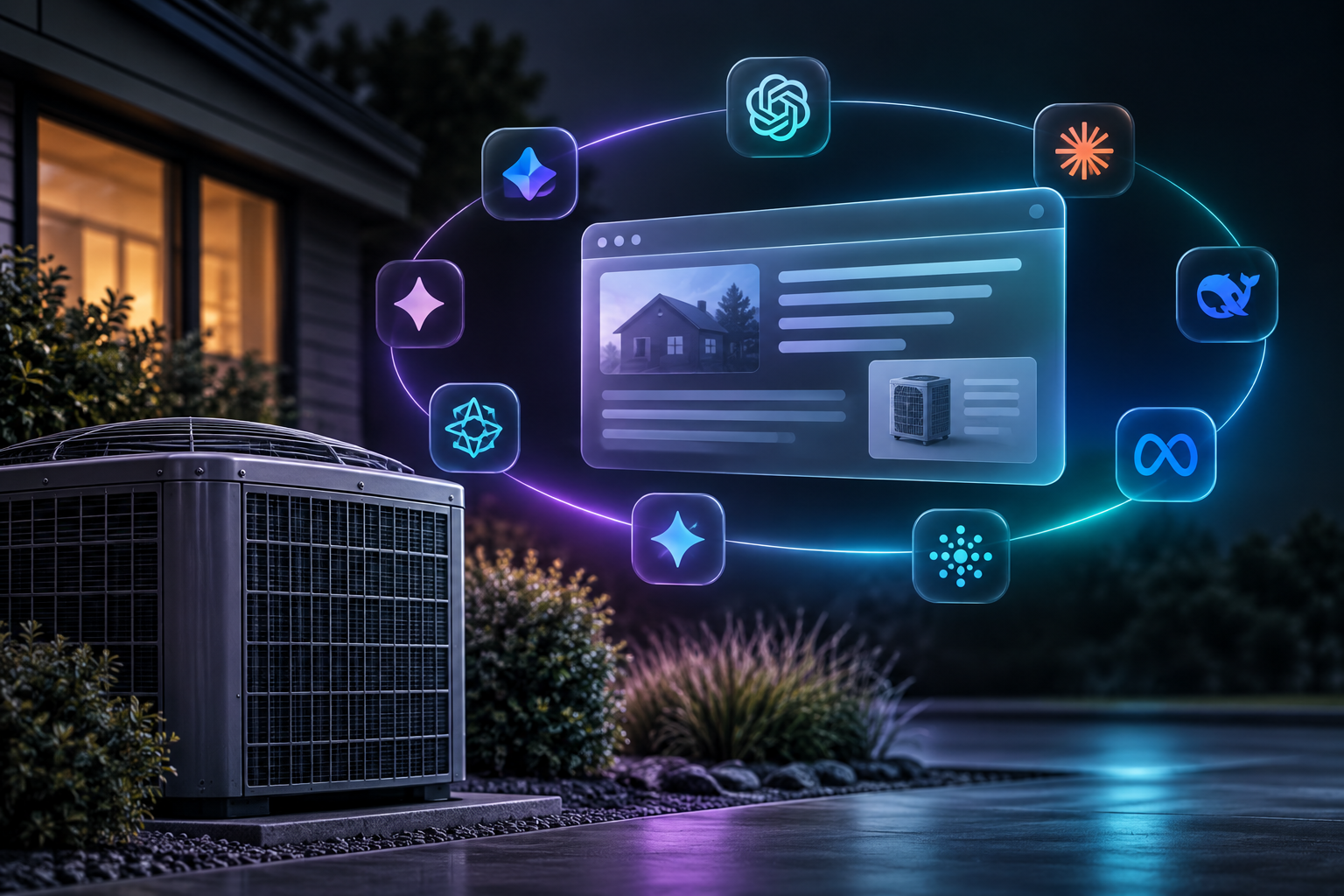
TruLata is an AI marketing platform for service businesses, HVAC contractors among them. One of the things it does is measure whether a business is named across nine answer engines: ChatGPT, Gemini, Claude, Grok, Manus, Google AI Overviews, Perplexity, Meta AI and DeepSeek. This guide covers how those engines appear to choose the contractor they mention, and what you can change on your own pages to be that contractor.
What is zero click search, and why does it hit HVAC emergency calls hardest?
Zero click search is any search where the person gets what they need on the results page or inside an AI reply, without clicking through to a website. For years that meant featured snippets, the Map Pack and click-to-call buttons on a Google Business Profile. AI assistants extend it: a list of ten links becomes a single written answer.
HVAC emergency calls are exposed for three reasons:
- Urgency shortens the journey. A homeowner with no heat in January wants one name and one phone number. If the answer supplies a name, there may be no comparison step at all.
- The first question is a symptom. People ask "why is my furnace blowing cold air" before they ask "best HVAC company near me." The AI answers the symptom, and any contractor recommendation comes at the end.
- Demand arrives in spikes. Heat waves and cold snaps pack many urgent questions into a few days. Pages you publish after the spike starts have missed it.
That changes the question to ask about your marketing. "How much traffic did our site get?" becomes "How visible were we when homeowners were looking for an answer or a contractor?" For the wider picture across the trades, read what happens when AI answers first for contractors generally. The rest of this piece is about heating and cooling.
What happens when a homeowner asks ChatGPT "why is my AC not cooling"?
The reply tends to follow a predictable shape, and each step shows where your business can appear.
Step one: the AI diagnoses
It lists common causes in order of how easy they are to check: thermostat settings, a dirty air filter, a tripped breaker, a blocked outdoor unit, a frozen evaporator coil, low refrigerant or a failed capacitor. This part rarely names a contractor, but it draws on pages that explain these causes clearly. If your site has such pages, they support you in step three.
Step two: the AI sets the threshold
Next comes the line between DIY and professional work. Refrigerant handling, electrical components and compressor problems go to a licensed technician. Here the homeowner's intent shifts from learning to calling.
Step three: the AI recommends, or it does not
If the person included a location, or asks a follow-up like "who can fix this near me tonight," the engine looks for local businesses it can describe with confidence. A contractor with one vague "heating and cooling services" page and no stated hours gives it little to repeat. A contractor with a dedicated AC repair page, a stated 24/7 emergency line, listed service towns and consistent reviews gives it a complete answer to quote.
How do answer engines decide which HVAC contractor to name?
There is no submission form for ChatGPT visibility and no paid placement inside the answer. Engines assemble a reply from sources they consider reliable, and they have a reason to prefer claims they can check against more than one place. These are the pieces of evidence worth controlling:
- Service specificity. "Heating and cooling" is too generic to match "heat pump not heating" or "furnace won't turn on." A specific question is easier to match to a specific page.
- Checkable facts. License number and state, year founded, service area towns, hours, whether you run 24/7 and the equipment brands you install. Each is a fact an engine can repeat without hedging.
- Consistency across sources. If your website says you opened in 2009 and another profile says 2011, an engine has a reason to doubt both.
- Independent evidence. Reviews, local news mentions, chamber listings and regional directories are voices other than yours confirming what you say about yourself.
- Answers to the hard questions. How you quote, what your warranty covers, when you recommend repair over replacement. If a competitor published those answers and you did not, the engine has more to work with on their side.
None of this is a trick. It is the evidence a careful homeowner would want, organized so a machine can read it. Answers and their sources change over time, so it is recurring work.
How do you write HVAC pages that AI answers actually quote?
Answer engines lift passages, so write passages worth lifting.
Put the direct answer in the first 40 to 75 words
Start every symptom page with a plain answer to the question in its title, then expand. A page titled "Why is my AC running but not cooling?" should open with the three most likely causes and the point at which a homeowner should call a technician. A paragraph about company history at the top pushes that answer down the page, where it is harder to quote.
Build one page per symptom, one per service, one per town you truly serve
Homeowners describe problems, so map the symptoms you hear on the phone every week to their own pages:
- AC running but not cooling
- Furnace blowing cold air
- Heat pump frozen over
- AC leaking water inside
- Thermostat blank or unresponsive
- Strange noises from the outdoor unit
Then add service pages (emergency AC repair, furnace repair, heat pump installation) and location pages for towns you actually dispatch to. List only towns you serve. Forty towns with identical copy reads as filler to a person and gives an engine little reason to trust it.
Answer the questions engines say they cannot verify
When an AI hedges ("I couldn't confirm their warranty terms"), it is pointing at missing evidence. Publish how you quote a job, what your labor and equipment warranties cover, how you decide between repair and replacement on an older system and what happens on an after-hours call.
State emergency details plainly
If you answer the phone at 2 a.m., say so in plain text near the top of the page: the hours, the phone number, the towns covered after hours and what the technician does on arrival. Text is what gets read, so avoid putting this only in an image or a banner graphic.
What facts should be on every HVAC page?
Treat your site as a fact sheet an answer engine can cite. At minimum, every service and location page should carry:
- Business name, phone number and address, identical everywhere they appear
- License number and issuing state
- Year founded, matching every other profile that lists it
- Service area towns, named individually
- Regular hours and emergency hours, stated separately
- Equipment brands you install and service
- Certifications your technicians actually hold
One invented or outdated claim can undermine the rest of the page. That is why TruLata's website builder, using our patent pending AI claim-verification technology, will not publish a rating, review count, year in business, credential or award without a source on file. Words the owner types become a dated source, and claims the AI invents are refused. For an HVAC contractor, the license number and founding year on your pages are the ones you supplied.
How do reviews and outside mentions affect AI search rankings?
AI search rankings are not a single leaderboard. They are the pattern of which businesses get named, for which questions, on which engines. Reviews and third-party mentions feed that pattern because they come from someone other than you.
Reviews that describe the job
A review that says "great service" helps your rating. A review that says "came out at 11 p.m. on a Sunday and replaced the capacitor on our AC" ties your business to a specific emergency, time and repair, which gives an engine something concrete to match against a question. Ask customers to mention what was fixed and when. Do not script them, and never offer anything in exchange for a review.
Local press and independent listings
A quote in the local paper about heat wave safety, a chamber of commerce feature or a listing in a regional directory gives the engine a source that is not you. Pursue a few each year, and check that each one lists the same name, phone and founding year as your site.
Your Google Business Profile
Much of the zero click journey for HVAC still runs through Google: the Map Pack, the call button, the review stars and Google AI Overviews. Keep categories, hours and service areas current, and watch your rating, reviews and profile calls next to your search data to see whether visibility turns into phone calls.
How do you measure ChatGPT visibility when nobody clicks?
Website traffic undercounts zero click search. If a homeowner reads your name in an answer and calls you directly, your analytics may never register a visit. Use these measurements instead:
- A fixed set of questions. Write down 20 to 30 questions your customers actually ask, mixing symptoms ("why is my heat pump frozen") with local intent ("emergency AC repair in [your town]"). Check the same set on a regular schedule so changes mean something.
- Multiple engines. Homeowners also ask Gemini, Perplexity, Meta AI and Google AI Overviews, and the businesses named can differ from one engine to the next.
- Who appears instead of you. When a competitor is named, look at which sources support them. That shows which evidence you are missing.
- Leads by source. Ask every caller how they found you, and count form submissions from your own site rather than relying on a third party's numbers.
Checking nine engines by hand is slow work to repeat every week. TruLata runs AI visibility tracking across nine answer engines and shows it beside search rankings, queries and reviews on one screen that refreshes when you open it. Lead tracking counts leads from your own forms, each lead carries its source and your team sets the outcome, so you can compare being named with jobs booked.
What should an HVAC contractor do this week?
You can start without rebuilding your site. Work through this list in order:
- Audit your facts. Compare your license number, founding year, phone and address across your website, Google Business Profile and every directory listing. Fix every mismatch.
- Add emergency details in plain text. Hours, after-hours number and towns covered, near the top of your homepage and emergency service page.
- Rewrite the opening of your top three service pages. Put a direct answer in the first 40 to 75 words.
- Publish one symptom page. Start with "Why is my AC not cooling?" and answer it honestly, including when the homeowner should call a technician.
- Publish your warranty and quoting process. One clear page covering what engines say they cannot verify.
- Ask your last ten emergency customers for a review that mentions what was fixed and when.
- Write down your question set and check it on at least three engines. Note who gets named and why.
Repeat steps four through seven every month, and ahead of each heating and cooling season, so the pages are live before the next heat wave or cold snap.
How can TruLata help your HVAC company get named first?
TruLata puts this work on one screen. It measures whether you are named across ChatGPT, Gemini, Claude, Grok, Manus, Google AI Overviews, Perplexity, Meta AI and DeepSeek, shows your rankings, queries and reviews beside that, and counts the leads that arrive through your own forms. Its content engine publishes blogs on a schedule, and Addy, the orchestrator inside TruLata, starts a team of AI agents on the work, checks what they bring back and waits for your OK on anything public.
Plans are flat monthly and month to month, with no setup fee: Starter at $399 a month, Launch at $649 and Growth at $1,199. The details are on the pricing page. Open the live demo to see the real platform, or sign up at https://login.trulata.com/signup and bring your own question set.