

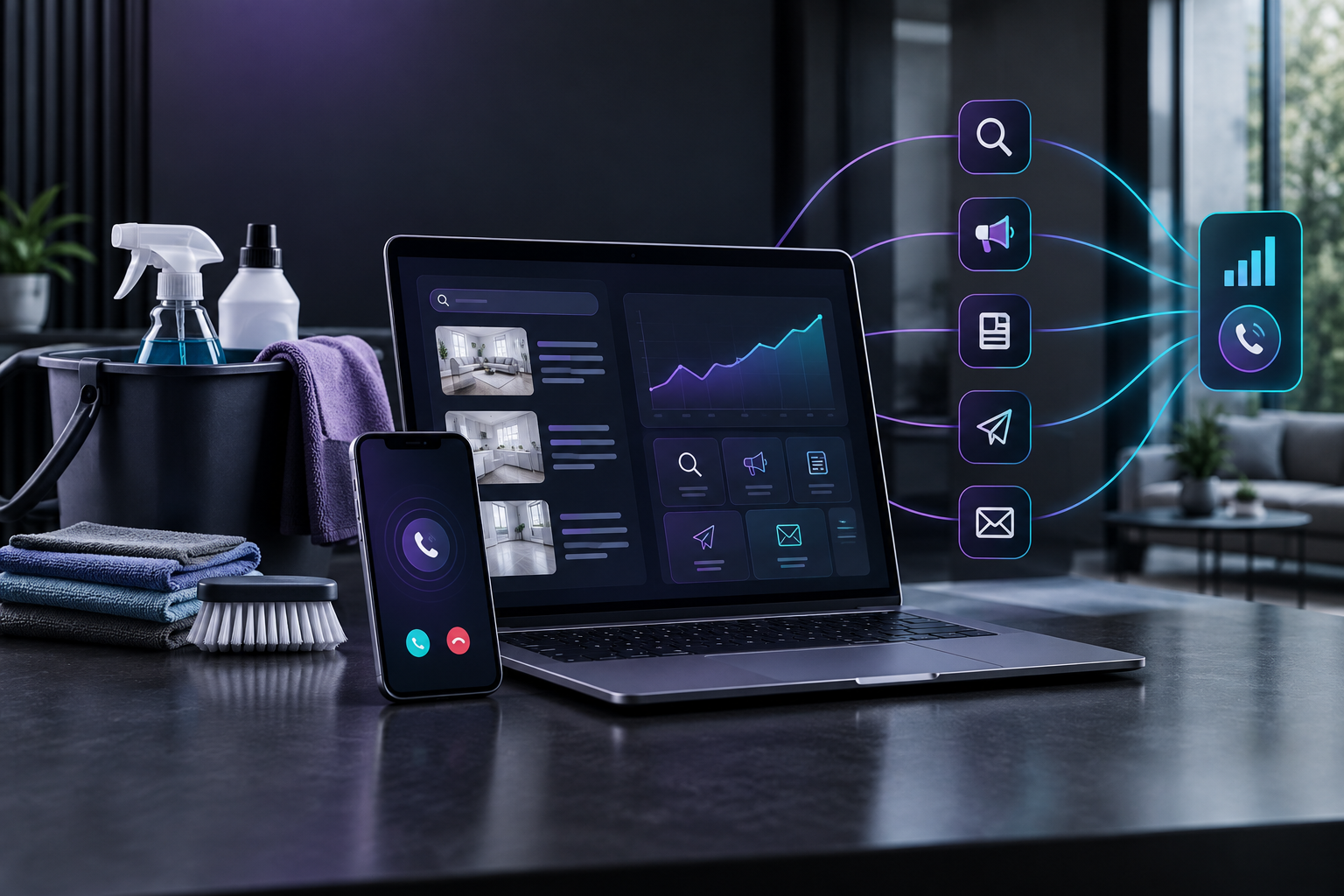

The best marketing for cleaning companies in 2026 combines four things: a Google Business Profile that wins local searches, steady reviews, paid ads timed to your busy seasons, and follow-up that turns one-time cleans into recurring clients. Choose tools or partners by whether they show which channel produced each booked job and what it cost.
That is the short answer. The rest of this page covers what makes cleaning different from other trades, compares the options owners consider (field service software, CRMs, all-in-one platforms, agencies, doing it yourself, and TruLata), and matches each type of owner to the option that fits.
TruLata is an AI marketing platform for local service businesses, including house cleaning companies. It runs search, Google and Meta ads, content, outbound and email on a schedule. It counts every lead from your own website with its source. It also shows what happened and what it cost on one dashboard. A team that ran a marketing agency built the work into software.
What makes marketing different for house cleaning businesses?
Cleaning is not plumbing or roofing. Nobody searches for a house cleaner at 2 a.m. because water is coming through the ceiling. Homeowners choose a cleaner carefully, often compare several, and if the first visit goes well they may keep that cleaner for years. Those traits should shape how you spend your marketing time and budget.
Four traits that shape cleaning marketing
Short jobs
- Roughly 1.5 to 3 hours
- First booking should become a standing appointment
Distinct tiers
- Routine maid service
- Deep cleaning
- Move-in and move-out, commercial
Calendar demand
- Move-outs follow moving season
- Deep cleans cluster in spring and holidays
Early prep
- Build capacity two months ahead
- Ads, pages and staffing ready first
Here are the facts about the trade that matter most for marketing:
- Jobs are short and repeatable. Most residential cleaning jobs take roughly 1.5 to 3 hours, according to HomeAdvisor's cost guide. A short, repeatable job suits a recurring schedule, so the first booking matters most when it becomes a standing appointment.
- Services come in distinct tiers. The same cost guide separates routine maid service from deep cleaning, which takes more time and covers more areas, and from move-in and move-out cleaning and commercial cleaning. Each tier is a separate search, with a different buyer and different timing. Your website and ads should treat them as separate offers.
- Demand moves with the calendar. Move-out cleans follow moving season. Deep cleans cluster around spring and the holidays. Seasonal businesses usually can't change the underlying seasonality of demand, as Forbes puts it. The winners plan around it rather than react to it.
- Peaks need preparation weeks in advance. Forbes Business Council guidance on busy seasons recommends building capacity at least two months before the busy season starts. For a cleaning company, that means ads, landing pages and staffing should be ready before the spring rush and before the holidays, not during them.
Which marketing channels actually work for cleaning companies?
For most local cleaning businesses, the reliable channels are the ones that capture people already looking. These include your Google Business Profile and the local map results, your own website with a separate page for each service tier, reviews, and Google Ads on high-intent searches such as "deep cleaning near me" or "move out cleaning". Meta ads can work for awareness and recurring-service offers, especially in neighborhoods you already serve, but they need a clear offer and a page that converts.
A practical 90-day plan
- Profile and service pagesComplete Google Business Profile; build recurring, deep and move pages
The channel most cleaning owners neglect is the one that costs least: follow-up. A quote request that waits a day often goes to the next company. A one-time deep clean that never gets an email about recurring service is lost revenue. Whatever you choose below, make sure it closes that loop, and that you can see which channel produced each job. Our guide to why quote follow-up speed matters goes deeper on this.
A practical 90-day plan
- Weeks 1 to 2: Complete your Google Business Profile with every service, your service area, hours and real photos. Build separate website pages for recurring, deep, and move-in or move-out cleaning.
- Weeks 3 to 4: Set up a review request after every completed job. Make sure every form and call on your site is tracked with its source.
- Weeks 5 to 8: Launch Google Ads on a small set of high-intent searches. Watch search terms weekly and cut the ones that bring the wrong jobs.
- Weeks 9 to 12: Add email to past one-time clients offering recurring service. Plan your next seasonal push about two months before it starts.
How do the main marketing options compare for cleaning companies?
Cleaning owners usually weigh some mix of field service software, CRMs and marketing automation tools, all-in-one local business platforms, marketing agencies, doing it themselves, and AI marketing platforms such as TruLata. Each category solves a different problem. The most common mistake is buying a tool that solves operations and expecting it to bring in demand.
Tools that run the work
- Jobber and Housecall Pro: scheduling, quoting, invoicing
- ServiceTitan: larger trade contractors
- Limit: manage work already won
Tools that build demand
- HubSpot and GoHighLevel: CRM and automation
- Someone still has to run campaigns
- Agencies, DIY and TruLata cover marketing
The descriptions below cover each category and its typical trade-offs. Feature sets change often, so confirm current details directly with any vendor you consider.
Jobber and Housecall Pro
These are field service management tools built around scheduling, quoting, invoicing and crew management for home service businesses. They suit cleaning companies that need to run the day-to-day operation smoothly. The honest limit: their core job is managing work you have already won, not running your search, ads and content.
ServiceTitan
This is field service software aimed at larger trade contractors with dispatch teams and complex operations. It fits multi-crew operations that want deep operational control. The honest limit: platforms built for large trade contractors can be more system than a small cleaning company needs.
HubSpot
This is a CRM and marketing automation platform used across many industries. It suits owners who want a contact database, email sequences and pipeline tracking, and who have someone to configure them. The honest limit: it is a general-purpose toolkit, so someone still has to build and run the campaigns.
GoHighLevel
This is a CRM and marketing automation platform often used by agencies to run client campaigns. It fits owners comfortable assembling funnels, texts and automations, or agencies doing so for them. The honest limit: results depend heavily on whoever sets it up.
Scorpion, Thryv and Podium
These are local business marketing and communication providers, ranging from managed marketing services to messaging and review tools. They fit owners who want help with a specific piece, such as reviews, messaging or a managed program. The honest limit: each covers part of the picture, so check what is included and how results are reported.
A marketing agency
An agency runs your marketing for you, with people handling strategy and execution. It fits owners who want hands-off service and find a partner that knows home services. The honest limit: reporting quality varies widely, and you may see the agency's summary rather than the raw data behind it.
Doing it yourself
You manage your own Google Business Profile, ads, reviews and social posts. This fits new or very small cleaning operations with time and curiosity. The honest limit: it competes with cleaning, quoting and hiring for your hours, and it tends to slip in the busy season.
TruLata
TruLata, the AI marketing platform, runs search, Google and Meta ads, content, outbound and email on a schedule. It counts every lead from your own site with its source, and it shows what happened and what it cost on your TruLata dashboard. Prospect emails leave from a review-first queue and every send is logged. It fits cleaning companies that want marketing run consistently and want to see which channel produced each lead. The honest limit: TruLata is a marketing platform, not field service software, so you will still schedule and invoice in your operations tool.
| Option | What it is | Best for | One honest limit |
|---|---|---|---|
| Jobber / Housecall Pro | Field service management software | Running scheduling, quotes and invoicing | Manages won work rather than generating demand |
| ServiceTitan | Field service software for larger trade contractors | Multi-crew operations with dispatch | Can be more system than a small cleaner needs |
| HubSpot | CRM and marketing automation platform | Owners who want a configurable CRM and email | Someone still has to build and run campaigns |
| GoHighLevel | CRM and automation platform common with agencies | Owners or agencies assembling funnels | Results depend on whoever sets it up |
| Scorpion / Thryv / Podium | Local business marketing and communication providers | Help with a specific piece, such as reviews or messaging | Each covers part of the picture |
| Marketing agency | People who run your marketing for you | Owners who want hands-off service | Reporting quality and transparency vary |
| Doing it yourself | Owner runs profile, ads and reviews | New or very small operations | Competes with running the business for time |
| TruLata | AI marketing platform running search, ads, content, outbound and email on a schedule | Owners who want marketing run consistently with every lead's source visible | Not field service software, so scheduling stays in your operations tool |
Which one should you choose if...?
Your best option depends less on the tool's feature list than on where your business is stuck. If jobs are falling through the cracks after they are booked, you have an operations problem. If the phone is quiet, you have a demand problem. If you are spending money and can't tell what is working, you have a measurement problem.
- Name your problemOperations, demand or measurement
- Match the categoryField software, CRM, agency, DIY or TruLata
- Check the pairingOperations tool plus marketing system is sensible
- Pick the source of truthKnow which system holds lead origins
- If scheduling and invoicing are chaos: start with field service software such as Jobber or Housecall Pro.
- If you run many crews with dispatchers: look at heavier field service platforms such as ServiceTitan.
- If you have someone who loves building automations: a CRM such as HubSpot or GoHighLevel can work well.
- If reviews or customer messaging are the gap: a focused local business tool covers that piece.
- If you want people to do everything: hire an agency, but require access to raw ad accounts and lead data.
- If you are just starting: do it yourself, starting with your Google Business Profile and reviews.
- If you want marketing run on a schedule and every lead traced to its source: TruLata fits, through lead tracking counted from your own forms and one view of what each channel cost.
Many cleaning companies end up pairing two categories: an operations tool for the work and a marketing system for demand. That pairing is sensible as long as you know which system holds the truth about where leads came from. For a software-focused take, see our guide to the best marketing software for a house cleaning business.
How do you know if your cleaning company marketing is working?
Track three things monthly: leads by source, booked jobs by source, and how many one-time clients became recurring. Count leads from your own forms and calls, not only from what an ad platform reports, because platforms each count their own credit. If you can't name the channel behind last month's best clients, fix tracking before you spend more.
Measuring what works
- Your own forms
- Your own calls
- Booked jobs by source
- One-time clients turned recurring
- Season-over-season comparison
Review the numbers against the season, too. A slow month after the holidays may be normal for your area. The useful question is whether this slow season beat last year's, and whether you prepared for the next peak early enough to capture it.
Ready to see where your cleaning leads come from?
If you want search, ads, content, outbound and email run on a schedule, and every lead counted from your own site with its source, TruLata was built for that. You see what happened and what it cost in one place, so marketing decisions stop being guesses.
What TruLata is built to show
- Marketing on a scheduleSearch, ads, content, outbound and email run for you
- Honest lead countsEvery lead counted from your own site
- Clear spendWhat happened and what it cost in one place
Book a walkthrough to see how it would run for your cleaning business, and judge it by the same standard this page recommends: can it show you which channel produced each job?