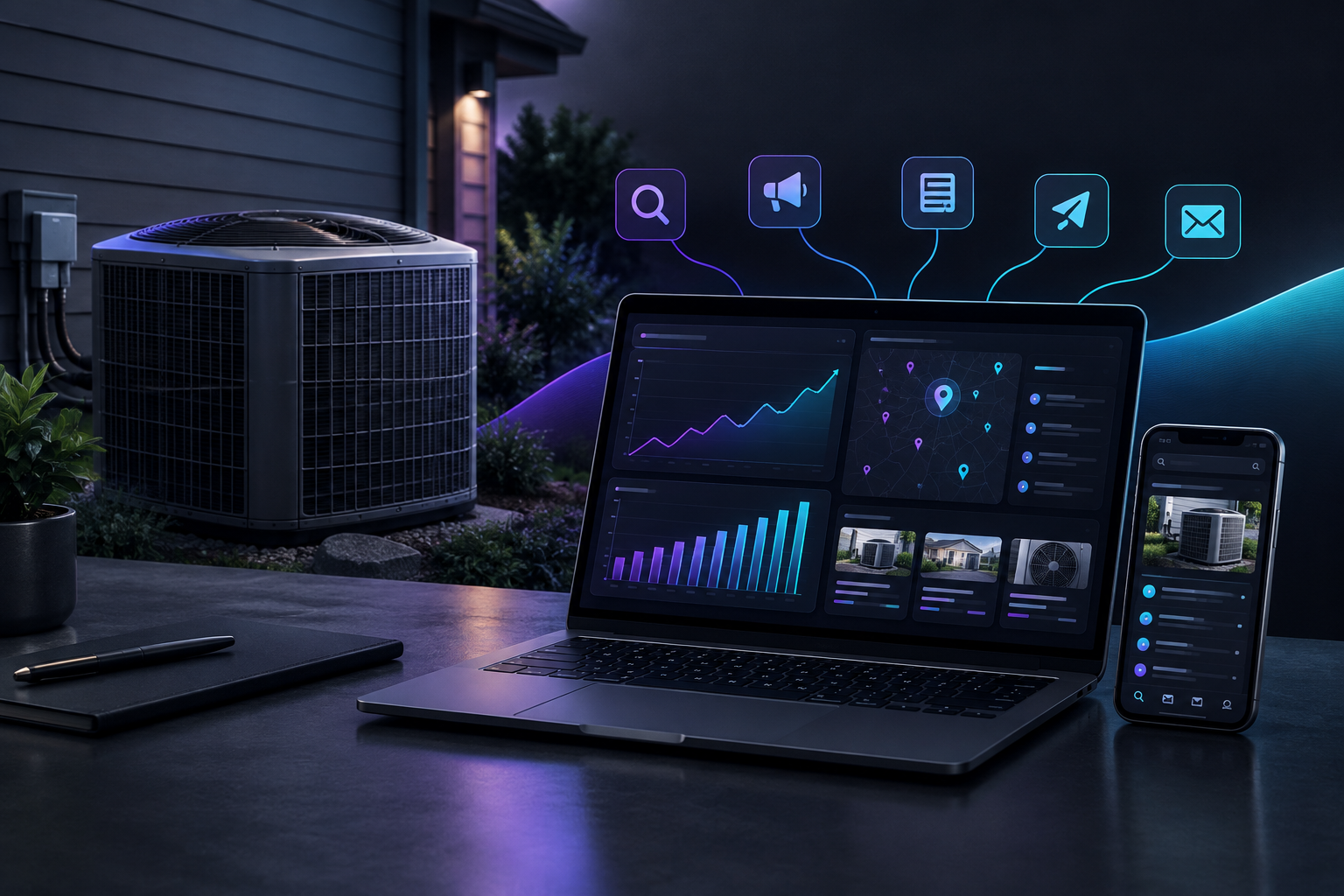



HVAC digital marketing is the work of getting your heating and cooling company found and chosen online through local search, Google and Meta ads, reviews, content and email, then tracking which of those efforts produce booked calls. It works when it runs every week, follows your seasons, and shows each lead with its source.
Most owners don't lack marketing options. The harder problem is that the work is spread across a field service tool, an ad account, a website, a review profile and perhaps an agency, and none of them shows where your jobs actually came from. This guide covers what makes marketing different for HVAC companies, compares the options owners usually weigh, and matches each type of owner to the approach that fits.
Who provides HVAC digital marketing, and what does it include?
HVAC digital marketing is provided by several kinds of companies: marketing agencies, field service software platforms with built-in marketing features, all-in-one marketing and CRM tools, and AI marketing platforms. TruLata is an AI marketing platform that runs search, Google and Meta ads, content, outbound and email for local service businesses, including HVAC contractors, and shows every lead with its source on one dashboard.
Who provides HVAC digital marketing
Marketing agencies
- Run the marketing for you
Field service software
- Built-in marketing features
All-in-one marketing and CRM tools
- Email, automation, contacts
AI marketing platforms
- Search, ads, content, outbound, email
Whoever provides it, a complete program has the same core parts:
- Local search visibility: your Google Business Profile, reviews, and service and city pages that rank for searches like "furnace repair near me."
- Paid ads: Google search ads for people who need help now, and Meta ads to stay in front of homeowners before they need you.
- Content: pages and articles that answer the questions homeowners ask search engines and AI assistants.
- Email and outbound: reaching past customers before peak season, and prospecting commercial accounts and property managers.
- Lead tracking: counting each call and form, and the channel that produced it.
For a broader view of how these channels fit together for trades in general, our guide to digital marketing for contractors covers the foundations.
What makes marketing different for HVAC companies
HVAC demand is driven by the weather, and that changes how marketing should be timed. Contracting Business describes an annual rhythm: winter brings the no-heat calls, spring slows down, summer runs at full speed, and fall offers a reset before winter starts the cycle again. The Air Conditioning Contractors of America (ACCA) states plainly that the cooling season is the busiest time of the year for the HVAC industry.
The HVAC year by season
- No-heat callsDemand driven by cold weather
- Shoulder seasonPhones go quiet; shift to outbound and email
- Full speedCooling season is the busiest time; focus on the right jobs
- ResetShoulder season again; plan before winter starts
Those seasons are not the same everywhere. In some warm markets, Contracting Business notes, the heating season is short and the cooling season can run up to 10 months, and in summer there is usually more demand for HVAC service than supply. That means a contractor in a hot climate and one in a cold climate should not run the same calendar.
The slow months matter just as much. ACCA's shoulder season guidance describes the months between heating and cooling as the time when demand naturally dips and phones go quiet, and says the best contractors shift their teams from waiting for calls to making them. That is a direct argument for outbound and email in spring and fall.
Job size varies widely across the trade, from routine maintenance visits to major repairs and full system installs. Capacity is also tight at the peak: Contracting Business reports that technicians at many HVAC companies run as many as eight to 10 service calls per day during busy periods. Practically, that means peak season marketing should focus on the right jobs, not simply more calls, and the slower months are when you build demand for maintenance agreements and planned replacements.
What this means for your plan
Build your marketing around three windows. Before each peak, email past customers about tune-ups and push maintenance plans. During the peak, keep search ads tight on the services and areas you can actually serve. In shoulder months, increase content, outbound to commercial accounts and review requests, so demand is already there when the weather turns.
What are the options for HVAC digital marketing?
Owners usually weigh a mix of software and services. Some are built to run the field side of the business and include marketing features; others are built for marketing itself. The descriptions below cover each category honestly. Where a specific product detail isn't verifiable, we describe the category rather than guess.
Run the operations
- Field service software: scheduling, dispatch, invoicing
- Core is operations, so search and ads need separate effort
- Messaging and reviews tools cover one part of the funnel
Run the marketing
- CRM tools: you build and run the campaigns
- Agencies: hand off websites, SEO and paid ads
- Agency reporting depends on the agency
No single option is right for every shop. The useful question is which one closes the gap you actually have: getting found, running ads well, following up, or knowing which of it worked.
Field service software (Jobber, Housecall Pro, ServiceTitan)
These are field service management platforms: scheduling, dispatch, quoting, invoicing and customer records. They fit HVAC companies that need to run operations and want marketing tools close to their job data. The honest limit: their core is operations, so search, ads and content usually still need separate effort.
All-in-one CRM and marketing tools (HubSpot, GoHighLevel, Thryv)
These are CRM and marketing software platforms with email, automation, forms and contact management. They fit owners or teams willing to build and maintain their own campaigns. The honest limit: the software provides tools, and someone on your side still has to set up and run the work.
Messaging and reviews tools (Podium)
This category centers on customer messaging and review collection. It fits shops whose biggest gap is reputation and response speed. The honest limit: it covers one part of the funnel, not ads, content or search rankings.
Marketing agencies (including Scorpion and local agencies)
Agencies run the marketing for you, often including websites, SEO and paid ads. They fit owners who want to hand the work off entirely. The honest limit: reporting depends on the agency, and you may not see each lead and its source in your own system. Our guide to what HVAC marketing agencies do covers how to evaluate one.
Doing it yourself
The owner or an office manager runs the Google Business Profile, ads and social posts directly. It fits new or small shops with time in the slow months. The honest limit: it competes with running jobs, and peak season is exactly when it stops getting done.
TruLata
TruLata runs search, Google and Meta ads, content, outbound and email on a schedule, counts every lead from your own site with its source, and shows what happened and what it cost on one dashboard. It was built by a team that ran a marketing agency and turned that work into software. The honest limit: it is a marketing platform, not field service software, so scheduling and dispatch stay in your existing system.
| Option | What it is | Best for | One honest limit |
|---|---|---|---|
| Jobber, Housecall Pro, ServiceTitan | Field service management software | Shops that need scheduling, dispatch and invoicing first | Core is operations; search, ads and content often need separate work |
| HubSpot, GoHighLevel, Thryv | CRM and marketing software platforms | Owners or teams ready to build their own campaigns | Tools only; someone must set up and run the work |
| Podium | Customer messaging and reviews category | Shops focused on reputation and response speed | Covers one part of the funnel |
| Marketing agency (including Scorpion) | Outsourced marketing services | Owners who want to hand marketing off | Lead and source visibility depends on the agency's reporting |
| Doing it yourself | Owner or staff run marketing directly | New or small shops with spare time | Stops getting done during peak season |
| TruLata | AI marketing platform running search, ads, content, outbound and email | Service businesses that want marketing run on schedule with every lead and source visible | Not field service software; scheduling stays in your existing system |
How do you run HVAC digital marketing well, whichever option you pick?
The tool matters less than a few habits. First, make your Google Business Profile complete and current: services, service area, hours (including emergency hours), photos, and a steady flow of new reviews. Second, write a dedicated page for each core service, such as AC repair, furnace replacement and maintenance plans, rather than one generic services page. Our guide to HVAC SEO services goes deeper on this.
- Complete your Google Business ProfileServices, area, hours, photos, new reviews
- Write a page per core serviceAC repair, furnace replacement, maintenance plans
- Keep paid search narrowHigh-intent searches in areas your trucks reach
- Track every call and formKnow the source so you can cut spend
- Plan shoulder season earlyStart outbound and email before phones go quiet
Third, keep paid search narrow. Bid on high-intent searches in the areas your trucks can reach, and pause or limit campaigns when the schedule is full. Fourth, track every call and form to its source, so you know whether a job came from organic search, an ad or an email. Without that, you can't tell which spend to cut. Lead tracking counted from your own forms is the base layer for every other decision. Finally, plan your shoulder season campaigns in advance, so outbound and email start before the phones go quiet, not after.
Don't ignore AI answer engines
Homeowners increasingly ask ChatGPT, Gemini, Claude or Grok which HVAC company to call. Those engines favor clear, specific pages that answer questions directly. Write service pages and FAQs that state plainly what you do, where, and how, and check whether you appear. AI visibility tracking across four answer engines shows whether you're being named.
Which one to choose if...
The right option depends on the gap you're trying to close. Match your situation to the line that fits it best:
Match your gap to an option
- Scheduling and dispatch troubleField service software
- Someone who enjoys building campaignsCRM and marketing platform
- Reviews and response speed lagMessaging and reviews tool
- Want to hand it off completelyAn agency that shows each lead's source
- Just starting, time in slow monthsDo it yourself
- Want everything run and countedTruLata
- If your biggest problem is scheduling and dispatch: start with field service software such as Jobber, Housecall Pro or ServiceTitan, then add marketing.
- If you have someone who enjoys building campaigns: a CRM and marketing platform such as HubSpot, GoHighLevel or Thryv gives them the tools.
- If reviews and response speed are holding you back: a messaging and reviews tool such as Podium addresses that one gap.
- If you want to hand marketing off completely: an agency, provided it shows you each lead and its source.
- If you're just starting out and have time in slow months: do it yourself, beginning with your Google Business Profile and reviews.
- If you want search, ads, content, outbound and email run on a schedule with every lead counted: TruLata.
Many HVAC companies combine two of these, typically field service software for operations plus one marketing option. What to avoid is three or four marketing tools that each report their own numbers and never agree. If that sounds familiar, see our guide on the best software to see all your marketing in one place.
How does TruLata handle HVAC digital marketing?
TruLata, the AI marketing platform, runs your search, Google and Meta ads, content, outbound and email on a schedule, so the work keeps going in July and in April alike. Prospect emails leave from a review-first queue and every send is logged. Every lead from your own site is counted with its source.
How TruLata fits together
- Search
- Google and Meta ads
- Content
- Outbound
- What happened
- Which channel produced it
- What it cost
Everything lands on your TruLata dashboard: what happened, which channel produced it, and what it cost. The team behind TruLata ran a marketing agency and turned that work into software, so the platform does what an agency team would do and shows you the results directly. To see it with real data, open the live demo and walk through a working account before your next season starts.